
If you’ve ever stood in the air purifier aisle and wondered whether the H13 or H14 label on the box actually makes a difference — you’re asking exactly the right question. These two grades sit at the top of the HEPA classification system, and while the numbers look similar, the performance gap between them is real, measurable, and worth understanding before you spend money on a filter or a whole unit.
This guide breaks down how H13 and H14 are defined, what each one captures, and which grade makes sense for different situations — including allergies, wildfire smoke, and households with immunocompromised individuals.
The true meaning of HEPA
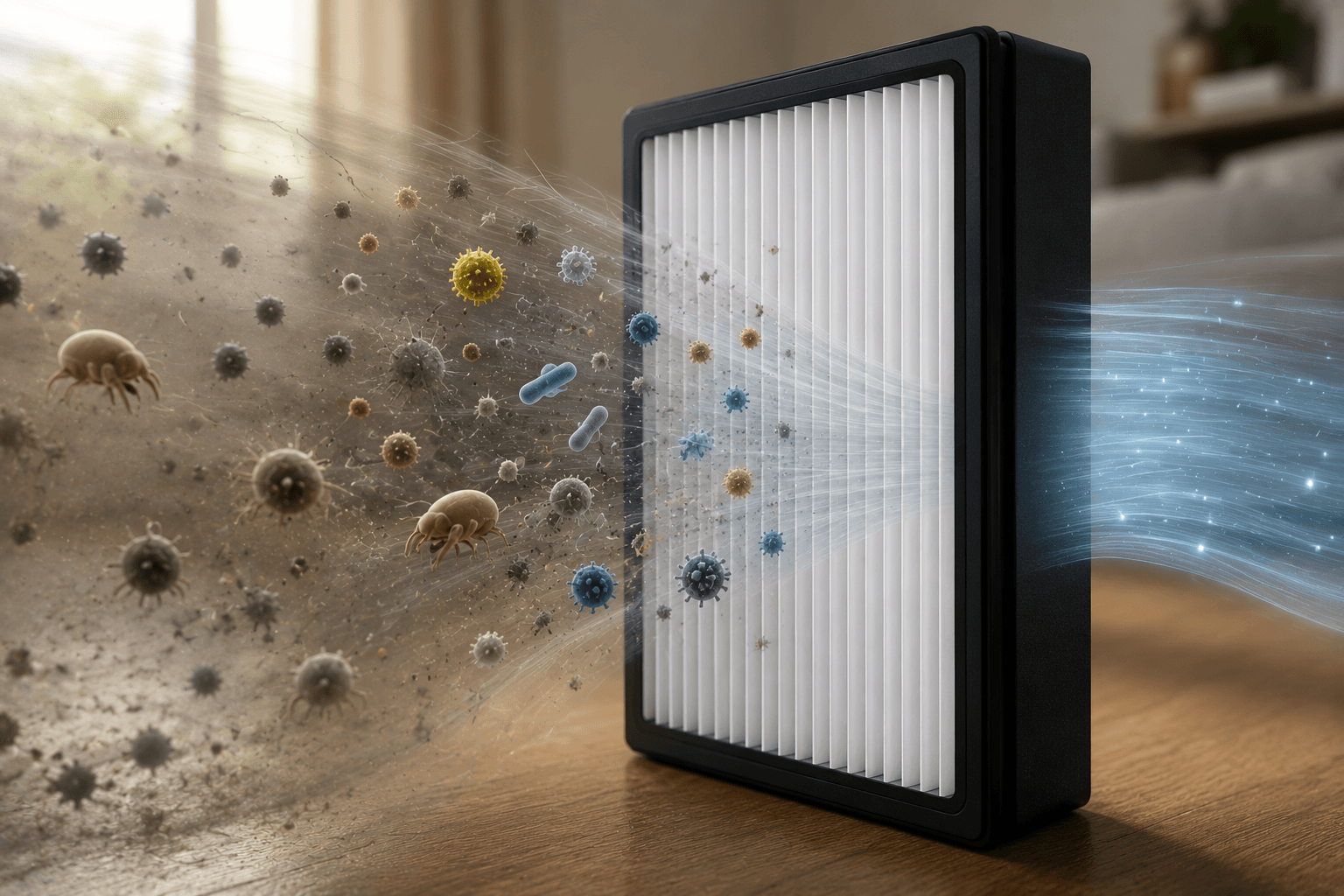
HEPA stands for High-Efficiency Particulate Air. In the United States, the Department of Energy sets the baseline: a True HEPA filter must capture at least 99.97% of airborne particles at 0.3 microns in diameter.
That 0.3-micron threshold isn’t random. It’s the size at which particles are hardest to trap — too small to be reliably caught by mechanical interception, but too large to be reliably captured through the erratic movement behavior that traps ultrafine particles. Engineers call this the Most Penetrating Particle Size, and it’s the universal benchmark the entire HEPA grading system is built around.
Here’s the problem most buyers don’t know about: in the United States, “HEPA” is not a protected trademark. Any manufacturer can print “HEPA-style,” “HEPA-type,” or “99% HEPA” on a product without meeting the actual standard. These labels are marketing terms with no standardized definition, and they often describe filters that capture particles at 85–95% efficiency — far below True HEPA performance.
The more rigorous classification system comes from Europe: EN 1822, the standard that defines filter grades from E10 all the way up to H14. If a product references EN 1822 and carries an H-grade designation, it has been tested against a consistent, published methodology. If it just says “HEPA,” it may or may not have cleared any meaningful threshold.
The EN 1822 Standard: How HEPA Grades Are Defined
The EN 1822 standard was developed by the European Committee for Standardization (CEN) and is widely regarded as the gold standard for high-efficiency air filtration testing. It classifies filters based on two specific measurements:
- Overall efficiency: the filter’s capture rate across the entire filter face
- Local efficiency: the minimum capture rate at any single point on the filter surface
Both measurements are taken at the MPPS — the hardest particle size to catch. A filter only earns its grade if it passes both tests.
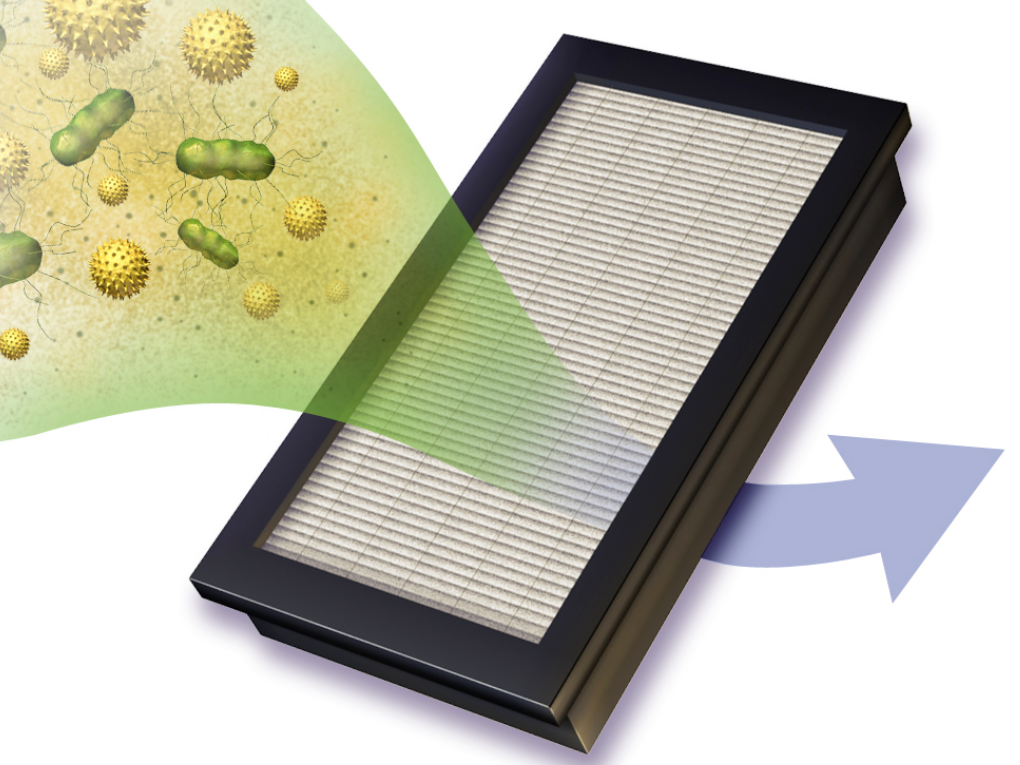
This dual-measurement approach matters because a filter can average high efficiency across its whole surface while having weak spots around the edges or seams. The local efficiency requirement is what prevents that from happening.
The grades most relevant to home air purification are H11 through H14. Here’s how they compare:
| Grade | Efficacité globale minimale | Efficacité locale minimale |
|---|---|---|
| H11 | 99.95% (at MPPS) | 99.75% |
| H12 | 99.5% (at MPPS) | 99% |
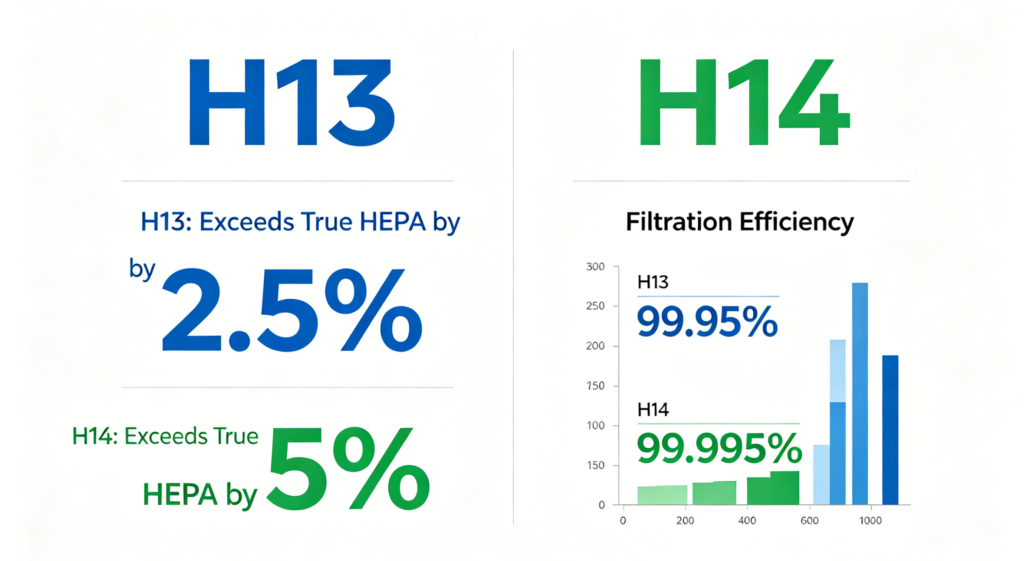
| H13 | 99.95% (at MPPS) | 99.75% |
| H14 | 99.995% (at MPPS) | 99.975% |
Some EN 1822 revisions present slightly different threshold values; manufacturers should publish the specific version their product is tested against.
H13 HEPA Filters: Definition, Efficiency, and What They Capture
What H13 Means
An H13-grade filter must capture at least 99.95% of particles at the MPPS across its entire surface, with no single point on the filter falling below 99.75% efficiency. This is a genuine high-performance threshold. It exceeds the US DOE’s basic True HEPA standard and represents the most common “premium” grade found in quality consumer air purifiers.
H13 is sometimes called medical-grade HEPA, though that term isn’t formally standardized. What is accurate is that H13 performance is sufficient for the vast majority of real-world residential air quality challenges.
What H13 Filters Remove
At H13 efficiency, a properly sealed air purifier will capture:
- Dust mite allergens: particles typically 0.5–30 microns; well within H13 capture range
- Pet dander: 2.5–10 microns; reliably removed
- Pollen: most pollen ranges from 10–100 microns; easily captured
- Mold spores: typically 1–30 microns; captured effectively
- Fine particulate matter: particles under 2.5 microns; H13 captures the majority of these, including those from cooking smoke, candles, and vehicle exhaust
- Most common bacteria: ranging from 0.5–5 microns; captured at high efficiency
- Quelques particules virales en aérosol: particularly those attached to larger respiratory droplet nuclei
Where H13 Is the Right Choice
For allergy sufferers, asthma patients, pet owners, households with young children, or anyone dealing with general urban air pollution, H13 in a properly engineered, sealed unit is the appropriate grade. It removes the particle categories responsible for the overwhelming majority of respiratory irritation and allergy triggers.
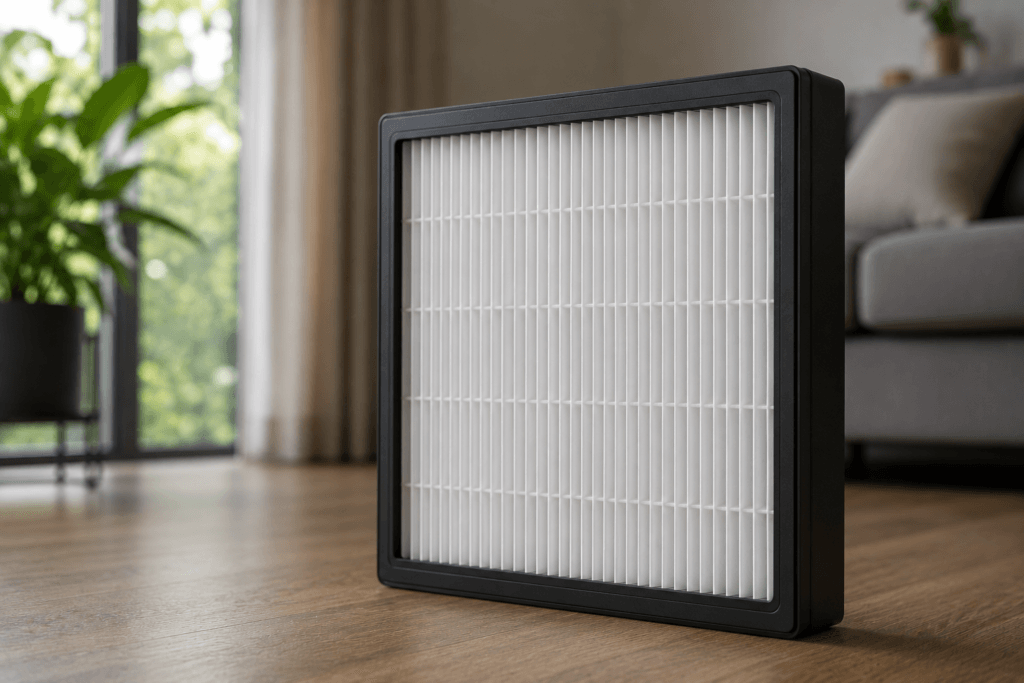
H14 HEPA Filters: Definition, Efficiency, and What They Add
What H14 Means
An H14-grade filter must capture at least 99.995% of particles at the MPPS across its entire surface, with no single point falling below 99.975% efficiency.
Written differently: an H14 filter allows through ten times fewer particles than an H13 filter at the most penetrating particle size. That’s not a marginal difference. At the submicron level — the range where the smallest viral particles and ultrafine combustion particles exist — that tenfold reduction is measurable in real air quality outcomes.
H14 is classified as pharmaceutical-grade filtration. It’s the standard used in hospital isolation rooms, sterile pharmaceutical manufacturing facilities, neonatal intensive care units, and high-level biosafety laboratories.
What H14 Filters Capture That H13 Does Not
In practical terms, H14 adds meaningful improvement for:
- Particules virales submicroniques: the smallest aerosolized particles, including individual virus particles not attached to larger droplets
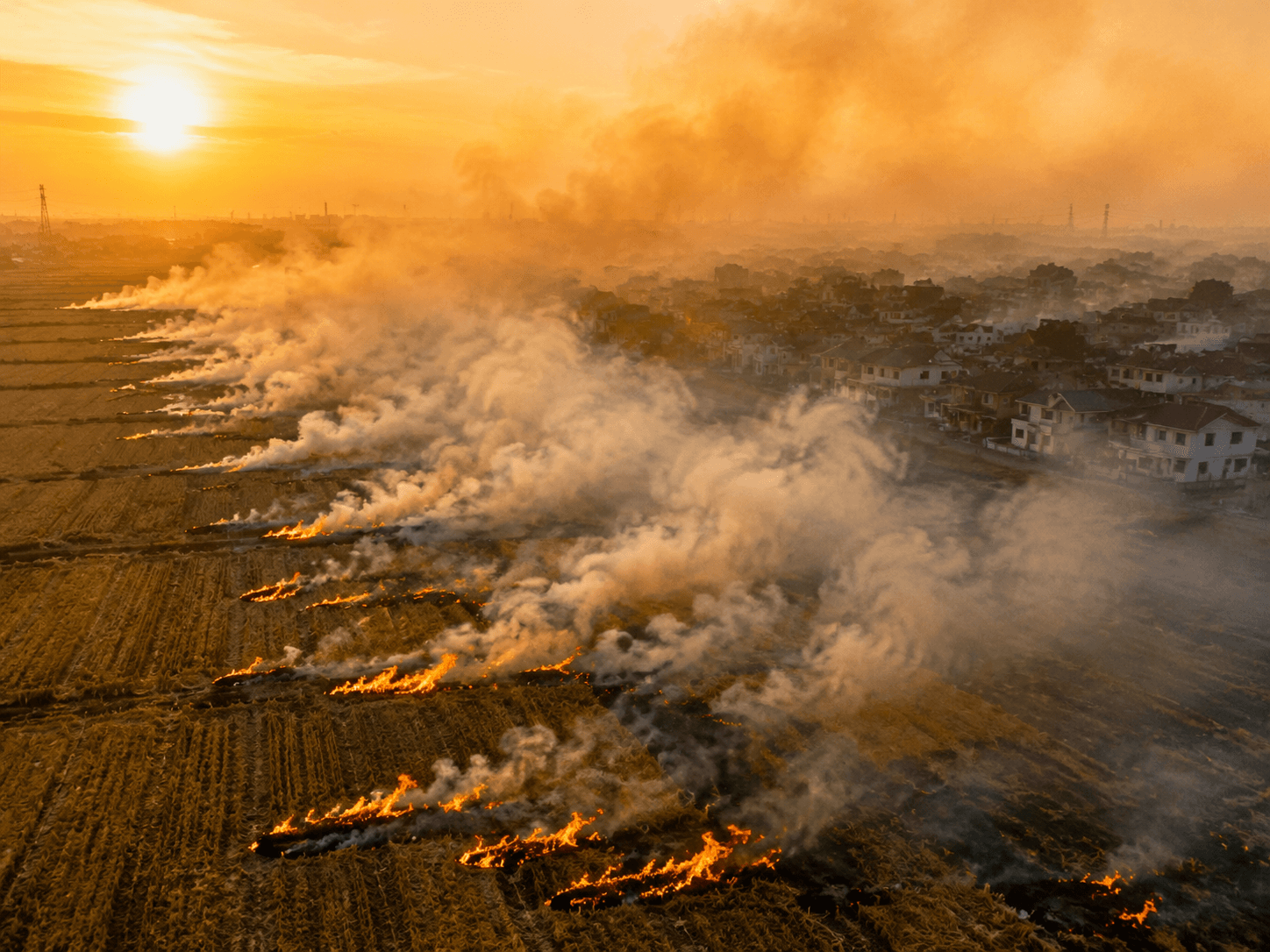
- Ultrafine combustion particles: PM0.1 to PM1 particles from wildfire smoke, traffic exhaust, and industrial sources; these penetrate deepest into lung tissue
- Ultrafine carbon particles: produced by gas stoves, candles, and cigarette smoke
- Nanoscale industrial pollutants: relevant in areas near heavy manufacturing
The Airflow Tradeoff With H14
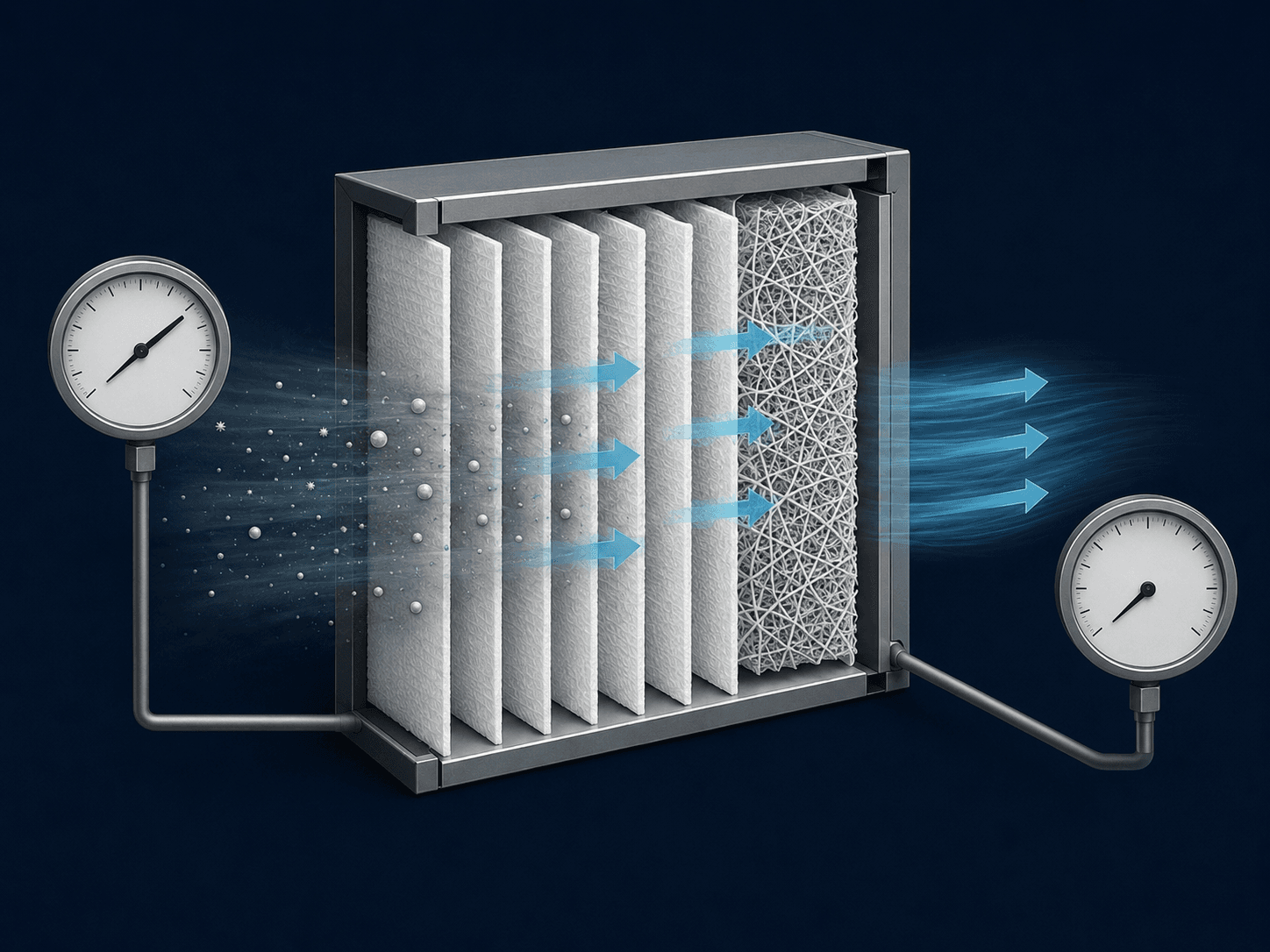
H14 filters are physically denser than H13. That density creates higher resistance to airflow — meaning the fan motor in an air purifier has to work harder to pull the same volume of air through the filter per minute.
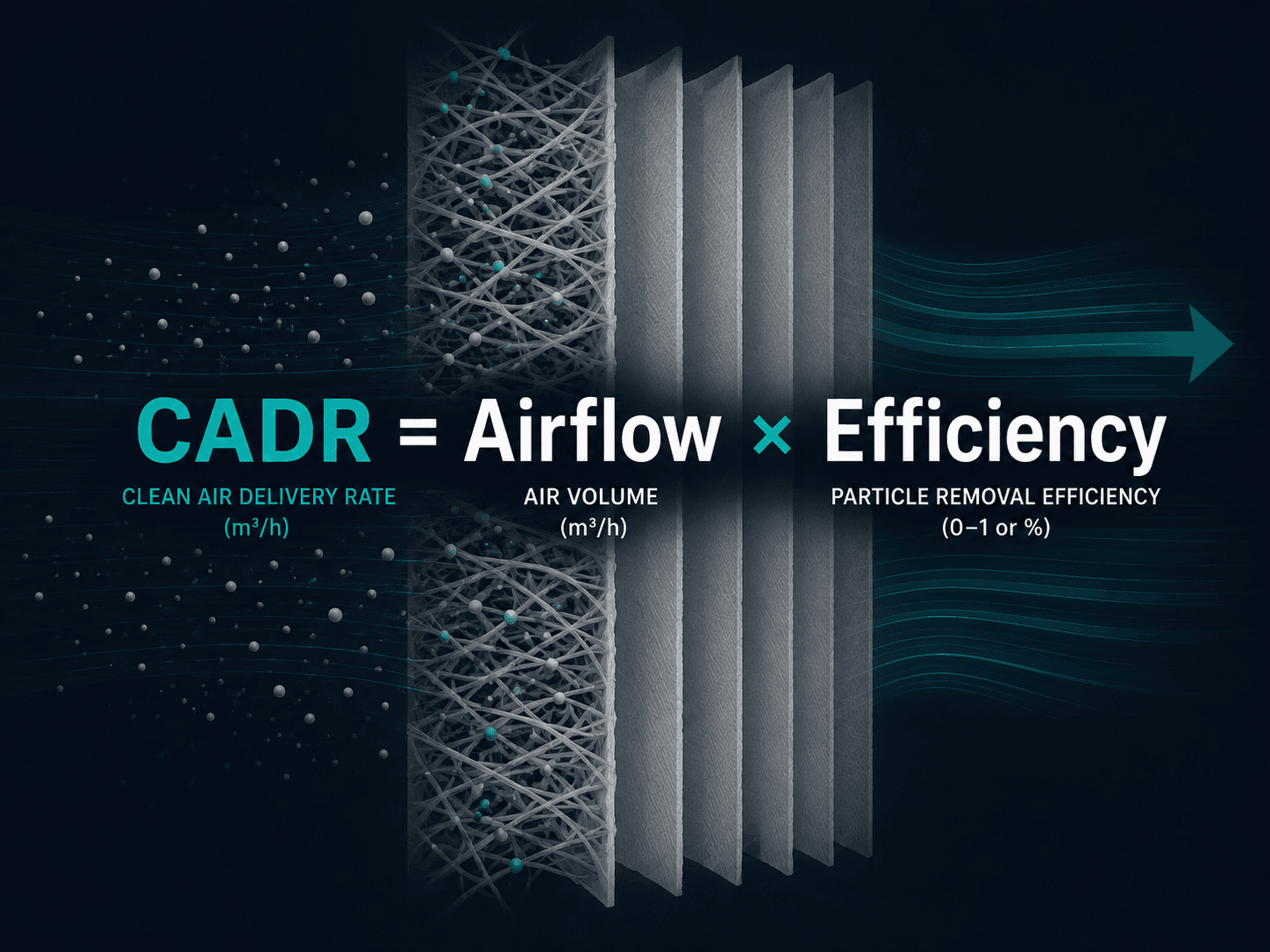
This has a direct consequence for CADR — the metric that tells you how many cubic feet or cubic meters of air a purifier actually cleans per minute. If a unit isn’t specifically engineered to handle H14 filter resistance, installing an H14 filter can reduce its airflow significantly, resulting in pire qualité de l'air réelle qu'une installation H13 correctement adaptée.
This is why H14 filters are only beneficial in units that are rated and tested for them. Putting an H14 filter in an underpowered purifier doesn’t upgrade your air quality — it just strains your motor.
H13 vs H14: Side-by-Side Comparison
| Fonctionnalité | H13 | H14 |
|---|---|---|
| EN 1822 overall efficiency | 99.95% | 99.995% |
| EN 1822 local efficiency | 99.75% | 99.975% |
| Particles let through | ~5 per 10,000 | ~0.5 per 10,000 |
| Common classification | Medical-grade | Pharmaceutical-grade |
| Typical use case | Home, office, medical | Hospital, cleanroom, lab |
| Airflow resistance | Moderate | High |
| CADR impact | Low | Significant if unit not rated |
| Consumer availability | Wide | Limited; specialist units |
De quel niveau avez-vous réellement besoin ?
Choose H13 If:
- You have allergies, asthma, or respiratory sensitivities
- You have pets at home
- You live in a city with moderate air pollution
- You have young children or elderly family members
- Your concern is dust, pollen, mold, dander, or general particulate matter
- You want reliable performance without worrying about unit compatibility
H13 in a well-sealed, properly rated unit removes the particle categories that drive the vast majority of indoor air quality problems. For most households, it’s the practical ceiling — not a compromise.
Choose H14 If:
- Vous ou un membre de votre famille êtes immunodéprimé.
- You live in an area with chronic wildfire smoke or heavy industrial air pollution
- You’re managing a confirmed mold infestation while remediation is underway
- Your air purifier is specifically rated and tested for H14 filter use
- You want the closest thing to clinical-grade filtration available for home use
Why Filter Seal Quality Matters as Much as Filter Grade
One of the most overlooked factors in air purifier performance is whether air is actually passing through the filter — or bypassing it entirely.
A certified H13 or H14 filter installed in a housing with poor frame seals, loose edges, or gaps around the filter media will perform far below its rated grade. Air takes the path of least resistance. Any gap between the filter and its housing creates a bypass route where unfiltered air moves directly into the output stream.
When evaluating any air purifier, check:
- Whether the unit has third-party certification from an independent testing body
- That the filter seats flush with no visible gaps around the frame perimeter
- Whether the manufacturer publishes CADR data alongside the filter grade
- The filter replacement interval — a degraded filter in good housing still outperforms a fresh filter in leaky housing
An H13 filter in an airtight, properly engineered unit will consistently outperform a nominal H14 filter in a unit with poor sealing. Grade matters. Fit and housing quality matter just as much.
FAQ
En général, oui. La norme américaine est “True HEPA” (99,97% à 0,3 micron). Le filtre H13 est testé conformément à la norme européenne EN 1822, plus stricte, qui vérifie le point le plus défavorable du filtre, et pas seulement sa moyenne. Il s'agit d'une certification plus fiable.
En partie. Les particules virales sont minuscules, mais elles se déplacent généralement sur des gouttelettes plus grosses que les filtres H13/H14 capturent. Aucun filtre n'élimine totalement le risque - la ventilation et le taux de renouvellement de l'air ont également leur importance.
Tous les 12 mois pour une utilisation domestique normale. Dans les zones à forte pollution ou dans les maisons où vivent des animaux domestiques, il est préférable de le faire tous les 6 à 8 mois. N'attendez pas de remarquer une différence - les performances ont alors déjà baissé.
Non. Le terme “HEPA” ne bénéficie d'aucune protection juridique et peut figurer sur n'importe quel emballage. Recherchez un taux d'efficacité explicite (99,95%+ à 0,3 micron) ou une désignation de qualité H11-H14. Si aucune de ces mentions n'apparaît, il ne s'agit probablement pas d'un True HEPA.