Walk through any home goods store and you’ll see “HEPA” on everything — vacuums, air purifiers, portable fans, even some humidifiers. The word has become a marketing fixture. The problem? It doesn’t always mean what people think it means.
There’s a real standard behind the term. And then there are products that gesture toward it without actually meeting it. Understanding the difference — especially between H13 and H14 grades — is the most important thing you can do before buying an air purifier for your home.
“HEPA” Is Not One Standard. It’s a Spectrum
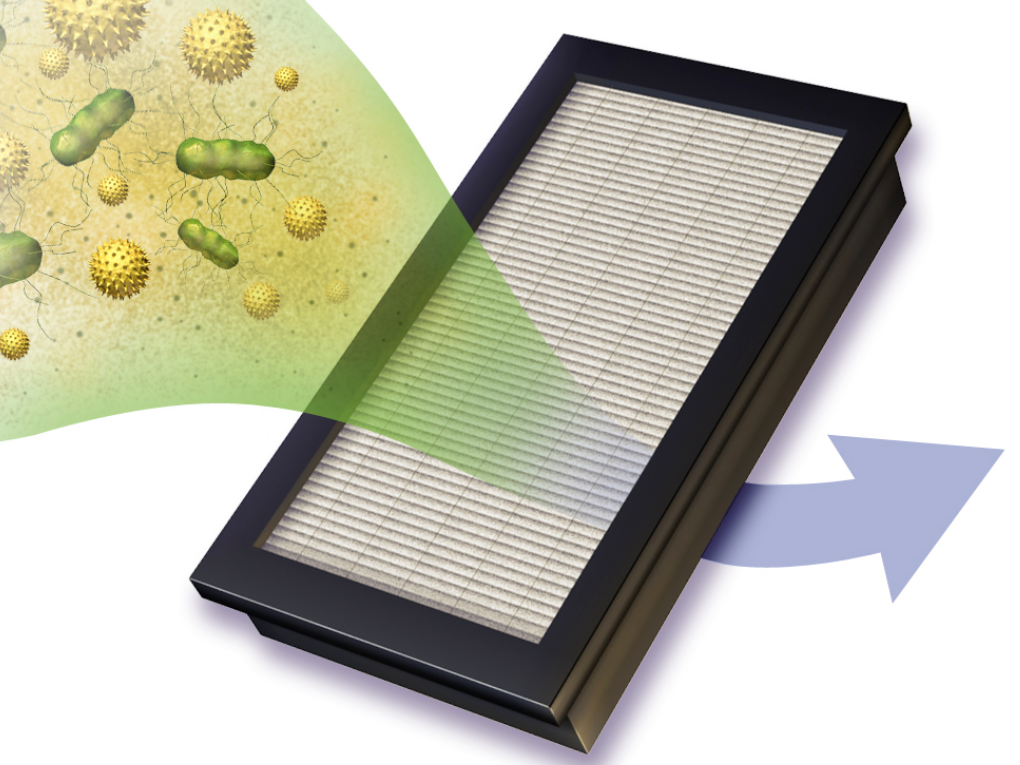
HEPA stands for High-Efficiency Particulate Air. In the United States, the Department of Energy defines a true HEPA filter as one that captures at least 99.97% of particles at 0.3 microns in diameter. That specific particle size — 0.3 microns — isn’t arbitrary. It’s the hardest size for any filter to catch.
Particles larger than 0.3 microns are intercepted mechanically. Particles smaller than 0.3 microns are captured through Brownian motion — they move erratically and get trapped in the fiber matrix. But particles at exactly 0.3 microns are just the right size to slip past both mechanisms most easily. It’s called the Most Penetrating Particle Size (MPPS), and it’s the benchmark the entire HEPA rating system is built around.
Here’s where it gets complicated: the European standard (EN 1822) takes this further, classifying HEPA filters into distinct grades — E10 through H14. The grades most relevant to home air purification are H13 and H14, and they represent a meaningful performance gap.
Why “HEPA-Type” and “HEPA-Style” Are Red Flags
Products labeled “HEPA-type,” “HEPA-like,” or “99% HEPA” are not True HEPA filters. These labels have no standardized definition. They typically describe filters that capture particles at a lower efficiency — sometimes as little as 85–99% — and they’re legal to market because “HEPA” is not a trademark. If a filter doesn’t explicitly state 99.97% efficiency at 0.3 microns, or carry an H11–H14 grade designation, it hasn’t cleared the true HEPA threshold.
H13 vs H14: The Grade Numbers Actually Mean Something
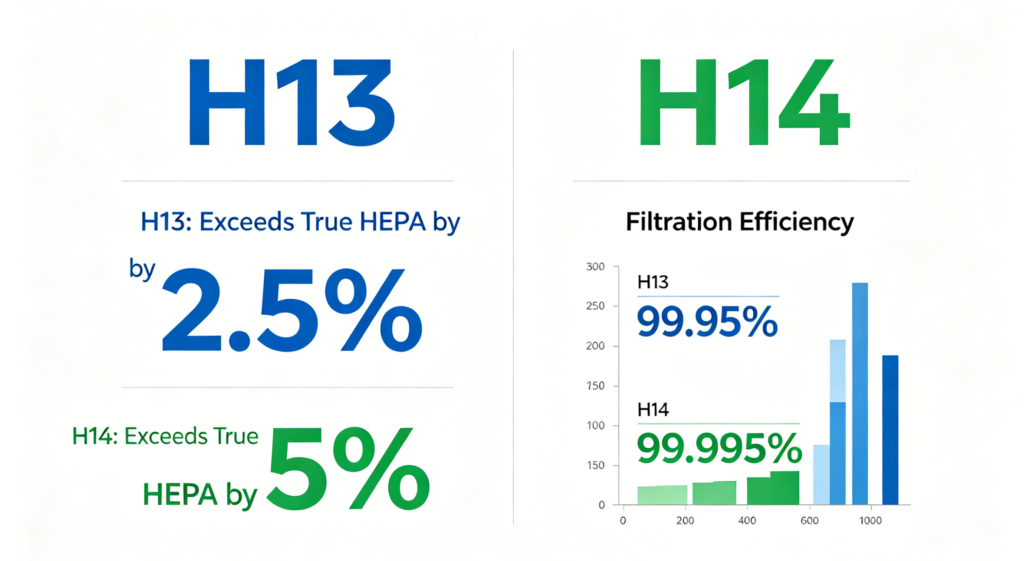
Both H13 and H14 exceed the basic True HEPA standard. The difference is in how far they exceed it — and what that means for filtration in practice.
| Grade | Minimum Overall Efficiency | Minimum Local Efficiency |
|---|---|---|
| H13 | 99.95% at MPPS | 99.75% (any single point) |
| H14 | 99.995% at MPPS | 99.975% (any single point) |
That gap might look small in percentage terms. In real-world terms, it isn’t. An H14 filter lets through ten times fewer particles than an H13 at the most penetrating particle size. At that scale — we’re talking about particles that include fine PM2.5, certain bacteria, and some viral aerosols — that difference is measurable in air quality outcomes.
What H13 Filters Actually Capture
An H13 filter running in a well-sealed air purifier will capture:
- Dust mite allergens and pet dander
- Pollen and mold spores
- Fine particulate matter (PM2.5)
- Most bacteria
- Some viral aerosol particles
What H14 Adds on Top of That
H14 is considered pharmaceutical and clinical grade. The additional filtration efficiency matters most for:
- Submicron viral particles
- Ultrafine combustion particles from wildfire smoke or traffic
- Laboratory and cleanroom environments
- Immunocompromised individuals or neonatal settings
Which Grade Do You Actually Need?
For most households — including homes with allergy sufferers, asthma, pets, or young children — H13 is the right answer. It removes the particle categories that trigger the majority of respiratory symptoms, and it does so without the increased airflow resistance that H14 introduces.
H14 filters are denser. That density means your purifier’s fan works harder to pull air through, which can reduce total airflow (measured as CADR — Clean Air Delivery Rate) unless the unit is specifically engineered for it. A high-efficiency filter in an underpowered unit can actually result in worse real-world air quality than a properly matched H13 setup.
H14 makes strong sense if:
- You or a family member is immunocompromised
- You live in an area with chronic wildfire smoke or heavy industrial pollution
- You’re managing a home with a confirmed mold problem
- You want clinical-grade protection and your purifier is rated for H14
For most people navigating allergies, urban air quality, or general wellness, a genuine H13 filter in a well-sealed purifier delivers exactly what the research supports.
HIFINE's True HEPA H13 replacement filters are built to EN 1822 certification standards, not just labeled — each filter is tested at the MPPS threshold before leaving production.
What you need to know
Filter grade only describes the media itself. A certified H13 filter in a poorly sealed housing — one where air bypasses the filter through gaps around the frame — performs like a much lower grade filter in practice. When evaluating any air purifier, check:
- Whether the entire unit (not just the filter) has third-party certification
- That the filter seats flush with no air bypass around the edges
- Whether the manufacturer publishes CADR data alongside filter grade
A genuine H13 filter in a properly engineered, sealed unit beats a nominal H14 in a leaky housing. Grade matters. Fit matters just as much.
The gap between a marketed claim and a certified standard matters most when the air in your home does. For H13-certified HEPA filters built to the EN 1822 standard — not just labeled — explore HIFINE’s air purifier filter range at hifinefilter.com.
FAQ
Usually yes. “True HEPA” is the US standard (99.97% at 0.3 microns). H13 is tested under the stricter European EN 1822 standard, which checks the filter’s worst-performing point — not just its average. It’s a more reliable certification.
Partially. Viral particles are tiny, but they typically travel on larger droplets that H13/H14 filters do capture. No filter eliminates risk entirely — ventilation and air exchange rate also matter.
Every 12 months for normal home use. In high-pollution areas or homes with pets, closer to 6–8 months. Don’t wait until you notice a difference — by then, performance has already dropped.
No. “HEPA” has no legal protection and can appear on any packaging. Look for an explicit efficiency rating (99.95%+ at 0.3 microns) or an H11–H14 grade designation. If neither is listed, it’s likely not True HEPA.