
Si alguna vez te has quedado parado frente al pasillo de los purificadores de aire y te has preguntado si la etiqueta H13 o H14 en la caja realmente marca una diferencia, te estás haciendo exactamente la pregunta correcta. Estos dos grados se encuentran en la cima del sistema de clasificación HEPA y, aunque los números parecen similares, la diferencia de rendimiento entre ellos es real, medible y vale la pena entenderla antes de gastar dinero en un filtro o en una unidad completa.
Esta guía explica cómo se definen los índices H13 y H14, qué captan cada uno de ellos y qué nivel es el adecuado para diferentes situaciones, incluyendo alergias, humo de incendios forestales y hogares con personas inmunodeprimidas.
El verdadero significado de HEPA
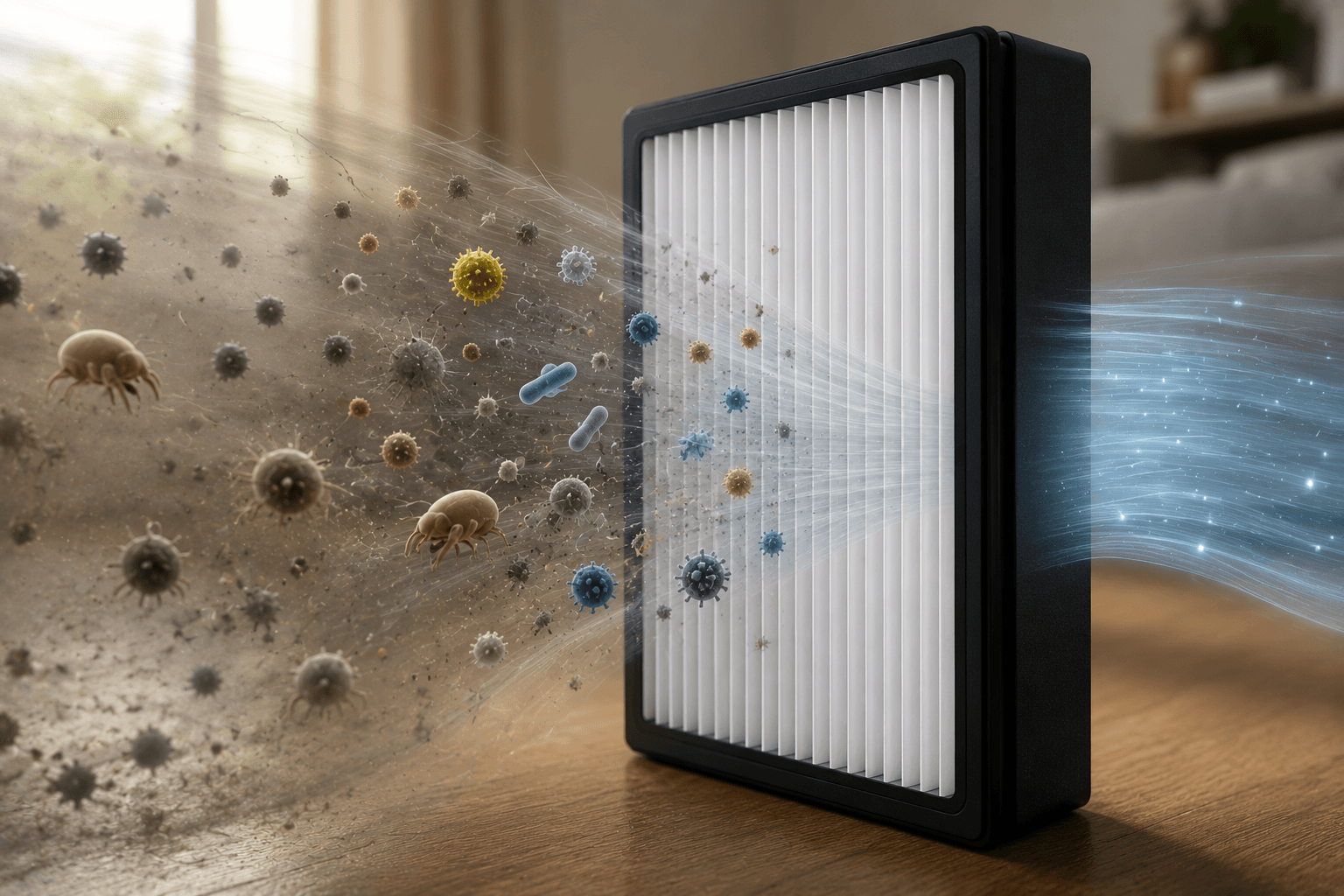
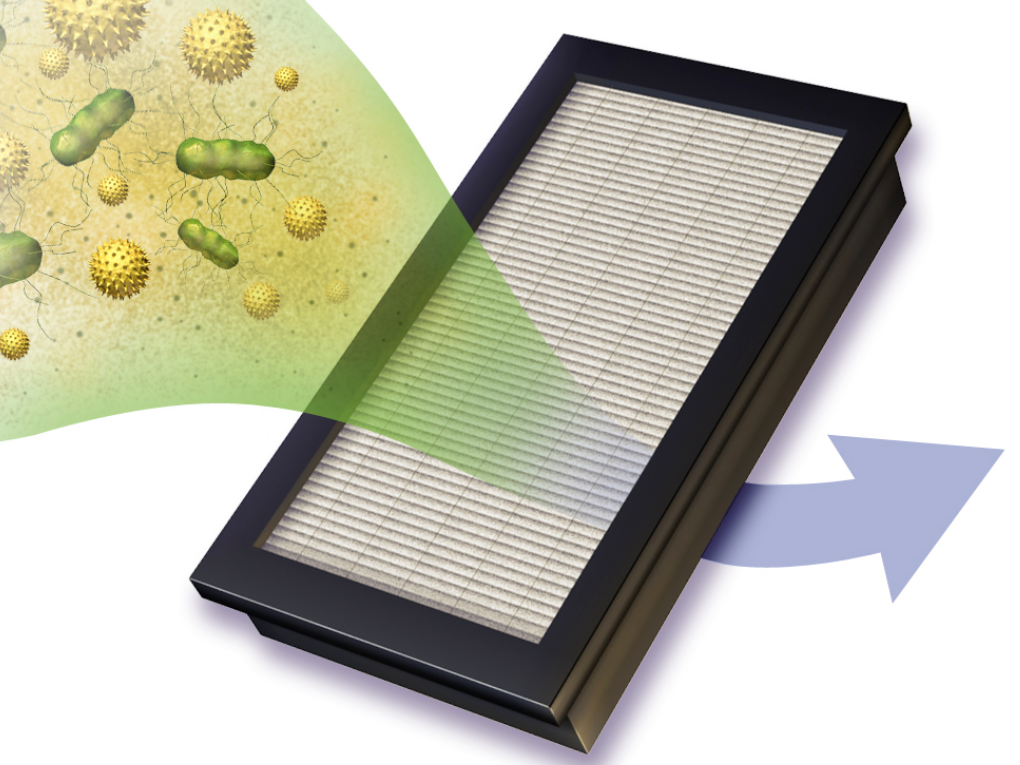
HEPA son las siglas de «High-Efficiency Particulate Air» (filtro de aire de alta eficiencia para partículas). En Estados Unidos, el Departamento de Energía establece el estándar de referencia: un filtro True HEPA debe capturar al menos el 99,971 % de las partículas en suspensión en el aire con un diámetro de 0,3 micras.
Ese umbral de 0,3 micras no es aleatorio. Es el tamaño en el que las partículas son más difíciles de atrapar: demasiado pequeñas para ser capturadas de manera confiable mediante interceptación mecánica, pero demasiado grandes para ser capturadas de manera confiable a través del comportamiento de movimiento errático que atrapa las partículas ultrafinas. Los ingenieros lo llaman el «tamaño de partícula más penetrante», y es el punto de referencia universal en torno al cual se basa todo el sistema de clasificación HEPA.
Este es el problema que la mayoría de los compradores desconocen: en Estados Unidos, “HEPA” no es una marca registrada protegida. Cualquier fabricante puede indicar “estilo HEPA”, “tipo HEPA” o “HEPA 99%” en un producto sin cumplir con la norma real. Estas etiquetas son términos de mercadotecnia sin una definición estandarizada y, a menudo, describen filtros que capturan partículas con una eficiencia de 85–95 %, muy por debajo del rendimiento de un filtro HEPA auténtico.
El sistema de clasificación más riguroso proviene de Europa: la norma EN 1822, que define los grados de filtración desde E10 hasta H14. Si un producto hace referencia a la norma EN 1822 y lleva una designación de grado H, significa que ha sido sometido a pruebas siguiendo una metodología coherente y publicada. Si solo dice “HEPA”, puede que haya superado o no algún umbral significativo.
La norma EN 1822: cómo se definen los grados HEPA
La norma EN 1822 fue elaborada por el Comité Europeo de Normalización (CEN) y es ampliamente considerada como el estándar de referencia para los ensayos de filtración de aire de alta eficiencia. Clasifica los filtros en función de dos parámetros específicos:
- Eficiencia general: la tasa de captura del filtro en toda su superficie
- Eficiencia local: la tasa mínima de captura en cualquier punto concreto de la superficie del filtro
Ambas mediciones se realizan en el MPPS, el tamaño de partícula más difícil de capturar. Un filtro solo obtiene su calificación si supera ambas pruebas.
Este enfoque de doble medición es importante porque un filtro puede presentar una alta eficiencia media en toda su superficie, pero tener puntos débiles en los bordes o en las uniones. El requisito de eficiencia local es lo que evita que eso suceda.
Los grados más relevantes para la purificación del aire en el hogar son del H11 al H14. A continuación se muestra una comparación entre ellos:
| Curso | Eficiencia global mínima | Eficiencia local mínima |
|---|---|---|
| H11 | 99.95% (en MPPS) | 99.75% |
| H12 | 99,51 TP4T (en MPPS) | 99% |
| H13 | 99.95% (en MPPS) | 99.75% |
| H14 | 99.995% (en MPPS) | 99.975% |
Algunas revisiones de la norma EN 1822 presentan valores límite ligeramente diferentes; los fabricantes deben indicar la versión específica con la que se ha probado su producto.
Filtros HEPA H13: definición, eficiencia y qué capturan
Qué significa H13
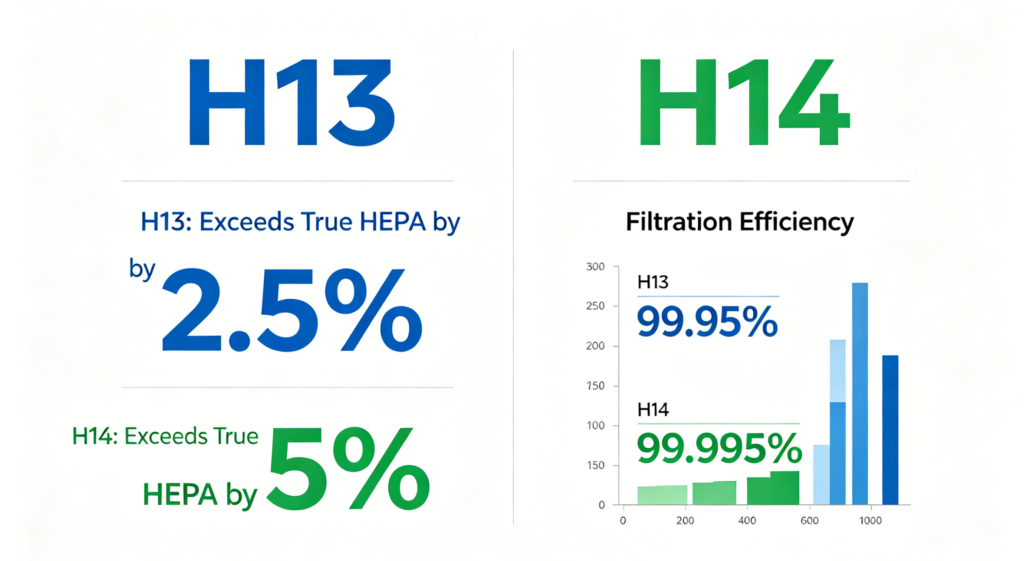
Un filtro de grado H13 debe capturar al menos el 99,951 % de las partículas en el MPPS en toda su superficie, sin que ningún punto del filtro tenga una eficiencia inferior al 99,751 %. Este es un umbral de alto rendimiento genuino. Supera el estándar básico True HEPA del Departamento de Energía de EE. UU. (DOE) y representa el grado “premium” más común que se encuentra en los purificadores de aire de consumo de calidad.
A veces se denomina al filtro H13 «HEPA de grado médico», aunque ese término no está oficialmente normalizado. Lo que sí es cierto es que el rendimiento del filtro H13 es suficiente para la gran mayoría de los problemas de calidad del aire que se dan en el ámbito residencial en la vida real.
Qué eliminan los filtros H13
Con una eficiencia H13, un purificador de aire debidamente sellado capturará:
- Alérgenos de los ácaros del polvo: partículas que suelen tener un tamaño de entre 0,5 y 30 micras; dentro del rango de captura del filtro H13
- Caspa de mascotas: 2,5–10 micras; eliminación eficaz
- Polen: la mayoría de los granos de polen miden entre 10 y 100 micras; se capturan fácilmente
- Esporas de moho: normalmente de 1 a 30 micras; se capturan eficazmente
- Partículas finas: partículas de menos de 2,5 micras; el filtro H13 captura la mayoría de ellas, incluidas las procedentes del humo de la cocina, las velas y los gases de escape de los vehículos
- Las bacterias más comunes: con un tamaño de entre 0,5 y 5 micras; capturadas con gran eficacia
- Algunas partículas de aerosol viral: en particular, aquellos adheridos a núcleos de gotitas respiratorias de mayor tamaño
Por qué H13 es la elección acertada
Para quienes padecen alergias, los pacientes con asma, los dueños de mascotas, los hogares con niños pequeños o cualquier persona que se vea afectada por la contaminación atmosférica urbana en general, H13 en un diseño adecuado, el filtro de unidad sellada es el más adecuado. Elimina las partículas responsables de la gran mayoría de los casos de irritación respiratoria y de los desencadenantes de alergias.
Filtros HEPA H14: definición, eficiencia y ventajas
Qué significa H14
Un Filtro de grado H14 debe capturar al menos un 99,9951 % de las partículas en el MPPS en toda su superficie, sin que ningún punto concreto presente una eficiencia inferior al 99,9751 %.
Dicho de otra manera: un filtro H14 deja pasar diez veces menos partículas que un filtro H13 en el tamaño de partícula más penetrante. No se trata de una diferencia insignificante. A nivel submicrónico —el rango en el que se encuentran las partículas virales más pequeñas y las partículas de combustión ultrafinas—, esa reducción de diez veces se refleja en los resultados reales de la calidad del aire.
El H14 está clasificado como filtración de grado farmacéutico. Es el estándar que se utiliza en salas de aislamiento hospitalarias, instalaciones de fabricación de productos farmacéuticos estériles, unidades de cuidados intensivos neonatales y laboratorios de bioseguridad de alto nivel.
¿Qué capturan los filtros H14 que los H13 no capturan?
En la práctica, la versión H14 aporta mejoras significativas en:
- Partículas virales submicrónicas: las partículas aerosolizadas más pequeñas, incluidas las partículas víricas individuales que no se adhieren a gotitas más grandes
- Partículas ultrafinas de combustión: Partículas de PM0,1 a PM1 procedentes del humo de incendios forestales, los gases de escape del tráfico y fuentes industriales; estas son las que penetran más profundamente en el tejido pulmonar
- Partículas ultrafinas de carbono: producido por cocinas de gas, velas y humo de cigarrillo
- Contaminantes industriales a nanoescala: relevante en zonas cercanas a la industria pesada
La relación entre el flujo de aire y el filtro H14
Los filtros H14 son físicamente más densos que los H13. Esa densidad genera una mayor resistencia al flujo de aire, lo que significa que el motor del ventilador de un purificador de aire tiene que esforzarse más para hacer pasar el mismo volumen de aire por el filtro cada minuto.
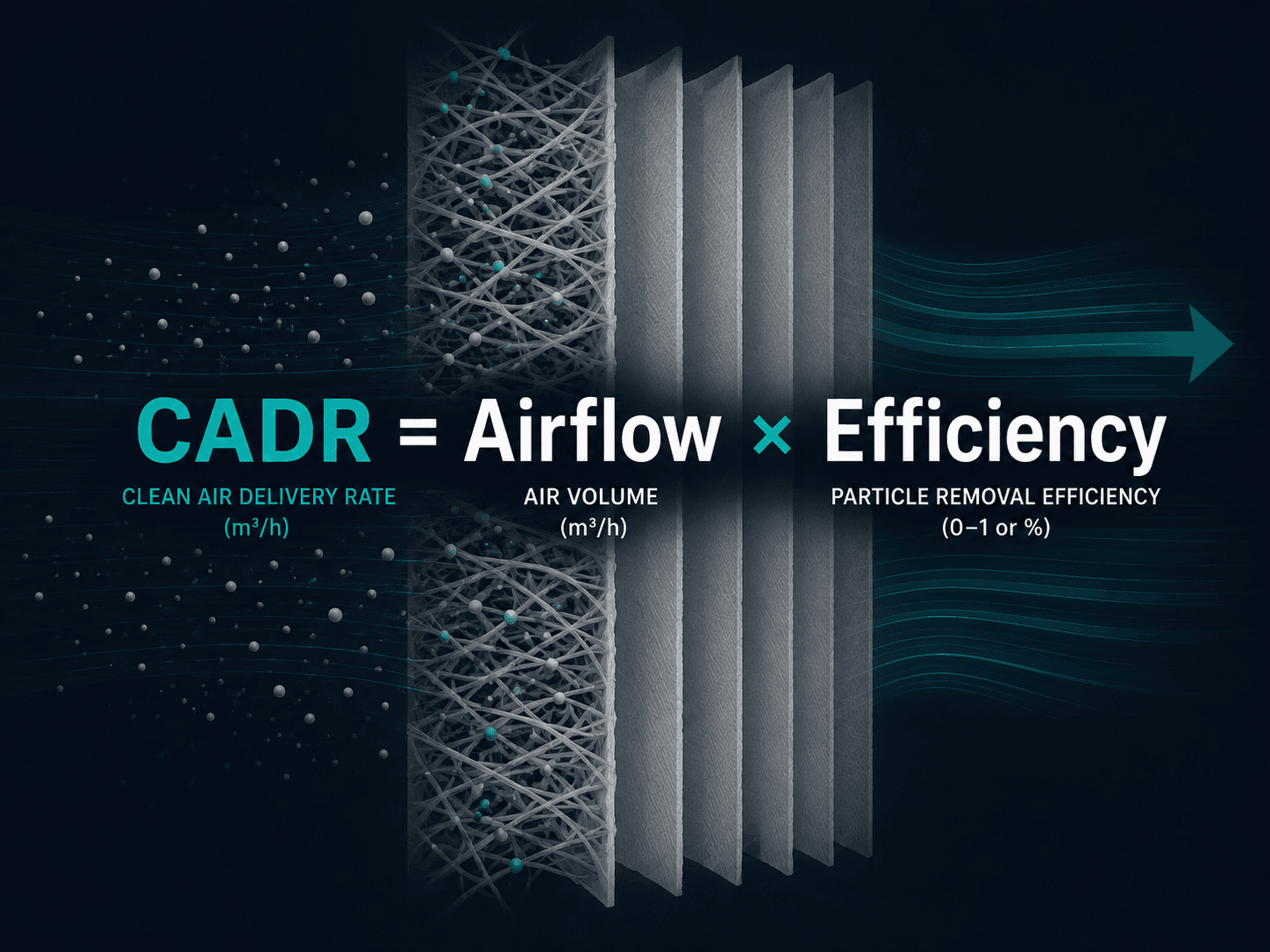
Esto tiene una consecuencia directa en el CADR —la medida que indica cuántos pies cúbicos o metros cúbicos de aire limpia realmente un purificador por minuto—. Si una unidad no está diseñada específicamente para soportar la resistencia de un filtro H14, la instalación de un filtro H14 puede reducir su flujo de aire de manera significativa, lo que da lugar a peor la calidad del aire en condiciones reales que una configuración H13 adecuadamente adaptada.
Por eso los filtros H14 solo son beneficiosos en aparatos que estén homologados y probados para ellos. Instalar un filtro H14 en un purificador de aire con poca potencia no mejora la calidad del aire, sino que solo sobrecarga el motor.
H13 frente a H14: comparación detallada
| Característica | H13 | H14 |
|---|---|---|
| Eficiencia global según la norma EN 1822 | 99.95% | 99.995% |
| Eficiencia local según la norma EN 1822 | 99.75% | 99.975% |
| Partículas que pasan | ~5 por cada 10 000 | ~0,5 por cada 10 000 |
| Clasificación común | De grado médico | De calidad farmacéutica |
| Caso de uso típico | Hogar, oficina, ámbito médico | Hospital, sala blanca, laboratorio |
| Resistencia al flujo de aire | Moderado | Alto |
| Repercusión del CADR | Bajo | Significativo si la unidad no está clasificada |
| Disponibilidad para el consumidor | Amplio | Limitadas; unidades especializadas |
¿Qué grado necesitas realmente?
Elija H13 si:
- Tienes alergias, asma o problemas respiratorios
- Tienes mascotas en casa
- Vives en una ciudad con un nivel moderado de contaminación atmosférica
- Tienes hijos pequeños o familiares mayores
- ¿Te preocupa el polvo, el polen, el moho, la caspa o las partículas en general?
- Quieres un rendimiento fiable sin tener que preocuparte por la compatibilidad de los dispositivos
El filtro H13, instalado en una unidad bien sellada y con la potencia adecuada, elimina las categorías de partículas que causan la gran mayoría de los problemas de calidad del aire interior. Para la mayoría de los hogares, es la solución más práctica, no una concesión.
Elija H14 si:
- Usted o un miembro de su familia tiene el sistema inmunitario debilitado
- Vives en una zona con humo crónico de incendios forestales o con una elevada contaminación atmosférica industrial
- Estás lidiando con una infestación de moho confirmada mientras se llevan a cabo los trabajos de remediación
- Tu purificador de aire ha sido diseñado y probado específicamente para el uso de filtros H14
- ¿Buscas lo más parecido a un sistema de filtración de grado clínico que haya disponible para uso doméstico?
Por qué la calidad de la junta del filtro es tan importante como el grado del filtro
Uno de los factores que más se pasa por alto en cuanto al rendimiento de los purificadores de aire es si el aire realmente pasa por el filtro o si, por el contrario, lo evita por completo.
Un filtro certificado H13 o H14 instalado en una carcasa con juntas defectuosas, bordes sueltos o huecos alrededor del medio filtrante rendirá muy por debajo de su grado nominal. El aire sigue el camino de menor resistencia. Cualquier hueco entre el filtro y su carcasa crea una vía de derivación por la que el aire sin filtrar pasa directamente al flujo de salida.
Al evaluar cualquier purificador de aire, comprueba lo siguiente:
- Si el dispositivo cuenta con una certificación de un organismo de pruebas independiente
- Que los asientos del filtro queden a ras, sin espacios visibles alrededor del perímetro del marco
- Si el fabricante publica los datos de CADR junto con el grado del filtro
- El intervalo de sustitución del filtro: un filtro desgastado en una carcasa en buen estado sigue funcionando mejor que un filtro nuevo en una carcasa con fugas
Un filtro H13 instalado en una unidad hermética y bien diseñada siempre ofrecerá un rendimiento superior al de un filtro H14 nominal en una unidad con un sellado deficiente. La clasificación es importante. El ajuste y la calidad de la carcasa son igualmente importantes.
Preguntas frecuentes
Por lo general, sí. “True HEPA” es la norma estadounidense (99,971 % a 0,3 micras). La norma H13 se somete a pruebas según la norma europea EN 1822, que es más estricta y evalúa el punto de peor rendimiento del filtro, no solo su promedio. Es una certificación más confiable.
En parte. Las partículas virales son minúsculas, pero suelen desplazarse en gotitas más grandes que los filtros H13/H14 sí capturan. Ningún filtro elimina el riesgo por completo; la ventilación y la tasa de renovación del aire también son importantes.
Cada 12 meses para un uso doméstico normal. En zonas muy contaminadas o en hogares con mascotas, cada 6 a 8 meses. No esperes a notar la diferencia: para entonces, el rendimiento ya habrá disminuido.
No. “HEPA” no goza de protección legal y puede aparecer en cualquier empaque. Busca una clasificación de eficiencia explícita (99,95%+ a 0,3 micras) o una designación de grado H11–H14. Si no aparece ninguna de las dos cosas, es probable que no sea un filtro True HEPA.