
Every spring the American Lung Association publishes a report that ranks air quality across the United States. Most years, the same region tops the list for the wrong reasons. The 2026 edition of State of the Air is the 27th since the report began in 2000. It found that 44 percent of Americans live somewhere that earned a failing grade for ozone or particle pollution. That is more than 152 million people. Look at where the single worst rankings land, and a pattern shows up fast. It is not random. It is geography.
Why the American West Leads in Air Quality Issues
Bakersfield, California held the top spot for year round particle pollution. This is the seventh straight year it has topped the report. Los Angeles kept its long running title for the worst ozone pollution in the country. It has now held that title in 26 of the report’s 27 editions. The bigger shift showed up in the short term particle pollution category. There, Fairbanks, Alaska overtook Bakersfield for the first time. It became the single worst metro area in the country for daily PM2.5 spikes. California still claims more cities on the worst 25 lists than any other state. Oregon, Texas, Utah, and Washington each appear multiple times too. A handful of eastern metro areas, including Pittsburgh and Philadelphia, still show up on these lists. So this is not purely a West versus East story. Still, the worst rankings clearly concentrate in western basins and valleys.
What Bakersfield, Fresno, Salt Lake City, and Fairbanks Actually Have in Common
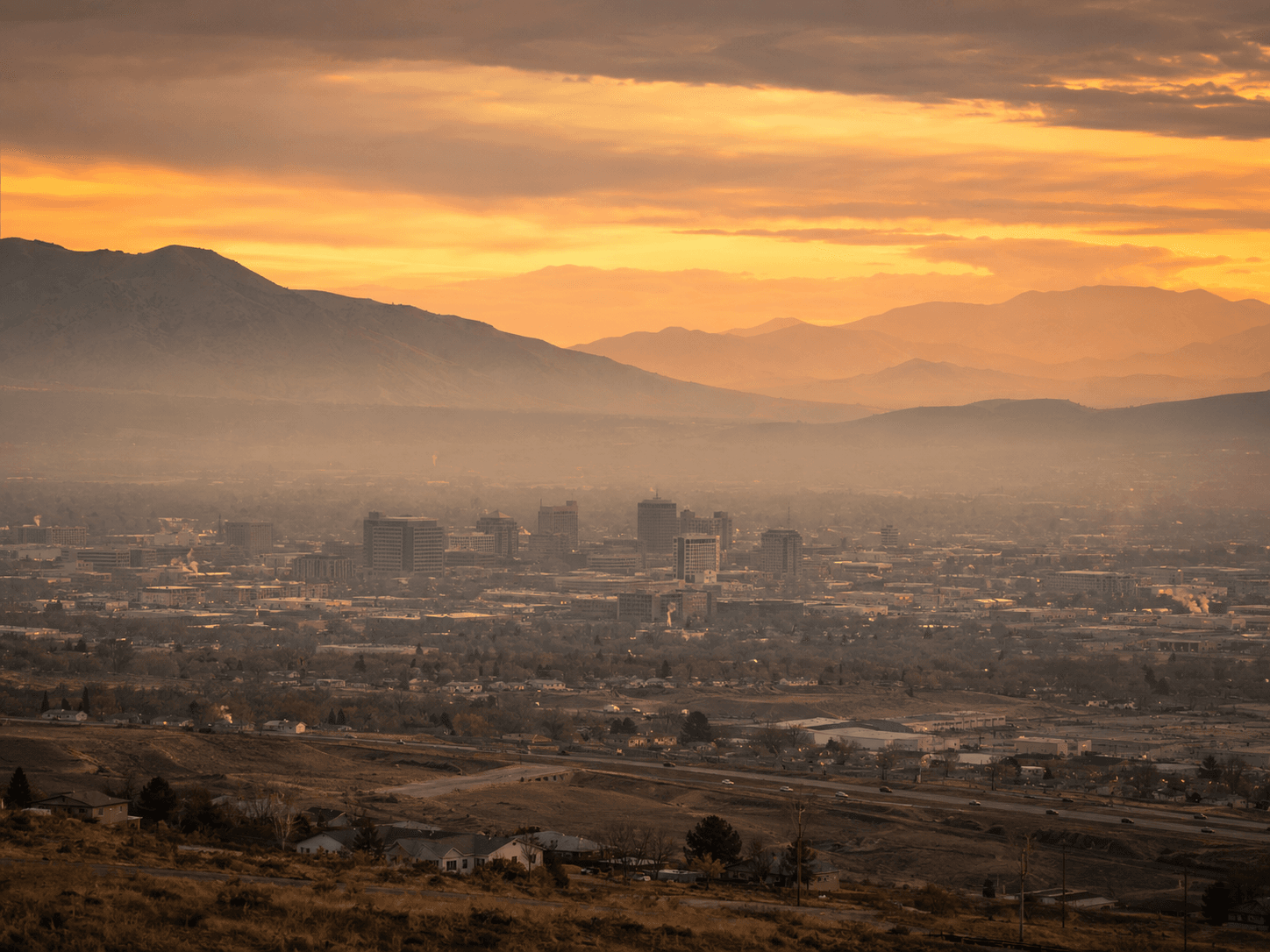
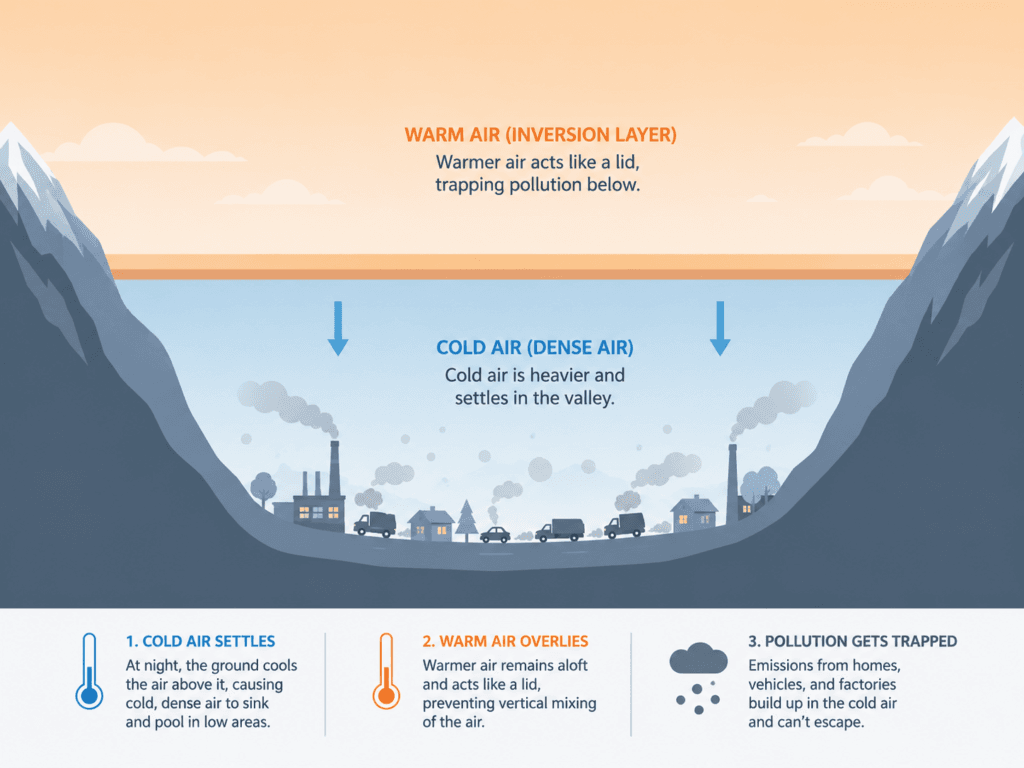
The obvious explanation for western air pollution is wildfire. Wildfire does play a real role in some of these rankings. But it does not explain Fairbanks, a city with almost no wildfire smoke in the depths of winter. It also does not fully explain why Bakersfield has held its ranking for seven consecutive years. That ranking holds regardless of how severe that year’s fire season was. The common thread is topography instead. Bakersfield and Fresno sit in California’s Central Valley, a long trough between two mountain ranges. The Sierra Nevada rises to the east, and the Coast Ranges rise to the west. Salt Lake City sits in a similar basin. The Wasatch and Oquirrh mountains ring it on every side. Fairbanks sits at the bottom of a river valley, with hills surrounding it on three sides.
In all of these places, cold air sinks to the valley floor on calm nights. A layer of warmer air caps it from above. This creates a temperature inversion that can hold for days at a time. Emissions from vehicles, agriculture, industry, and home heating then have nowhere to go. They build up at ground level instead of dispersing.
Alaska’s environmental agency has traced most of the particle pollution behind Fairbanks’ worst winter days to wood burning stoves. The share runs from 60 to 80 percent, and this inversion traps that smoke close to the ground. Swap wood smoke for agricultural dust and vehicle exhaust, and the mechanism driving Bakersfield’s ranking looks almost identical. The U.S. Environmental Protection Agency sets a health based standard for this pollutant. The 24 hour limit is 35 micrograms per cubic meter, and these basin cities cross it with striking regularity.
How Wildfire Smoke Adds a Second, Less Predictable Layer
Basin geography explains the steady, recurring pollution that shows up in annual averages. Wildfire smoke adds a different problem on top of it. It also reaches a wider stretch of the West than the handful of chronically polluted valleys. Researchers at Lawrence Berkeley National Laboratory’s Indoor Environment Group studied older homes without upgraded filtration. They found that indoor particle levels during a smoke event can reach 70 to 80 percent of outdoor concentrations. That holds even with the windows and doors shut.
A separate study of homes in British Columbia measured how outdoor PM2.5 made its way indoors and stayed airborne. That share averaged 0.61 without HEPA filtration. It dropped to 0.19 once a home added a HEPA filter. That is a real difference in exposure over the course of a fire season. People spend the large majority of their time indoors. That gap between filtered and unfiltered homes has a direct bearing on health outcomes.
Why Filtration Needs Differ by Pollution Source
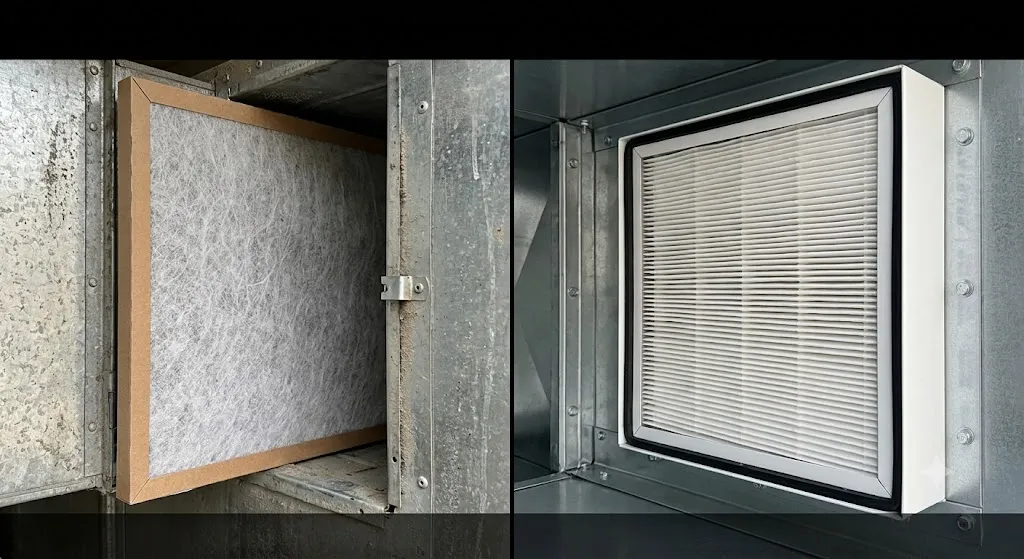
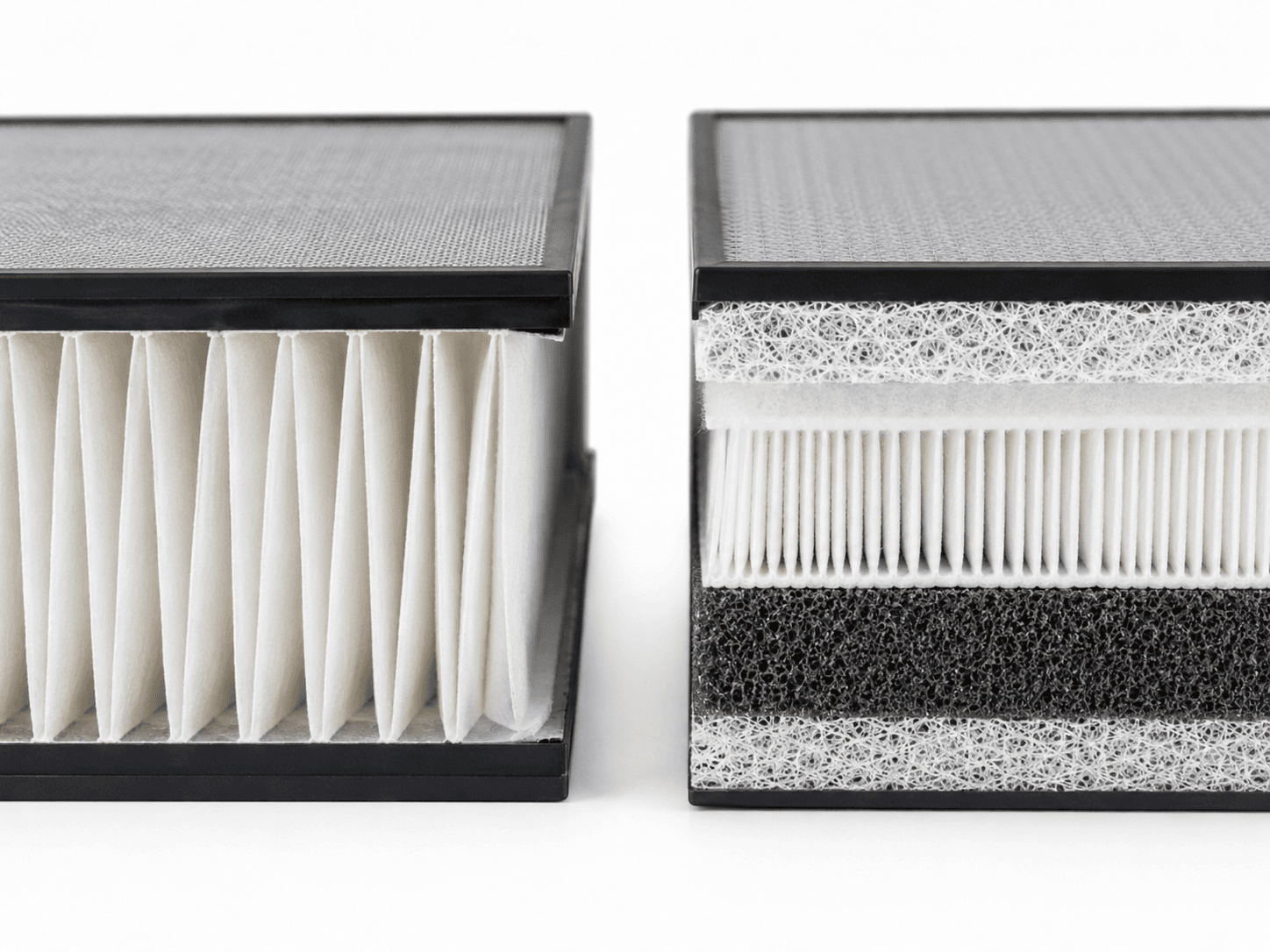
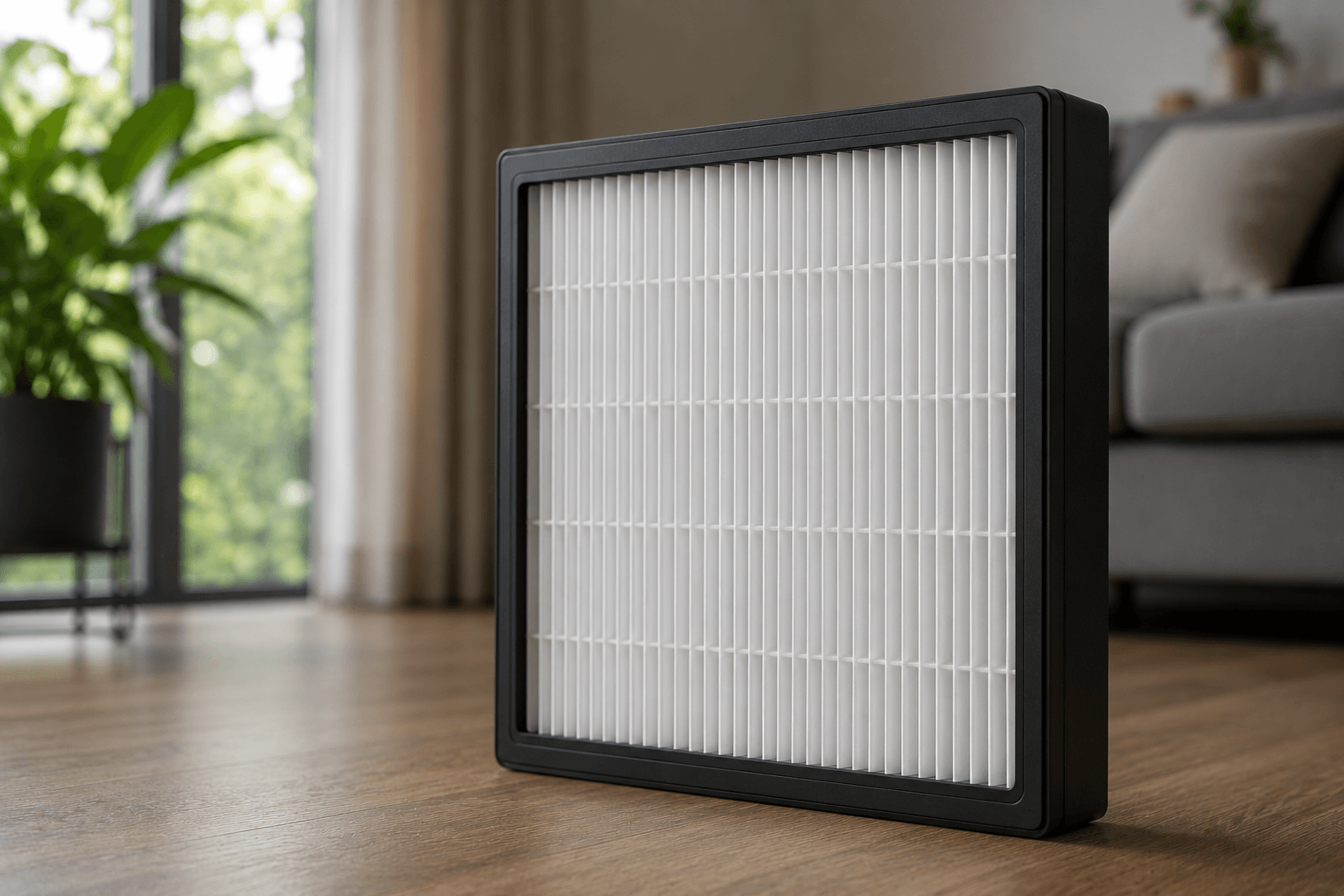
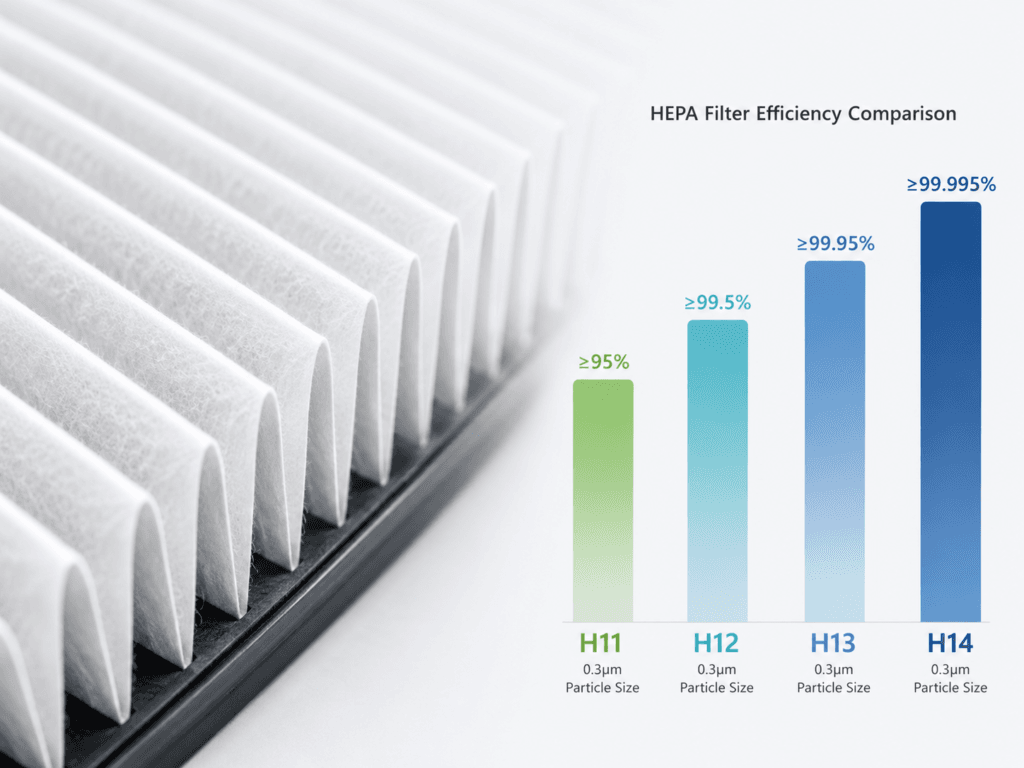
A single filter specification does not serve every problem equally well. Chronic valley pollution calls for continuous filtration, since the source rarely disappears during inversion season. A whole home HVAC system with a high efficiency filter does more good here. It beats a unit that only switches on when the sky looks smoky. The same goes for a portable purifier that runs around the clock in Bakersfield or Fairbanks. The filtration industry uses the EN 1822 classification for this. Under it, an H13 高效过滤器 must capture at least 99.95 percent of the most penetrating particle size. H11 media rates lower and suits less demanding environments. ASHRAE’s guidance for buildings in smoke prone regions likewise points toward higher grade filtration alongside adequate air changes. Sealing a building shut is not the answer, since indoor air still needs to circulate.
Indoor sources matter too. A kitchen that replaces a gas range with induction cookers removes one steady contributor to indoor fine particulate. That change alone will not offset an outdoor smoke event moving through the neighborhood, though. For short, intense wildfire spikes, the more useful number is often Clean Air Delivery Rate. CADR measures how quickly a portable unit can turn over the air in a room. Pair a highly efficient filter with a weak fan, and it can still leave a bedroom smoky for hours. Buyers researching air purifiers for these markets do better weighing HEPA grade and CADR together. Treating either one alone does not give the full picture.
Where This Leaves Buyers Sourcing Filtration Products for Western Markets
Distributors, wholesalers, and private label brands are building out product lines for the western United States and Alaska. For them, the State of the Air data works as a market signal as much as a health one. Basin cities generate steady year round demand for replacement HEPA media. The broader western fire season adds seasonal spikes in demand for high CADR portable units on top of that. A single product line rarely covers both use cases well.
HIFINE manufactures HEPA filter media and replacement filters across the H11 to H14 range under ISO 9001 quality control. The company works with OEM and ODM partners to match filter specifications to each market’s climate and pollution profile. That might mean a higher grade filter for a private label air purifier line. Or it might mean a replacement filter that holds up under continuous HVAC duty in an inversion prone city. The same western states dealing with drought and wildfire also face growing pressure on water supplies. That is one reason some brands now expand into water filtration and smart home filtration lines alongside air filtration. Rather than treating each category on its own, they build them together.