
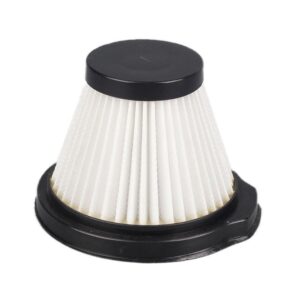
Most replacement filter purchases start with a model number search. That works for identical OEM swaps. But the moment you are sourcing a third-party replacement — or specifying filters across a product line you do not manufacture — model numbers stop being enough.
What actually determines whether a filter works in a given air purifier? Four things. Only one of them is visible from the outside.
How to Check Air Purifier Filter Dimensions Before You Buy
The obvious check is size. A filter that will not seat in the housing fails immediately. But dimensional tolerance matters just as much as the dimension itself.
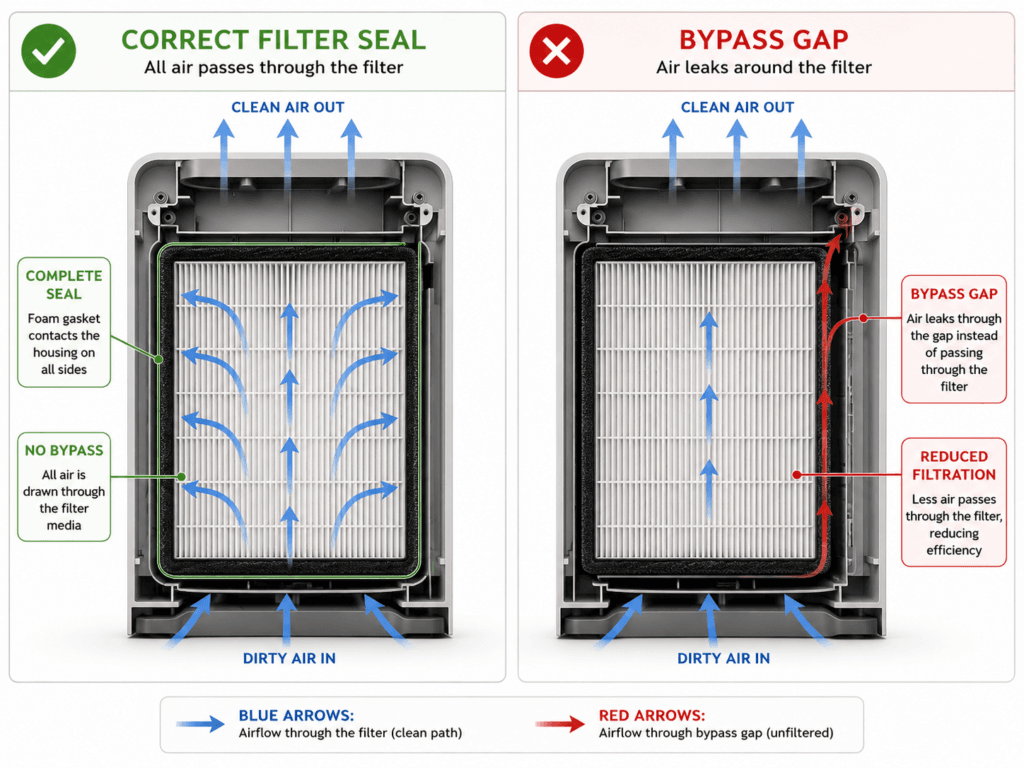
Air purifier housings are designed to maintain a sealed contact between the filter frame and the housing wall. If the filter runs 2–3 mm short, air bypasses the filter media entirely — traveling through the gap rather than through the HEPA fiber layer. That bypass is invisible from the outside and undetectable without airflow testing equipment.
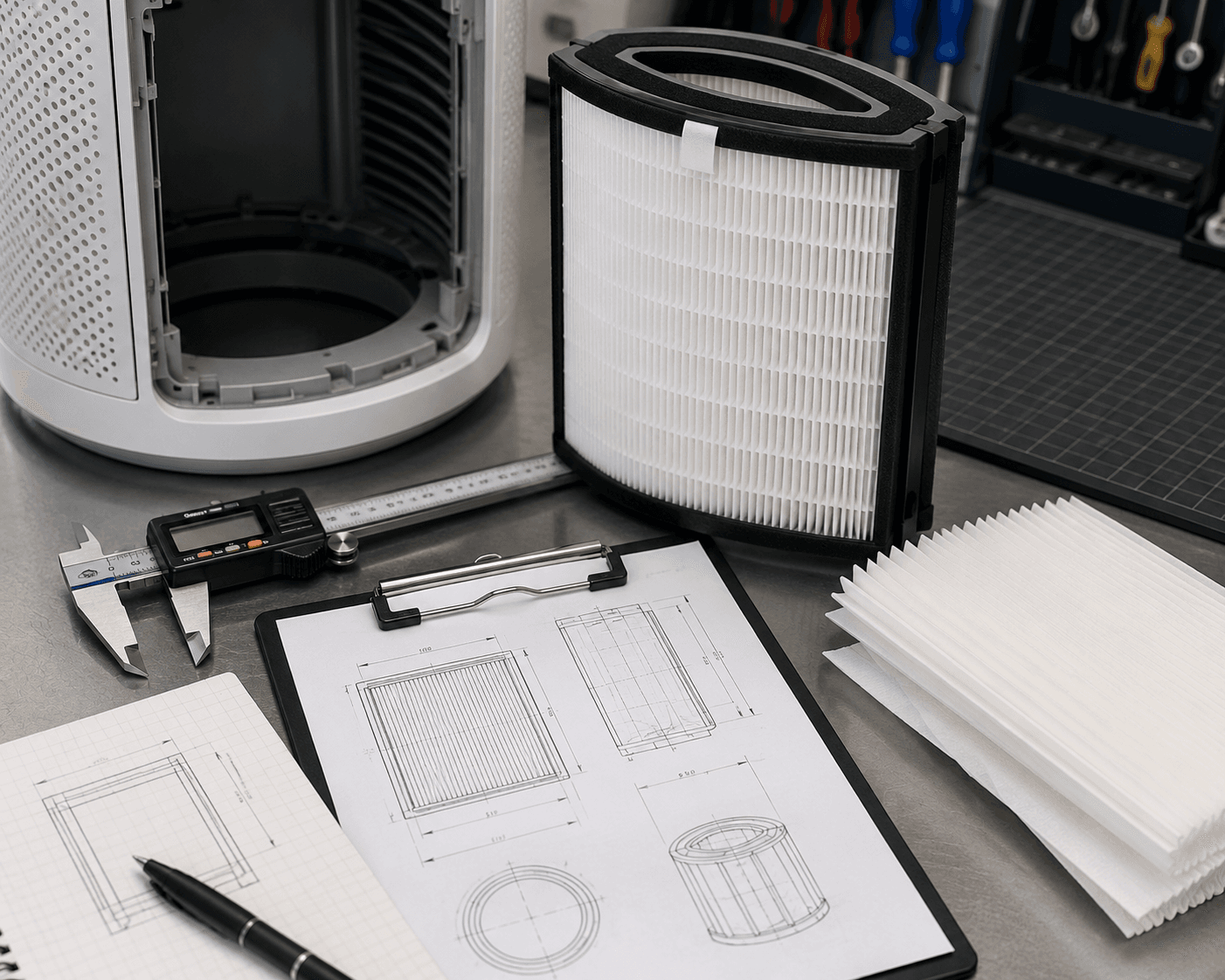
Before placing an order: measure the filter cavity depth, width, and height with digital calipers, not a tape measure. Confirm the sealing mechanism — friction seal, foam gasket, or mechanical latch. Note whether the frame is cardboard or rigid plastic. Cardboard compresses differently under motor suction and can warp in high-humidity environments. For procurement contexts, request dimension tolerances from your supplier, not just nominal measurements. A nominal match with loose tolerances is not a dimensional match.
Why HEPA Is Not a Single Standard and How to Verify the Grade
Consumer product pages often use “HEPA” as a binary — a filter either qualifies or it does not. The standard does not work that way.
Under EN 1822, the European testing standard for high-efficiency particulate air filters, HEPA is graded from H10 to H14 based on efficiency at the most penetrating particle size (MPPS) — typically 0.1 to 0.3 microns, the range where filters perform worst:
| Class | Minimum Overall Efficiency (at MPPS) | Common Application |
|---|---|---|
| H10 | 85% | General HVAC pre-filtration |
| H11 | 95% | Entry-level consumer air purifiers |
| H12 | 99.5% | Mid-range residential units |
| H13 | 99.95% | Hospital-grade and premium residential |
| H14 | 99.995% | Cleanrooms, critical control environments |
When evaluating compatibility, confirm the EN 1822 class — not just the word “HEPA” on the label. A filter legally marketed as HEPA in some jurisdictions can be H10 or H11, capturing 85–95% of MPPS particles. H13 captures 99.95%. That gap is meaningful. The EPA links elevated fine particle (PM2.5) concentrations to respiratory and cardiovascular effects. The grade difference is the difference between the label claim and what the unit actually delivers to the room.
The context of use shifts which grade is appropriate. In a bedroom, the dominant PM2.5 source is often outdoor infiltration through window gaps. In a kitchen where an induction cooker generates ultrafine cooking oil aerosols at high heat, the particle load changes — and so does the specification that matters. H13 is the baseline grade worth matching when replacing a filter in any purifier marketed for health-sensitive environments.
HIFINE 生产 H13 and H14 HEPA replacement filter media tested per EN 1822, with documentation available for OEM and ODM customers.
How Pressure Drop Affects Filter Compatibility and Motor Life
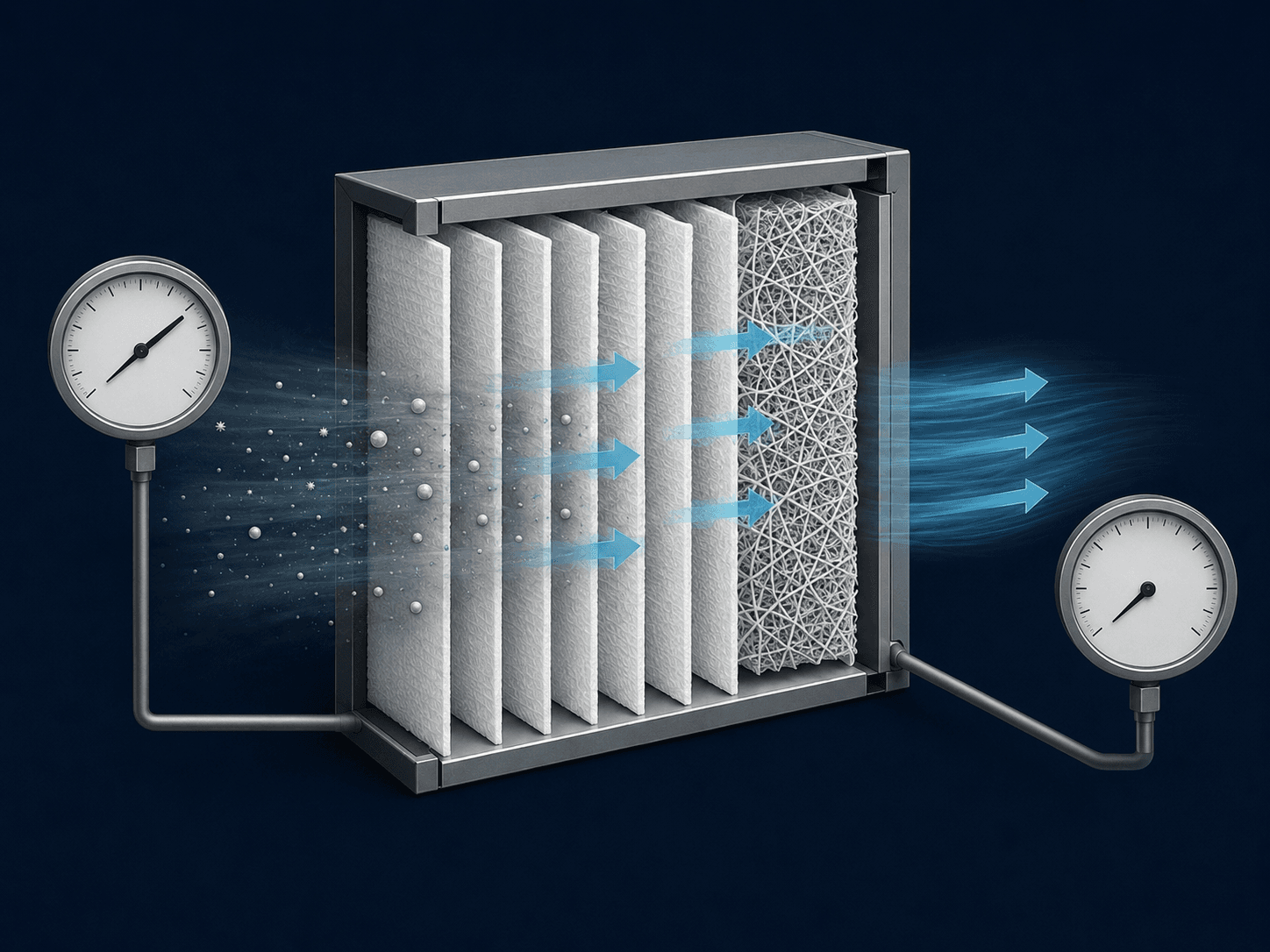
Every filter restricts airflow. Denser media — which captures smaller particles at higher efficiency — creates more resistance. The purifier motor compensates by working harder. This resistance is pressure drop, measured in Pascals.
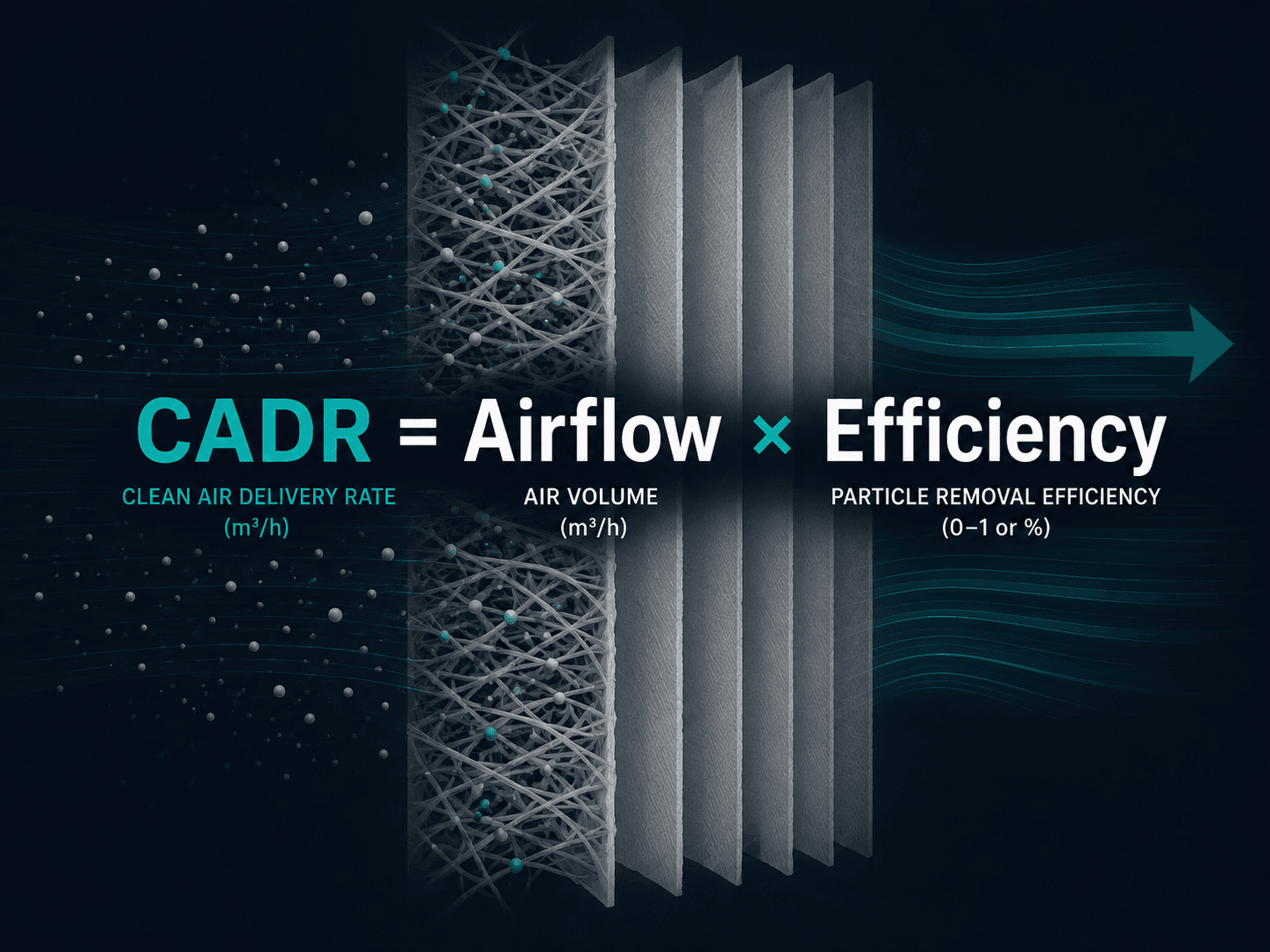
A replacement filter with substantially higher pressure drop than the original spec causes the motor to draw excess current, run hotter, and wear faster. CADR — Clean Air Delivery Rate, the metric standardized by AHAM for measuring actual air purifier output — falls below the unit’s rated performance. In purifiers with smart fan controls, high resistance can lock the unit into permanent high-speed operation, increasing both noise and energy draw.
A filter with lower pressure drop than the original typically uses less dense media, meaning lower actual filtration efficiency even when the grade label matches. Lower resistance is not automatically better.
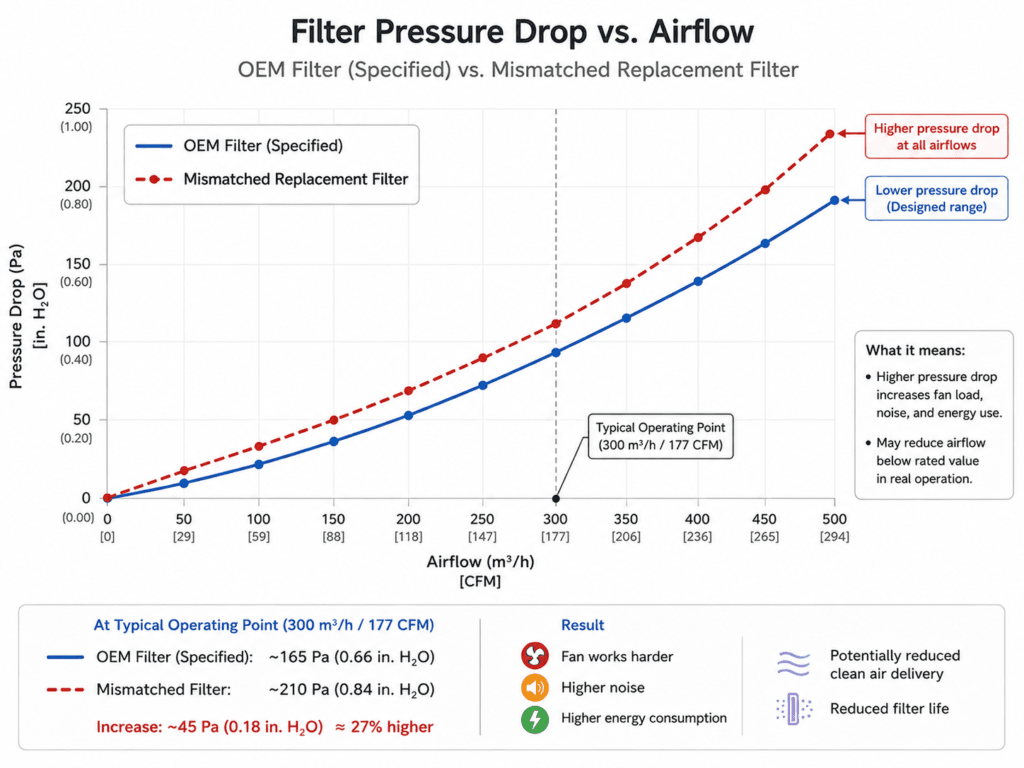
What to request from your supplier: initial pressure drop in Pascals at the unit’s rated airflow. Cross-reference this against the OEM filter’s published spec. A ±10% variance is generally acceptable for residential units. Beyond that threshold, test a sample batch before volume deployment.
For B2B sourcing contexts, this is where replacement filter media specifications from HIFINE include pressure drop data as a standard deliverable — not an on-request afterthought.
What Filter Certifications to Ask for Before You Order
A filter’s grade claim is only as credible as the testing behind it. In B2B procurement, this matters beyond performance — purchasing decisions carry product liability and compliance exposure.
Key standards that apply:
- EN 1822: European standard for HEPA and ULPA filters; tests efficiency at MPPS and classifies H10–H14. Required for a legitimate H-grade classification.
- ISO 29463: International equivalent; aligned methodology with EN 1822, accepted in markets outside Europe.
- ASHRAE 52.2: American standard for general ventilation filters; produces MERV ratings. Less directly applicable above H12, but relevant for pre-filter specifications.
- GB/T 6165: Chinese domestic standard for high-efficiency air filters.
When sourcing replacement media, request a test report from an accredited third-party laboratory — not just a CE or RoHS declaration. CE marking covers EU product safety broadly; it does not certify filtration efficiency. A supplier who cannot produce an EN 1822 test report for a filter sold as H13 cannot verify the grade claim. That is the answer to your compatibility question.
HIFINE holds ISO 9001 certification with 13+ years of filter media manufacturing history. Third-party EN 1822 test documentation is provided for all HEPA grades across our 空气过滤器 和 water filter product lines.
Why a Physically Compatible Filter Can Still Fail
Physical fit, grade, and pressure drop can all check out — and the filter can still underperform. The cause is usually bypass.
Bypass happens when air takes the path of least resistance around the filter rather than through it. Causes:
- Frame deformation: cardboard frames warp under sustained motor suction or in high-humidity rooms
- Improper seating: no confirmed gasket compression or mechanical latch click on installation
- Housing wear: plastic clips and channels that no longer hold filter edges flush after repeated replacement cycles
Research from Lawrence Berkeley National Laboratory on in-duct filter installation has documented that gaps under 1% of the filter face area can allow a disproportionately large share of unfiltered air to pass through. Real-world capture efficiency can fall well below rated values without any visible external indication.
This is why frame construction is not a secondary specification. The frame material, edge sealing method, and dimensional consistency determine whether the efficiency number on the test report is actually delivered to the room.
What a Legitimate Replacement Filter Spec Sheet Should Include
A complete spec sheet from any credible filter media supplier should include:
- Outer dimensions (L × W × D) with stated tolerances
- EN 1822 filter class
- Initial pressure drop at rated airflow
- Frame material and edge sealing method
- Third-party test report reference number from an accredited lab
If a supplier cannot provide items 3 through 5, that is the compatibility assessment.
When a Third-Party Filter Is a Safe Replacement for OEM
OEM replacement filters from the original equipment manufacturer are the safest spec match — dimensions and performance are guaranteed by design. But OEM pricing carries a markup that does not work for high-volume procurement, private-label sourcing, or distributors supplying multiple brands.
Third-party replacement filters are a viable substitution when:
- The supplier provides EN 1822 documentation at a matching or superior grade
- Dimensional tolerances are specified and verified against your housing
- Frame sealing matches the housing’s mechanism
- The supplier operates under a quality management system such as ISO 9001
For facility managers, appliance distributors, or brands sourcing filter media, the framework is simple: match the spec, verify the documentation, test a sample batch. Do not rely on the label.
HIFINE supports OEM and ODM replacement filter production across multiple air purifier housing formats. If you are evaluating media for a specific unit, dimensional and pressure drop comparison against your current OEM filter is the right starting point.
How Smart Air Purifiers Change the Compatibility Requirements
Many current air purifiers include filter life indicators or auto-mode sensors that estimate filter loading through motor resistance or time-based calculations. A replacement filter with meaningfully different pressure drop characteristics can confuse these systems — triggering early replacement alerts or, in the opposite direction, failing to flag a clogged filter approaching the end of its service life.
If the unit you are sourcing for uses sensor-based filter life monitoring, pressure drop matching becomes a primary compatibility requirement, not a secondary one. This is worth flagging explicitly when specifying filters for smart home or commercial purifier applications.
Summary
Filter compatibility comes down to four verifiable checks: physical dimensions including tolerance and sealing method, EN 1822 grade rather than just the word “HEPA,” pressure drop at the unit’s operating airflow, and third-party test documentation from an accredited lab. A filter that passes all four is a genuine replacement. One that passes only the first — visible fit — can perform significantly below the original specification with no external warning signs.
For B2B sourcing, the spec sheet is the conversation. If a supplier cannot produce one, that is the compatibility answer.