
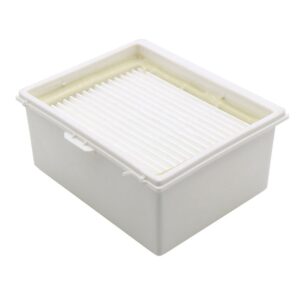
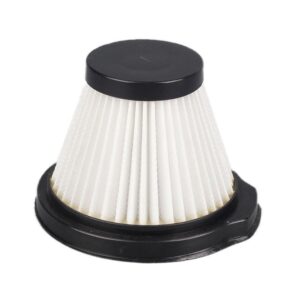
“Buy a real HEPA filter and your pet’s allergy problem will be solved.” This advice is not comprehensive and may even lead people to spend more money.
The HEPA filter is not where failure begins in a pet home. The pre-filter is. And by the time most owners realize this, they’ve already burned through a $60 replacement filter that didn’t need to die.
Why Pet Hair Destroys Expensive Filters
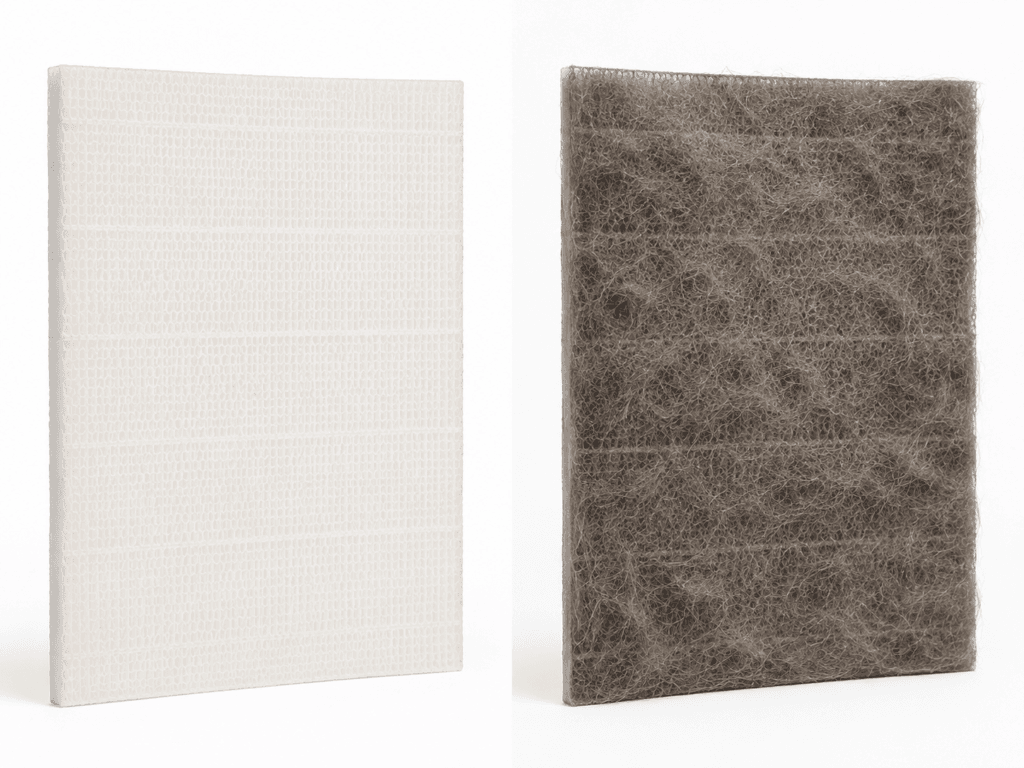
Standard pre-filters are engineered for general household dust — loose, fine particles that don’t mat together under airflow pressure. Pet hair behaves completely differently.
Guard hairs from heavy-shedding breeds — huskies, Maine Coons, golden retrievers — are coarser and springier than typical lint. Under sustained airflow, they interlock and compress into a dense, felt-like layer across the filter surface. In homes with active shedders, partial occlusion can develop within three to four weeks.
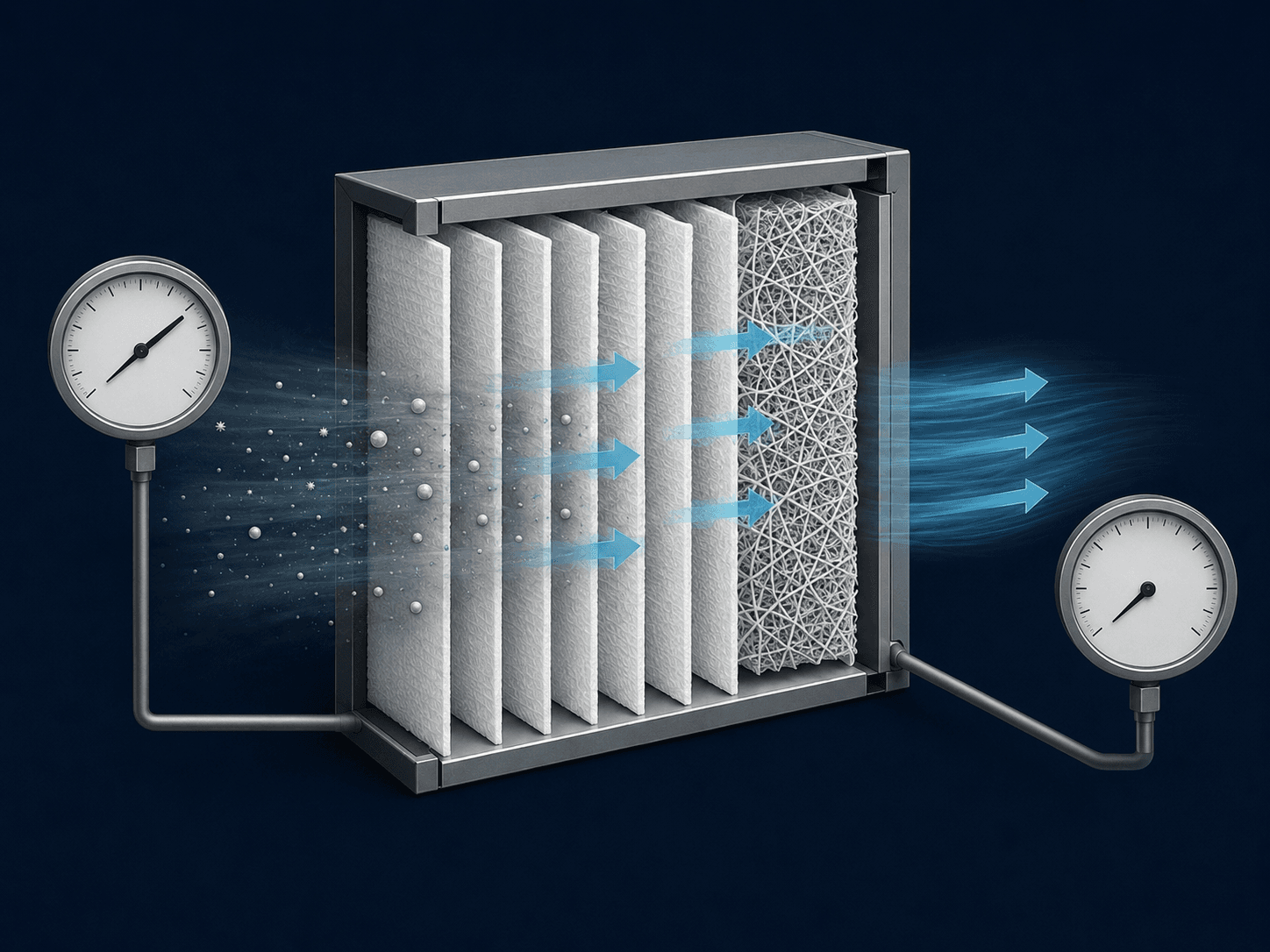
Once that mat forms, the physics shift. Rising pressure differentials push unfiltered air around the pre-filter’s edges and directly into the HEPA membrane — a component designed for fine particles, not coarse debris, and priced at $30–$80 to replace.
A 2023 study in Building and Environment found that homes with animals collect airborne particles 2-4 times faster than pet-free homes, with dramatic spikes during grooming and movement. Standard filter replacement schedules — built around average household conditions — don’t account for this load.
The result: A $300 purifier delivering the effective performance of a $30 fan, and shortening its own lifespan in the process.
Three ways pets render standard air purifier designs ineffective
Dander Lives in a Filter Blind Spot
Pet dander is not hair. It’s microscopic skin cells shed continuously by cats, dogs, and most other household pets, typically ranging from 2 to 10 microns in size. Because they’re so lightweight, dander particles stay airborne for hours after initial disturbance, and re-enter circulation long after settling on surfaces.
True HEPA (H13 or H14 certified) captures 99.95% of particles at 0.3 microns — which covers pet dander well. The problem is that many purifiers marketed as “HEPA” actually use H11-grade or uncertified “HEPA-type” media. These filters can miss 15–40% of particles in the 0.5–2 micron range. That is precisely where cat and dog allergens concentrate.
The American Lung Association recommends certified True HEPA — not HEPA-style variants — for allergy and asthma management in pet households. If your filter’s spec sheet doesn’t list H13 or higher, it may not be filtering what you bought it for.
The Carbon Layer Saturates Before You Notice
Pet odors — urine compounds, wet fur, litter box gases — are volatile organic compounds (VOCs). Absorbing them effectively requires activated carbon with enough mass for adequate contact time between passing air and the carbon surface. More carbon means longer dwell time. Longer dwell time means more odor captured.
Most standard purifiers ship with a carbon mesh layer weighing 50–100 grams. Effective pet odor control typically demands 300–500 grams or more of granular activated carbon. A thin mesh layer in a pet home reaches saturation within 6–10 weeks. After that, it stops absorbing — and can begin off-gassing previously captured compounds back into the room.
Most Purifiers Don’t Reach Where Pets Actually Live
Pet dander is a ground-level problem. Grooming, walking, and resting disturb allergen-loaded particles from carpet fibers and upholstery at 0–24 inches above the floor. Dogs and cats spend the majority of their time — and produce the majority of their dander — in this zone.
Most consumer air purifiers draw intake air from 12 inches above the floor at minimum, and many operate from mid-panel or top-mounted intakes. This means they’re largely processing air above your pet’s primary environment, not within it. Without a low-intake design, a meaningful fraction of the allergen load never reaches the filter.
CADR Is a Lab Number
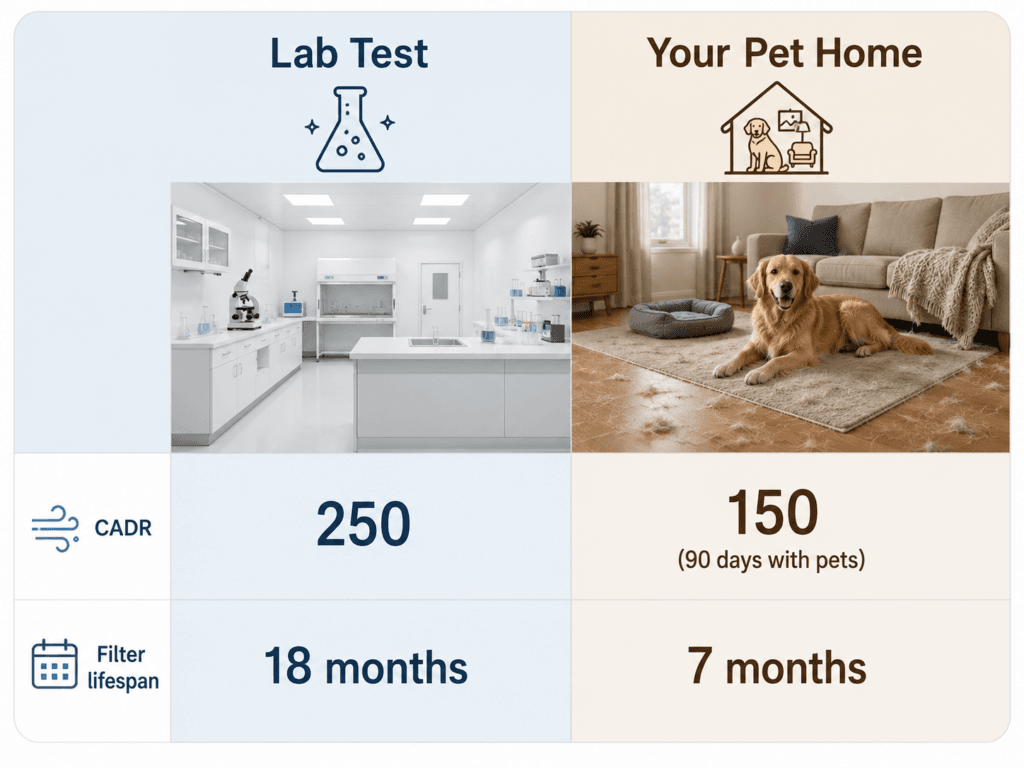
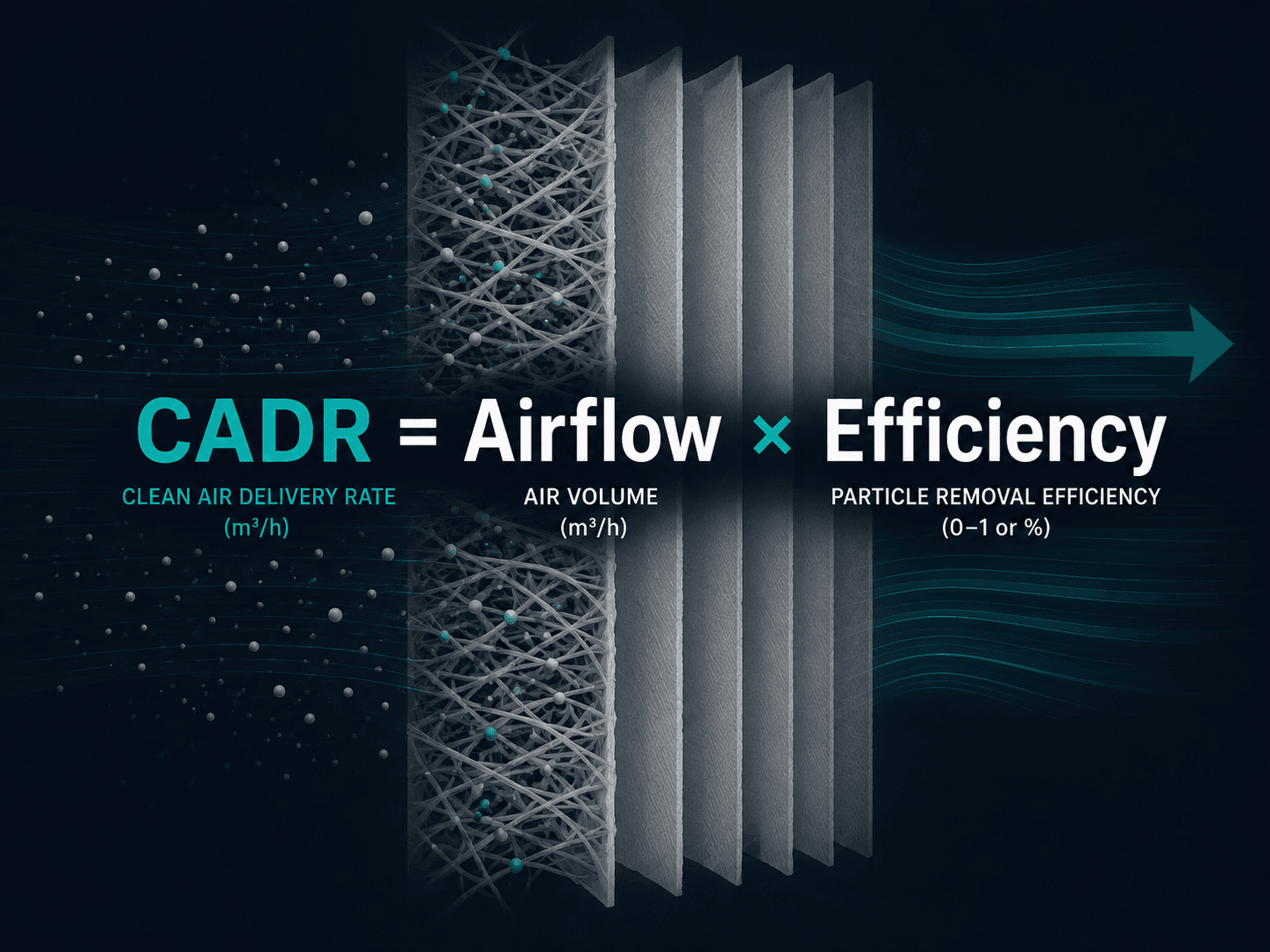
CADR is the industry’s standard efficiency benchmark — and it’s measured in controlled conditions: no pets, no hair, standardized test particles, and a clean filter at full performance.
A purifier rated at CADR 250 in a clean test environment may deliver an effective output closer to 150–180 within 60–90 days in a home with two dogs. As pet hair accumulates on the pre-filter, airflow resistance climbs. The fan works harder against more resistance, drawing more energy and producing more heat, while delivering less filtered air.
CADR tells you nothing about:
- How quickly filters degrade under real pet-hair loads
- Whether the pre-filter design handles high-volume shedding breeds
- The actual energy and financial cost of maintaining effectiveness in a pet household
Treating a CADR rating as a stable long-term number in a pet home is like trusting a car’s highway fuel economy figure for urban stop-and-go driving. The number is real — just not for your conditions.
The Real Math: Annual Filter Cost in a Pet Home
| Standard Home | Pet Home | |
|---|---|---|
| Pre-filter replacement | 3~6ヵ月ごと | Every 3–5 weeks |
| True HEPA lifespan | 12–18 months | 6–9 months |
| Carbon layer saturation | 10–12 months | 6–10 weeks |
| Estimated annual filter cost | $60–$100 | $200–$400 |
Most buyers compare machine prices. The filters are where the long-term cost lives — and where performance is actually maintained or lost.
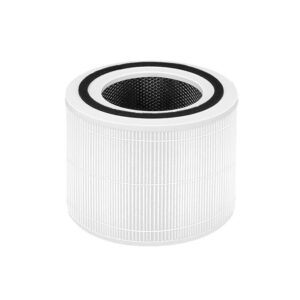
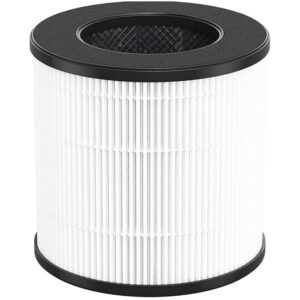
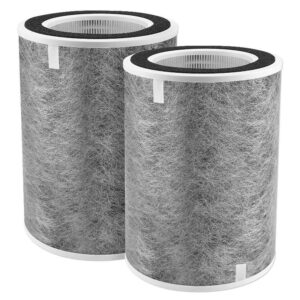
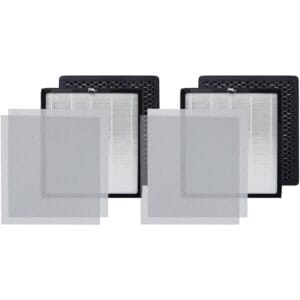
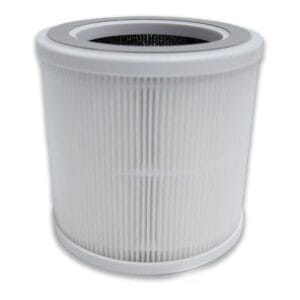
At HIFINE, our replacement air purifier filters are built for high-frequency replacement in active pet households: pre-filter media rated for coarse debris, H13 HEPA membranes for fine allergens, and granular carbon layers with meaningful volume. If you’re also running a robot vacuum as part of your pet-hair management system, replacement robot vacuum filters そして ダストバッグ follow the same logic — weekly checks in pet homes, not the monthly schedule designed for standard use.
What a Pet-Ready Filter System Actually Needs
You don’t necessarily need the most expensive unit. You need the right filter architecture.
- Washable or low-cost pre-filter: Ideally washable under running water and reinstallable. If disposable, replaceable for under $10 per unit. This is the component absorbing the hardest initial impact from pet hair.
- H13 or H14 True HEPA: Not “HEPA-style.” Not “HEPA-grade.” Look for the certification class listed explicitly in the product spec sheet. For cat allergy sufferers, the performance gap between H11 and H13 is clinically significant.
- 300g+ of granular activated carbon: Listed by weight in the specs — not just described as “a carbon layer.” Granular or pelletized form provides more surface area than mesh. Weight matters more than thickness.
- Ground-level or dual intake design: An intake at floor level or a dual-height intake system captures allergens where pets actually generate them, not just in the breathing zone designed for standing adults.
- Resistance-based filter monitoring: Timer-based reminders assume standard conditions. A system reading actual airflow resistance tells you when the filter is genuinely saturated — not when a calendar estimate runs out.
The One Question That Changes Everything
Before purchasing any air purifier for a pet home, ask this: “Is the pre-filter sold separately — and what does it cost?”
If the pre-filter is bundled-only, or if the replacement price isn’t published upfront, the machine wasn’t designed for a household with animals. It was designed for a household that changes filters twice a year. Pet owners change pre-filters roughly ten times a year.
The key is the HEPA filter; the real work comes from the filter screen inside.