
A technical reference for OEM engineers, procurement teams, and aftermarket filter manufacturers evaluating inlet air cleaning equipment.
The Standards Stack And Where Each One Actually Applies
Most engineers reach for ISO 5011 by default. That’s correct for engine air filters. But the full standards landscape covering automotive filtration is larger, and mixing up which standard governs which component is a source of supplier miscommunication that shows up late in the qualification cycle.
Here’s how the stack maps to applications:
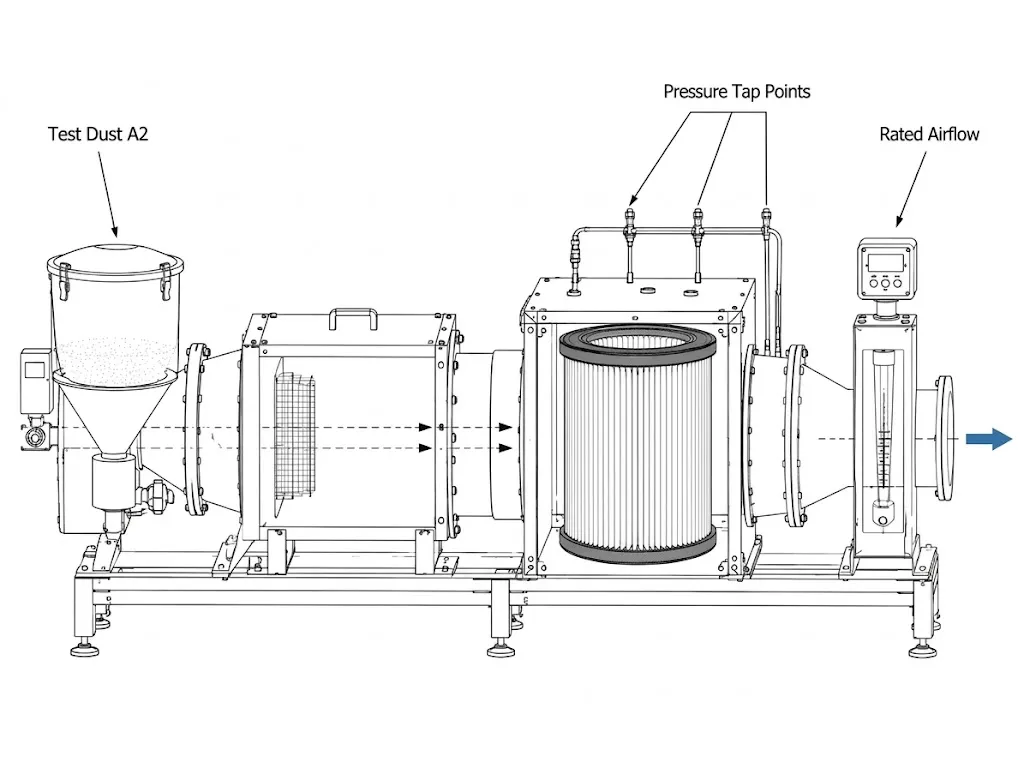
- ISO 5011:2020: The global benchmark for engine air intake systems. It standardizes test dust specifications and airflow protocols, focusing on three critical performance metrics: filtration efficiency, pressure drop, and dust-holding capacity.
- SAE J726: While procedurally parallel to ISO 5011, this standard is specific to the North American market. It is important to note that terminal restriction pressures and dust lot tolerances differ between the two; therefore, claiming J726 results as direct equivalents to ISO 5011 is technically inaccurate.
ISO 11155-1 & 11155-2:
- Part 1: Establishes standards for particulate filtration, specifically testing efficiency for particles as small as 0.3 μm.
- Part 2: Focuses on gas-phase filtration, measuring the adsorption capacity of activated carbon using toluene as the standard model compound.
SAE J1691
Commonly referenced in RFQs, this standard defines the minimum acceptable performance for aftermarket engine filters. It serves as a regulatory “floor” rather than a benchmark for high-end performance; when evaluating new suppliers for OEM replacement parts, J1691 should be viewed as the entry-level requirement, not the target for premium quality.
ISO 16890 and the Cabin Filter Bridge
For cabin air filters in markets where PM2.5 exposure is a product claim, ISO 16890 ePM1, ePM2.5, and ePM10 classification is increasingly layered on top of ISO 11155-1 results. The two standards are not interchangeable: ISO 16890 was designed for HVAC systems, not automotive, but its sub-micron particle efficiency methodology fills a gap that ISO 11155-1 doesn’t address.
Why the Gravimetric Number Isn’t the Whole Story
Under ISO 5011, filtration efficiency is measured gravimetrically: total captured dust mass divided by total introduced mass, expressed as a percentage. A high-performance engine air filter targets ≥99.5% efficiency at rated airflow using ISO 12103-1 A2 Fine Test Dust—a silica-based compound with a documented particle size distribution centered around 5 μm.
The built-in limitation: gravimetric efficiency is dominated by coarse, heavy particles. Sub-micron performance is nearly invisible in the result.
| Particle Range | Primary Source | Engineering Concern | Standard Coverage |
|---|---|---|---|
| >10 μm | Road dust, sand | Abrasive engine wear | ISO 5011 ✓ |
| 1–10 μm | Combustion deposits | Injector and bearing wear | ISO 5011 partial |
| <1 μm | Urban PM, soot | Catalyst degradation, DISI injector fouling | ISO 16890 / ISO 11155-1 |
For turbocharged direct-injection engines with tight injector tolerances—or EV thermal management inlets where fine particulate accumulation affects long-term performance—the gravimetric efficiency figure is an incomplete design input. Some OEM specifications now require both ISO 5011 efficiency and ISO 16890 ePM1 values from the same element.
Pressure Drop: Initial Restriction vs. Terminal Restriction
Every filter element represents a tradeoff between filtration efficiency and airflow restriction. More media surface area and tighter fiber structure improve capture but raise pressure drop.
Two numbers appear on test reports. Only one is commonly understood.
Initial restriction is the figure engineers check against engine inlet system design limits. Straightforward.
Terminal restriction is the maximum backpressure allowed before the element must be replaced. ISO 5011 sets this at 6.0 kPa (≈24.1 in H₂O) for most commercial vehicle applications. Passenger car OEM specs often set service triggers earlier—typically 3.5–4.5 kPa—to protect turbocharger efficiency and fuel economy.
The delta between initial and terminal restriction, divided by the accumulated dust load, is your working model of service life under real operating conditions. An element that reaches terminal restriction before the scheduled service interval points to one of three root causes: DHC is under-specified for the duty cycle, the operating environment is dustier than the design assumption, or upstream pre-cleaning is absent or underperforming.
Dust Holding Capacity
Dust holding capacity is the total mass of A2 test dust captured before the element hits terminal restriction, measured in grams. It’s the primary specification lever for service life management.
DHC scales with three variables:
- Effective media surface area: Determined by pleat count, pleat height, and element diameter
- Media porosity and fiber diameter: Tighter structure raises efficiency but reduces DHC per unit area—there’s no free optimization here
- Upstream pre-separation: Cyclonic pre-cleaners in heavy-duty applications can remove 80–90% of coarse dust before it reaches the filter element, multiplying effective DHC
Reference DHC ranges by application:
- Passenger vehicle engine filter: 60–180 g
- Light commercial / van: 150–400 g
- Off-road with cyclonic pre-cleaner: >800 g
One qualification: ISO 5011 DHC figures use A2 test dust under controlled lab humidity. Real-world dust cake permeability changes significantly in high-humidity conditions—the cake becomes denser and more restrictive. For filter elements deployed across diverse geographies, request field correlation data alongside the lab report.
Filter Media Construction: What Test Reports Don’t Show
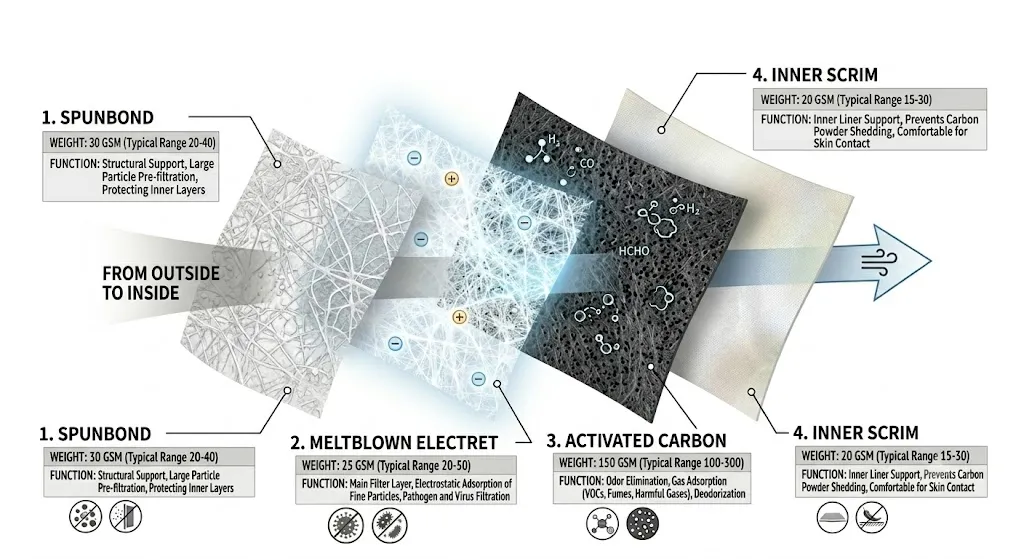
Standard ISO 5011 reports document output. They don’t specify the media construction that produced it. This gap is where OEM-to-aftermarket performance differences originate.
Cellulose-synthetic blend media remains the cost baseline for standard on-road applications—typically 80–85% cellulose fiber with 15–20% synthetic reinforcement. Adequate for temperate on-road duty cycles. Moisture uptake is the limiting factor in high-humidity deployments.
Fully synthetic media provides a higher efficiency floor, lower moisture sensitivity, and thermal stability above 120°C. The preferred choice for forced-induction applications where inlet temperatures spike under boost conditions.
Electrostatically charged media adds electrostatic fiber attraction to mechanical filtration—capturing sub-micron particles without the proportional pressure drop increase that tighter mechanical media would require. The documented limitation: charge decay under elevated humidity. ISO 16890 requires 24-hour pre-conditioning at 70% relative humidity before testing electret media. Post-conditioning efficiency values are the ones that predict field performance in humid climates. Initial efficiency numbers look better and mean less.
Для cabin air filters, activated carbon layers handle gaseous contaminant adsorption. ISO 11155-2 uses toluene as a model compound for capacity testing. Toluene performance doesn’t translate directly to mixed urban pollutant profiles involving NO₂, ozone, or mixed VOC compositions. When specifying carbon layers, request: carbon source, BET surface area, and iodine number. These predict real-world gaseous adsorption more reliably than the standard test alone.
HIFINE’s multi-layer air conditioning filters combine electrostatic adsorption synthetic filter media with an activated carbon layer conforming to ISO 11155-1 and -2 standards. View air conditioning filter specifications →
Pleat Geometry: The Optimization Space Inside the Housing Envelope
OEM housing dimensions constrain element geometry. Within those constraints, pleat optimization is the main engineering tool.
Pleat pitch controls the tradeoff between surface area and bridging risk. As dust loads accumulate, the cake can span adjacent pleats, blocking flow area prematurely. Tighter pitch increases media area per element but lowers the dust load threshold where bridging begins.
Pleat height determines media area per circumferential unit. Constrained directly by housing depth. Increasing height is the preferred route to more media area when pitch is already optimized.
End cap sealing is where bypass leakage originates. ISO 5011 requires ≤0.1% bypass at rated airflow. Polyurethane foam bonding has replaced plastisol as the industry standard for end cap-to-media joints, providing dimensional stability across -40°C to +120°C thermal cycles. At either extreme of that range, plastisol bonds show measurable shrinkage or cracking that creates bypass pathways the lab test catches but intermittent field testing misses.
What to Request from Your Filter Supplier
Standard qualification packages cover the test outputs. These additional items close the gaps:
- ISO 5011 full test report — efficiency, initial restriction, terminal restriction, DHC at rated airflow
- ISO 11155-1 and -2 — particle efficiency at 0.4, 1.0, and 4.0 μm; toluene adsorption capacity
- Bypass leakage certification — ≤0.1% per ISO 5011, with end cap bond specification documented
- Post-conditioning efficiency for electrostatic media — 70% RH / 24 hr per ISO 16890 protocol
- Field correlation data — supplier DHC lab-to-field ratio for target operating geographies
- RoHS / REACH compliance documentation — required for EU supply chain and increasingly for domestic EV OEM programs
HIFINE provides third-party ISO testing documentation for all automotive filters. Contact us to request the specifications.
Standards Define the Floor
ISO 5011, SAE J726, ISO 11155, and SAE J1691 share a single purpose: to give OEMs and suppliers a common test language. They define minimum acceptable performance under controlled lab conditions—not the operational envelope your filter will face in a dusty climate at altitude, with a cold-start cycle and an inlet system that runs hotter than the design point.
The performance that keeps warranty claims off the table lives above the specification number. That margin is built in at the media, pleat, and geometry level—by engineers who treat the standard as the starting constraint, not the target.