

Most property management companies run every unit on the same filter schedule, usually “every three months,” lifted straight from a homeowner’s manual. That number was never built for a portfolio. It was built for one house, one family, one climate, and one HVAC system running a predictable number of hours a year. Apply it across 50 or 500 doors with different tenants, different turnover, and different runtimes, and the same 90-day rule quietly overspends on some units while under-protecting others. Here’s a way to calculate a schedule that reflects what’s actually happening inside each unit, instead of copying a number off a bag.
Why a Single Replacement Schedule Fails a Portfolio
Сайт EPA’s guidance on HVAC filters lands on a 60- to 90-day range for standard filters under average household conditions. “Average” is the operative word. A portfolio is rarely average across every door. A unit with a smoker, two dogs, and a toddler loads a filter far faster than an empty-nester’s unit down the hall, running the identical system for the identical hours. The U.S. Department of Energy has also found that a clogged filter can raise energy costs by 5 to 15 percent, before you count a strained blower motor or an emergency HVAC call during a heat wave. Multiply either number across a 100-unit property, and a flat, guessed schedule stops being cautious. It becomes an unbudgeted line item.
The Three Numbers That Actually Drive Filter Load
Three variables explain most of the difference in how fast a filter loads inside a rental unit, and property managers already have two of them sitting in their own PM software.
Turnover Rate
National multifamily turnover runs close to 46 to 50 percent annually, meaning nearly half a typical portfolio’s units change hands in a given year, according to industry benchmark surveys. Move-outs and move-ins are dusty events. Drywall patching, carpet swaps, painting, and cleaning crews all put fine particulate into the air right as the HVAC system runs to condition the unit for showings. A unit that turned over twice this year has effectively lived through two mini-renovations. Its filter has earned a shorter interval than the one next door with a five-year tenant.
HVAC Runtime Hours
Climate and season decide how many hours a system actually runs. Runtime, not calendar time, is what loads a filter. A unit running cooling nine months a year pushes far more air, and far more particulate, through its filter than an equivalent unit in a mild coastal climate. If a portfolio spans climate zones, one national schedule is mathematically guaranteed to be wrong for part of it.
MERV Rating and Media Depth
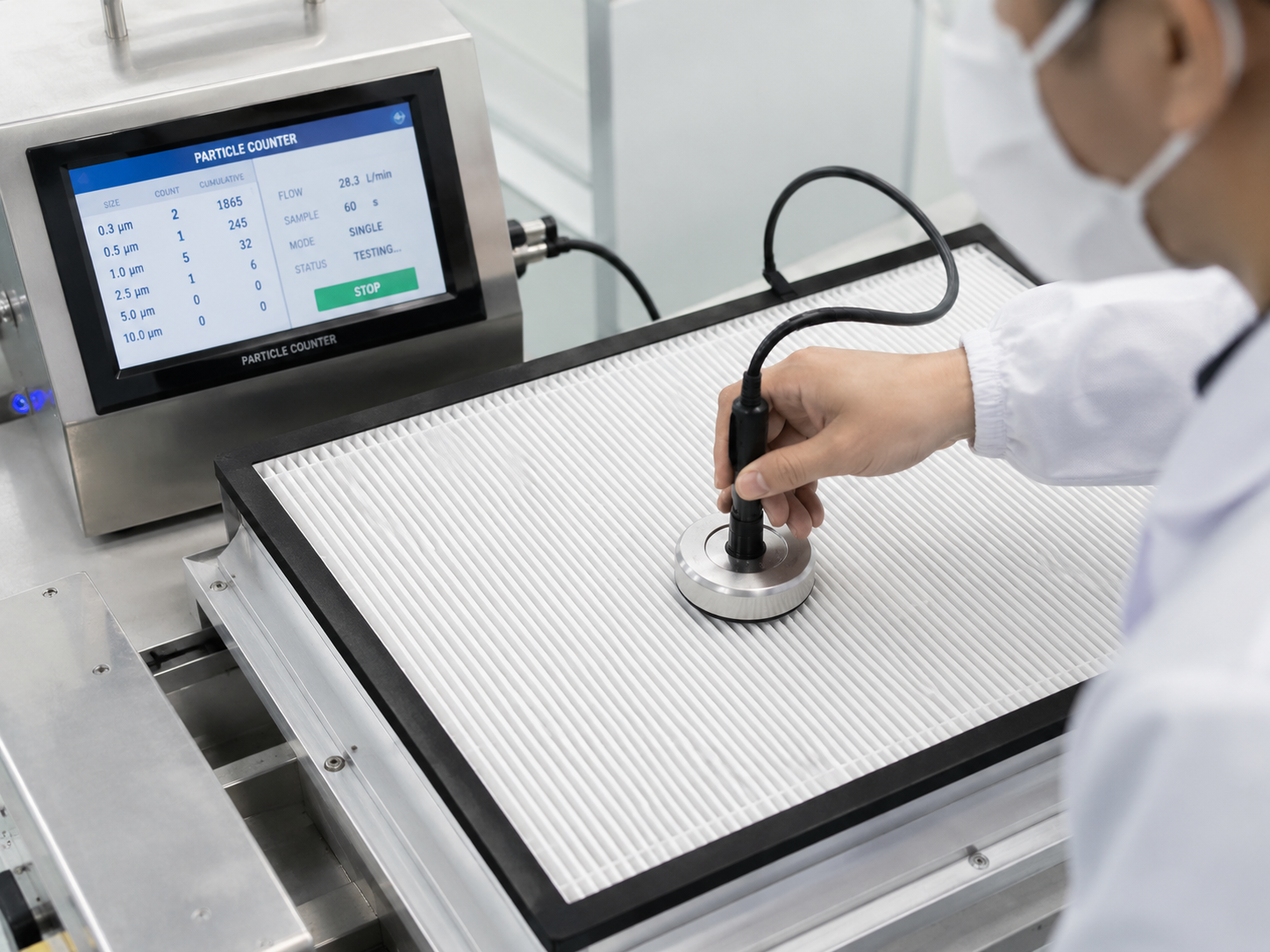
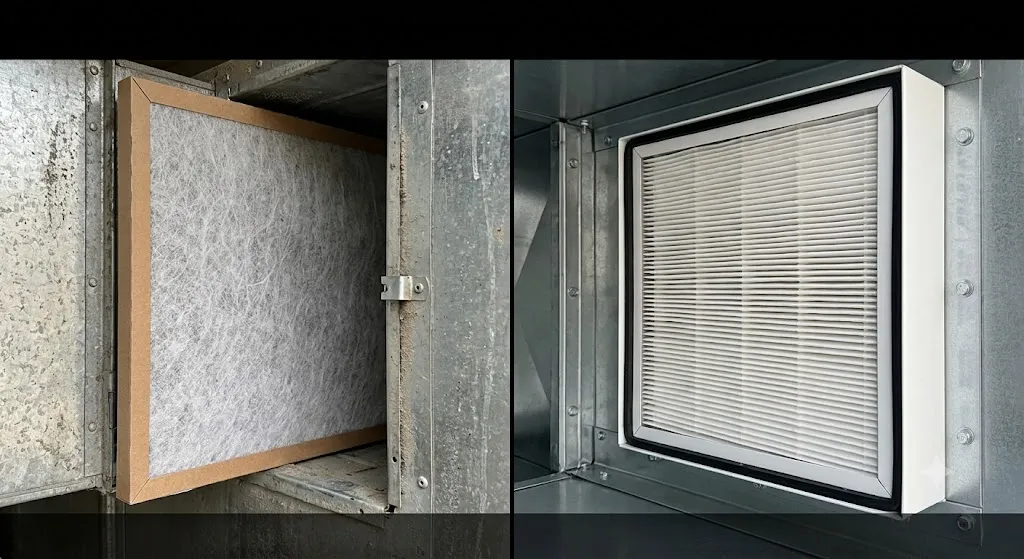
A higher MERV rating captures finer particles, which also means it loads faster under identical conditions. That’s why EPA wildfire guidance pairs a MERV 13 upgrade with more frequent replacement instead of a longer interval; the two go together. Thin 1-inch fiberglass panels typically last 30 to 45 days under normal use. Deeper pleated media stretches that to 60–90 days. True H13-grade HEPA filtration, paired with adequate pre-filtration, can run 6 to 12 months in the right application.
The Portfolio Filter Interval Formula
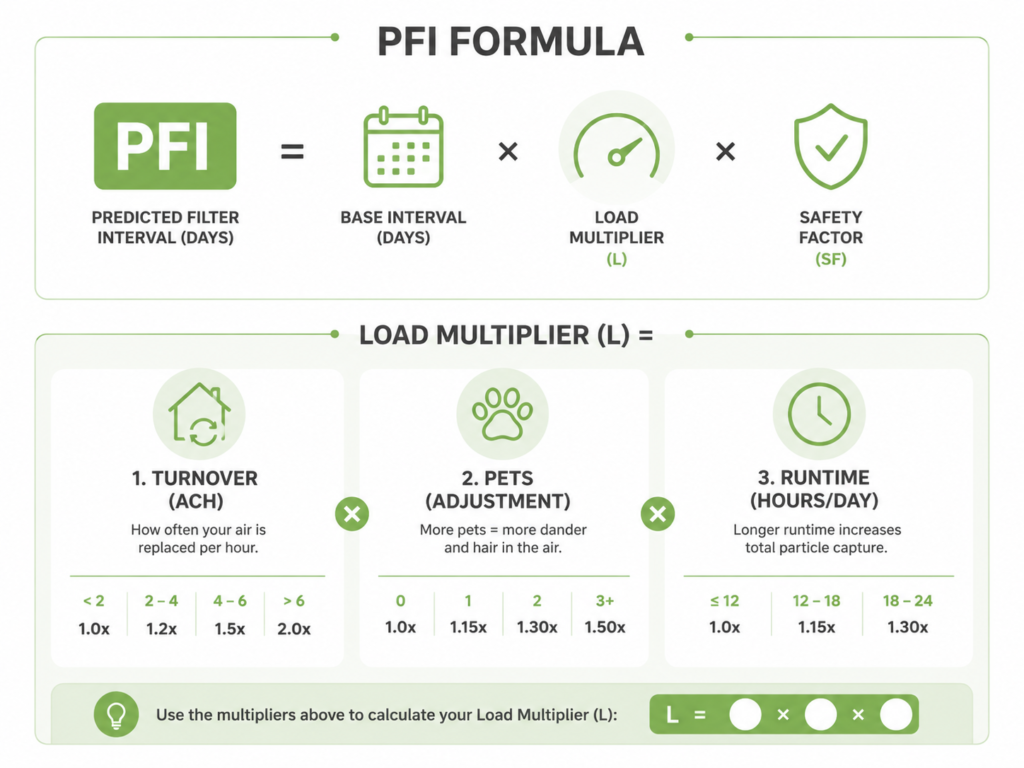
Turn those three variables into an actual number:
PFI (days) = Base Interval ÷ Load Multiplier
Base Interval comes from the filter’s media type:
| Filter Media | Base Interval |
|---|---|
| Fiberglass panel | 30–45 days |
| Standard pleated (MERV 8–11) | 60–90 days |
| High-MERV pleated (MERV 13) | 60–75 days |
| H13 HEPA + pre-filter | 180–365 days |
Load Multiplier starts at 1.0 and adds a fraction for each condition that applies to a given group of units:
- +0.3 if the unit’s annual turnover exceeds the portfolio average
- +0.2 if pets are on the lease
- +0.2 if the unit sits in a high-runtime climate zone
A unit hitting all three sits at a 1.5 multiplier. A quiet, long-term, mild-climate unit stays at 1.0.
A Worked Example: Sizing Cycles for a 120-Unit Portfolio
Instead of calculating per door, group units into tiers and run the formula once per tier.
| Tier | Profile | Base Interval | Multiplier | Calculated PFI | Rounded Cycle |
|---|---|---|---|---|---|
| A | High turnover, pets, standard MERV 8 | 75 days | 1.5 | 50 days | 45 days |
| B | Average turnover, no pets, MERV 8–11 | 75 days | 1.0 | 75 days | 75 days |
| C | Long-term tenants, mild climate, H13 HEPA + pre-filter | 270 days | 1.0 | 270 days | 9 months |
Three tiers, not 120 individual guesses. Tier A units carry the heaviest load: high turnover, pet dander, constant particulate churn. For that group, a cost-efficient H11 HEPA filter built for frequent replacement is often a better economic fit than a premium filter that gets thrown away half-used.
Turning the Math Into a Maintenance Calendar
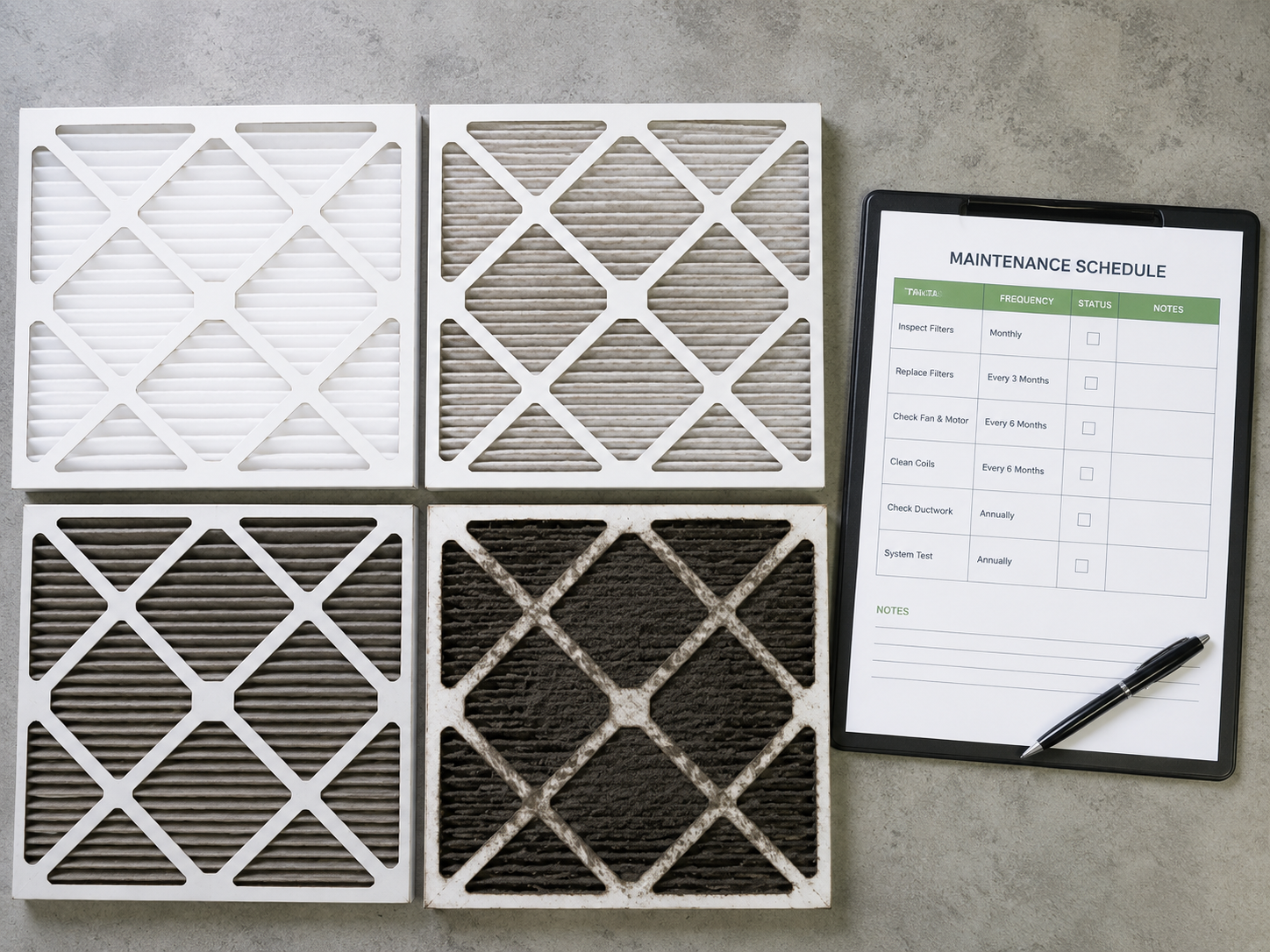
Don’t schedule by door. Schedule by tier. Grouping units this way turns an unmanageable 120-line spreadsheet into three purchase orders and three technician routes. It also makes procurement predictable. Instead of ordering reactively when a unit “runs out,” a portfolio manager can commit to standing orders sized to each tier’s cycle. That’s where bulk and OEM sourcing starts saving real money per door compared to retail, one-off replacements, including multi-stage pre-filter and final-filter components built to extend a primary filter’s service life.
When Portfolio Scale Justifies Upgrading to HEPA-Grade Filtration
The math above assumes every tier stays on its current filter type. But scale changes the cost-benefit of upgrading media, not just the schedule. A property running 45-day cycles on Tier A units is paying for eight maintenance visits a year in labor and truck time alone, separate from filter cost. Moving that tier to H13 HEPA with proper pre-filtration can stretch the interval past six months, which typically pays back the higher per-unit filter cost within a year once labor is counted. It isn’t the right move for every tier. A low-turnover, mild-climate building may already be running an efficient cycle on standard pleated media. But it’s worth running the numbers on any tier being replaced more than four times a year.
Run this formula against your own portfolio data next quarter, not next year. Turnover rate and lease terms are already in your PM software; the rest is a filter spec sheet. Portfolios large enough for tiered ordering to matter can source OEM and private-label filtration built to each tier’s exact spec, rather than mixing retail SKUs across a maintenance calendar.