
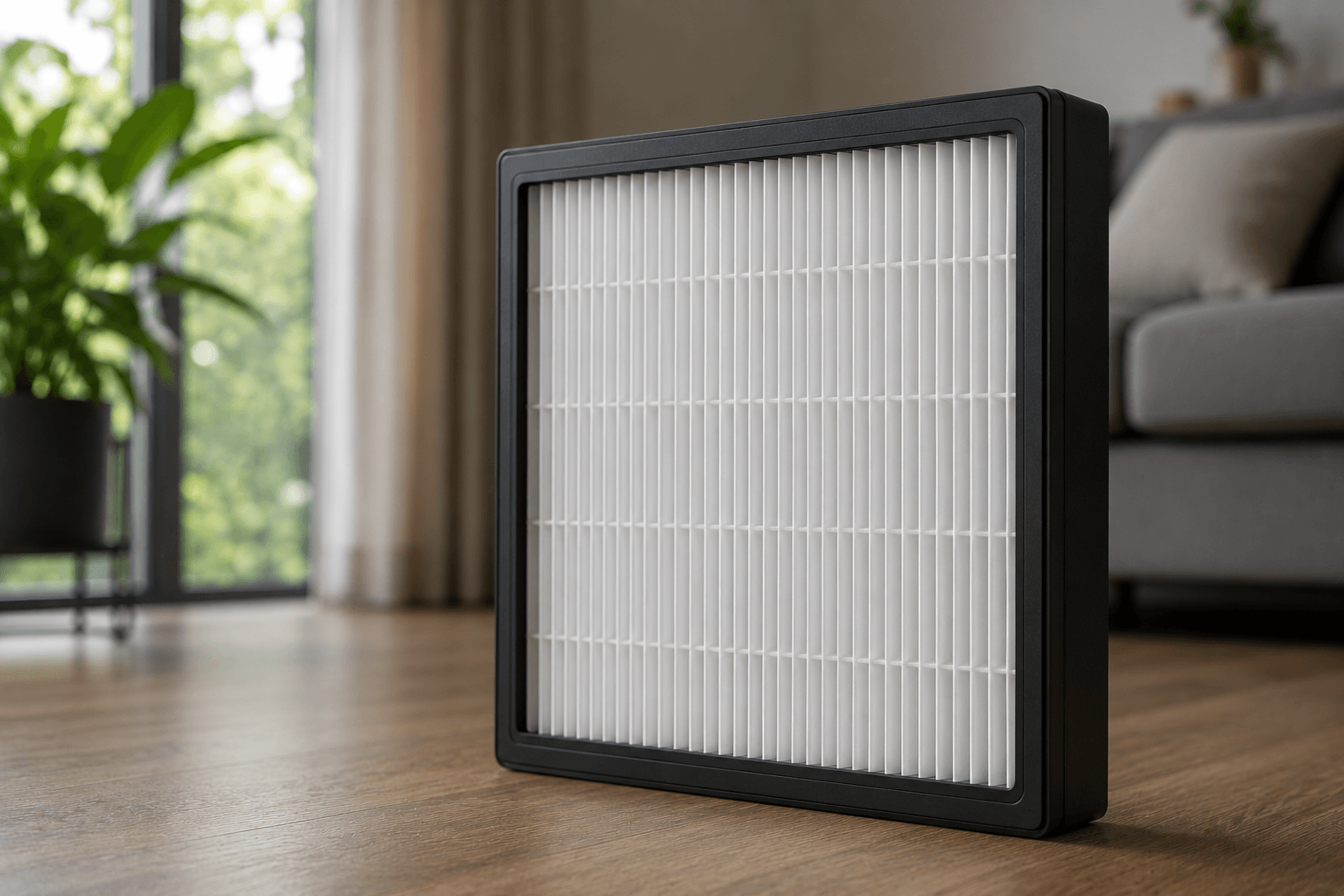
If you’re sourcing replacement or private-label filters for Dyson, Bosch, or Gtech vacuums, the model name on a listing isn’t enough to build a purchase order against. You need the OEM part number, the exact housing size, the mounting type, and, equally importantly, the filtration rating that the part has actually been tested for, not just what’s printed on the box.
That last point trips up more sourcing teams than it should. Most “HEPA” replacement filters for these three brands aren’t HEPA at all under the current version of the standard that matters most to EU buyers. That’s not a manufacturing defect — it’s a labeling gap that rarely gets caught until a customer or a customs auditor asks for the test report.
Below is a compatibility table built from verified OEM and authorized-distributor specs for Dyson, Bosch, and Gtech vacuum filters, followed by the standards background you need to specify a grade a factory can actually test against.
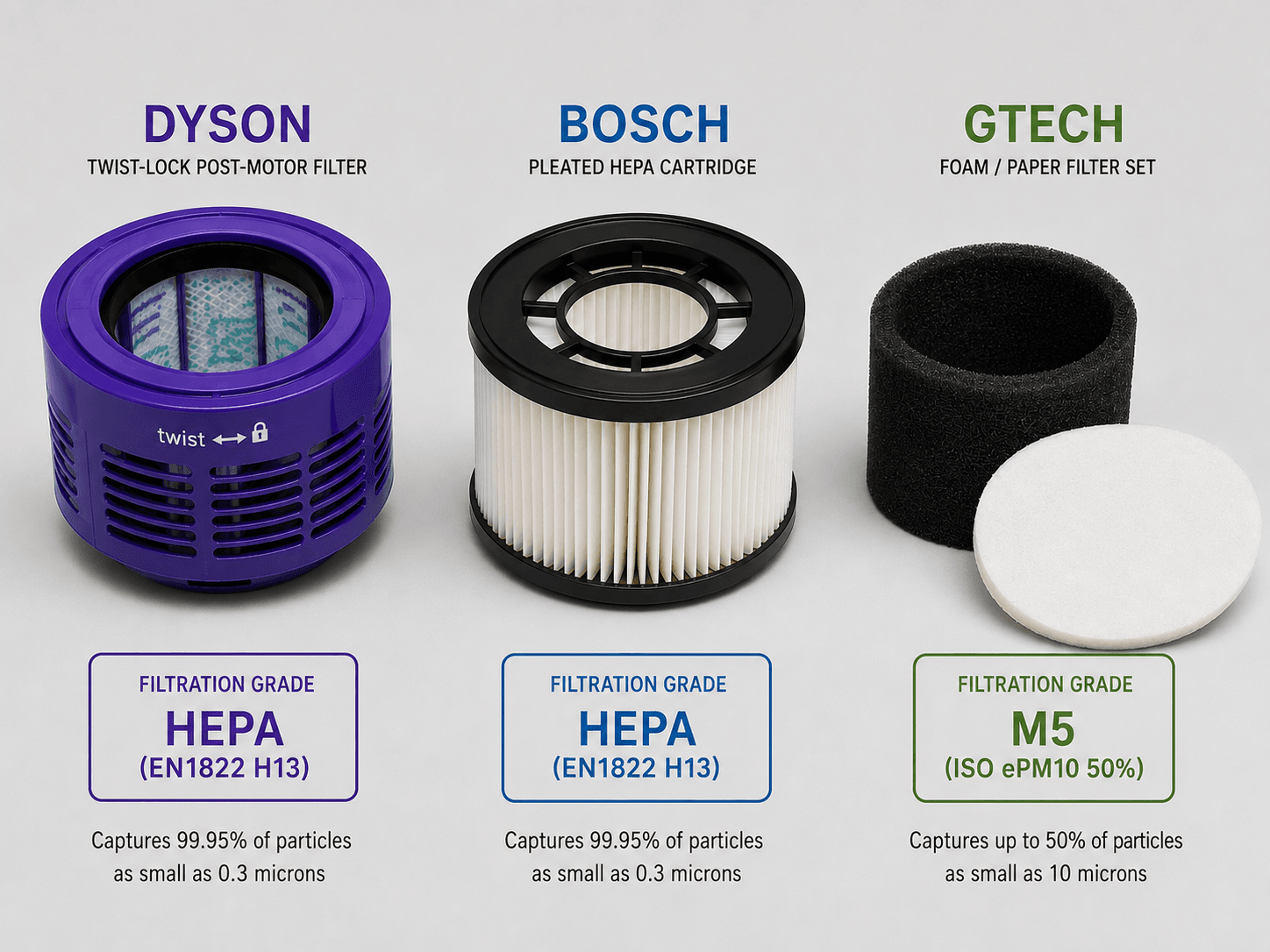
Dyson, Bosch, and Gtech Filter Specs
The specs below are verified against manufacturer listings and authorized-distributor documentation. The dimensions of the sub-models may vary by one to two millimeters between production batches; therefore, please consider these dimensions as preliminary reference values rather than final tolerances. Be sure to verify them against physical samples before beginning production.
Dyson
| Model line | OEM part no. | Position / mount | Media | Filtration claim | Моющийся | Service interval |
|---|---|---|---|---|---|---|
| V11 | 970013-02 | Post-motor, twist-lock | Pleated synthetic | Dyson lists this as a general replacement filter, not HEPA-certified on its own listing | Yes, monthly rinse | 3–6 месяцев |
| V15 Detect / V15s Detect / Submarine | 970013-03 | Post-motor, twist-lock | Pleated synthetic | Dyson’s own spec: captures 99.99% of particles down to 0.1 microns | Yes, monthly rinse | 3–6 месяцев |
Worth flagging: Dyson’s own parts catalog lists 970013-02 as a “replacement filter,” not a HEPA filter — the HEPA claim only shows up on the 970013-03 listing for V15 Detect. Aftermarket sellers routinely market both part numbers as “HEPA” interchangeably. If your buyer needs a certified HEPA claim, 970013-03’s spec is the one to match, not 970013-02’s.
Bosch
| Model line | OEM part no. | Position / mount | Media | Dimensions | Моющийся |
|---|---|---|---|---|---|
| GAS 18V-10 / GAS 18V-10L Professional | 2608000663 | Motor-protection, screw-fit | Pleated media | 125mm diameter × 155mm height, 2,375 cm² surface area | Да |
| GAS 18V-3 wet/dry | VF320H | Post-motor, twist-lock | Pleated media, approx. 6″ × 5″ | — | Да |
| VAC090A / VAC140A dust extractors | VF130H | Post-motor | Pleated media, low-stick surface | — | No — dry use only |
The 2608000663’s 2,375 cm² surface area figure comes directly from Bosch’s own distributor spec sheets — this is one of the few listings in this category where Bosch publishes exact dimensional data, which makes it a good reference point for tooling a mold.
Gtech
| Model line | Aftermarket part refs | Position | Media | Dimensions | Моющийся |
|---|---|---|---|---|---|
| AirRam AR01 / AR02 / AR03 / AR05 / DM001 | FLT9358 / 27-GT-02 / FIL569 | Pre-motor foam + post-motor pad | Foam pre-filter + padded filter element | Approx. 105mm × 90mm | Yes, hand rinse |
Gtech doesn’t publish its own OEM part number the way Dyson and Bosch do — the AirRam filter market runs almost entirely on cross-referenced aftermarket codes. That makes housing-dimension confirmation even more important for this line, since there’s no single manufacturer spec sheet to check against.
You’ll notice the “filtration claim” column above doesn’t always say HEPA — and when it does, it doesn’t always mean the same thing. That’s worth unpacking before you write a PO around any of these part numbers.
Why “HEPA” Doesn’t Mean One Thing
Two different standards define “HEPA,” and they don’t agree with each other.
Europe: EN 1822. This standard grades filters from H10 to H14 based on how much they capture at the Most Penetrating Particle Size, roughly 0.3 microns. H10 catches 85%, H11 catches 95%, H12 catches 99.5%. When EN 1822 was last revised, only H13 and H14 kept the HEPA designation. H10 through H12 were reclassified as EPA — a separate, lower tier. A filter tested at H11 is, under the current European classification, an EPA filter, not a HEPA filter, no matter what the box says.
United States: DOE-STD-3020-2015. The Department of Energy defines “HEPA” as a single cutoff: at least 99.97% capture at 0.3 microns. There are no letter grades. A filter can hit that number without ever being run through EN 1822, and a filter can pass EN 1822 at H12 without meeting the DOE threshold.
The practical problem: these are two different tests with two different pass bars. A media that clears the US bar can still fail the EU one. If you’re shipping the same SKU into both markets, you need to know which standard your factory actually tested against — not just the word on the spec sheet.
No Brand Here Publishes an EN 1822 Certificate
None of the three brands above publish an EN 1822 test certificate for their standard vacuum filters — that’s true across the vacuum category, not a gap specific to these three. “HEPA” on a consumer listing is marketing shorthand, not a certified class. That’s fine for a retail shelf. It’s a liability for a PO.
If your buyer is in the EU, where EN 1822 is the enforced reference standard, an audit or customs check can flag a “HEPA” claim that was never tested to H13 or above. The fix isn’t complicated — it’s specifying the grade instead of the word:
- Weak: “HEPA filter for Dyson V11”
- Workable: “Post-motor filter, pleated synthetic media, ≥99.5% at 0.3 microns, twist-lock mount, per Dyson 970013-02 housing dimensions”
The second version gives a factory a number to test against and gives your compliance team a paper trail if a customer or auditor asks for it later.
A Checklist with Four Key Points Before You Start a Production Run
- Get the OEM part number the tooling is cross-referenced against — not just the vacuum model name. “Fits Dyson V15” covers three different housing revisions; 970013-03 covers one.
- Confirm filter position and housing dimensions against a physical sample. A filter 2mm off in diameter won’t seat, regardless of filtration grade.
- Ask which standard the filtration grade was tested to — EN 1822 or DOE-STD-3020 — and whether it’s self-declared or third-party tested. These are not interchangeable numbers.
- Order a pre-production sample before a full run, even for a design your supplier has made before. Media lots and tooling drift over time.
How HIFINE Deals With This
HIFINE manufactures OEM and private-label filters cross-referenced to the specs above, including the foam and padded filter sets for Gtech AirRam AR01, AR02, and DM001 housings. We work from housing dimensions and filtration-grade documentation, not from the word “HEPA” on a listing — because that’s what a customs inspector or a QA audit will actually check.
The difference between the stated and real test levels discussed in this article is found not just in upright and cordless vacuum cleaner filters, but also in filters for robotic vacuum cleaners, воздухоочистители, HVAC systems, and dust bags.. If you’re sourcing across multiple filter categories for one catalog, the same four-point checklist applies to all of them.
Sourcing a private-label or OEM filter line and want the spec sheet matched to a real test standard before you commit to tooling? Get in touch with our engineering team for a compatibility review and pre-production sample quote.