

Open almost any filter quote and you’ll see three letters sitting right next to the price: EXW, FOB, CIF, or DDP. Buyers usually ask about MOQ, ask about lead time, and skip straight past these letters. This is a mistake. Without this information, a quote doesn’t actually tell you what you’re paying for, nor does it tell you when the shipment will become your problem rather than the supplier’s.
If you buy air purifier filters, robot vacuum filters, dust bags, or vacuum cleaner filters from overseas, those three letters decide who pays for trucking, insurance, and customs, and exactly when the risk of a damaged or lost shipment shifts from the seller to you.
What are trade terms?
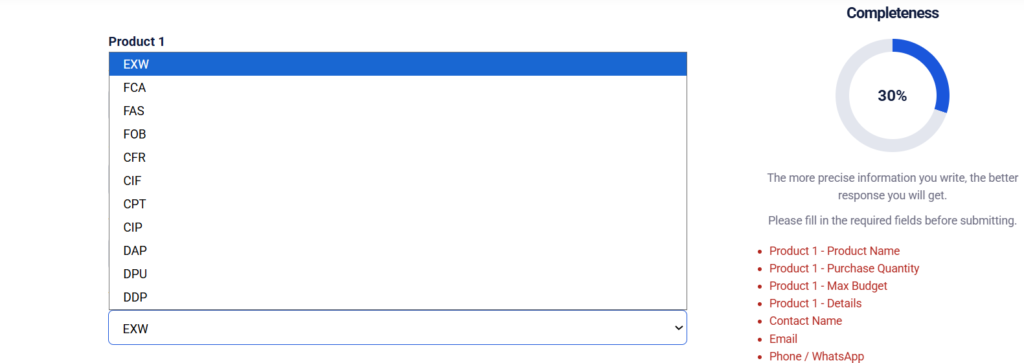
Trade terms, often referred to as Incoterms, are a set of standard three-letter codes used to identify the responsible parties for transportation, insurance, customs, and risk management at each stage of international trade transactions.. The rules are written and maintained by the International Chamber of Commerce, first published in 1936 and updated roughly every ten years; the current version, Incoterms 2020, has been in effect since January 1, 2020, and defines eleven separate rules. The U.S. International Trade Administration also publishes a plain-language explainer for exporters, which is a useful second reference if you want to cross-check a supplier’s terms.
Here’s the part that trips people up: trade terms are not about who legally owns the goods. They’re about who pays for each leg of the journey, and at what exact point the risk switches from seller to buyer. A filter that gets crushed in a warehouse forklift accident is either the seller’s problem or yours, depending entirely on which three letters are printed on the contract.
The Trade Terms You Will Really Encounter on a Filter Quote
Most filter suppliers only quote a handful of the eleven official terms. Here are the ones that show up again and again.
EXW
The supplier makes the filters available at their factory door and that’s it. You arrange and pay for everything else: loading the truck, export paperwork, ocean freight, insurance, import duty, the last-mile delivery. EXW quotes look cheapest on paper because almost nothing is included. It can work well if you already have a freight forwarder and want full control over routing, but first-time importers often underestimate the total.
FOB
The supplier handles trucking to the port, export clearance, and loading onto the vessel. Once the filters are on board, the risk and remaining costs pass to you. FOB is the most common term in filter sourcing because it splits the work sensibly: the factory, which already knows the local port system, handles the domestic side, while you or your forwarder handle international freight, which you can often shop around for a better rate.
CIF
The supplier pays for freight to your destination port and buys minimum insurance on your behalf, but risk still transfers once the goods are loaded onto the ship — not when they arrive. That distinction matters: if the container is damaged mid-voyage, you file the insurance claim, not the seller. CIF is popular with buyers who don’t yet have freight relationships of their own.
DDP
The supplier handles everything, including import duty and delivery to your warehouse. DDP is the most convenient term for a buyer placing a first order or a small trial shipment, but suppliers typically build a margin into the freight and duty estimate, so it rarely ends up being the cheapest option on repeat, high-volume purchases.
The other seven Incoterms 2020 rules — FCA, FAS, CFR, CPT, CIP, DAP, and DPU — cover more specific shipping scenarios, such as air freight, multimodal transport, or delivery before unloading. Most filter buyers won’t need them unless a freight forwarder recommends a specific one for a specific route.
Why This Matters More for Filters Than for Most Products
Filters are a strange category to ship. A carton of HEPA filters or vacuum dust bags is bulky relative to its value — you’re often paying to move air and cardboard, not just material. That makes the freight portion of the total cost unusually large compared to, say, electronics of the same weight.
It also means filters are a recurring purchase. A one-time equipment order can absorb a shipping mistake; a filter program that reorders every quarter cannot. Choosing the wrong trade term on a recurring SKU compounds the cost every single cycle, which is why experienced buyers spend as much time negotiating the term as they do the unit price.
A simplified example: a buyer orders two 20-foot containers of активированный уголь pre-filters. Under EXW, they’re quoted a low per-unit price but later discover trucking, port fees, and customs brokerage add roughly 18% to the landed cost. While the per unit price is a little higher with FOB, the ocean freight is negotiated directly with a forwarder at a better rate than the supplier would have marked it up to. The FOB total ends up lower, even though the initial quote looked higher. This kind of gap is common enough that it’s worth running the math on both terms before committing.
Matching the Term to the Order
There’s no single “best” trade term — the right choice depends on your shipment size and experience level.
- First order or small trial batch: DDP removes the guesswork while you evaluate a new supplier’s product quality.
- Regular, container-load orders: FOB usually gives the best balance of cost control and manageable paperwork, especially once you have a freight forwarder you trust.
- High-volume buyers with in-house logistics teams: EXW offers the most control and often the lowest total cost, but only if you have the infrastructure to manage it.
Before confirming any term, ask your supplier three questions: which port or factory location applies to the quote, whether insurance is included and to what value, and who is named as the responsible party for customs clearance on each end. A supplier who can answer all three without hesitation is usually one who ships internationally often enough to know exactly where the handoff points are.
At HIFINE, every quote for our air purifier filters, robot vacuum filters, dust bags, and vacuum cleaner filters follows the Incoterms 2020 framework, and we confirm the exact term in writing before you place an order — no fine print, no surprise charges at the port. If you want a cost breakdown by trade term for your next order, request a wholesale price and we’ll walk you through what changes under EXW, FOB, or DDP for your shipment size.