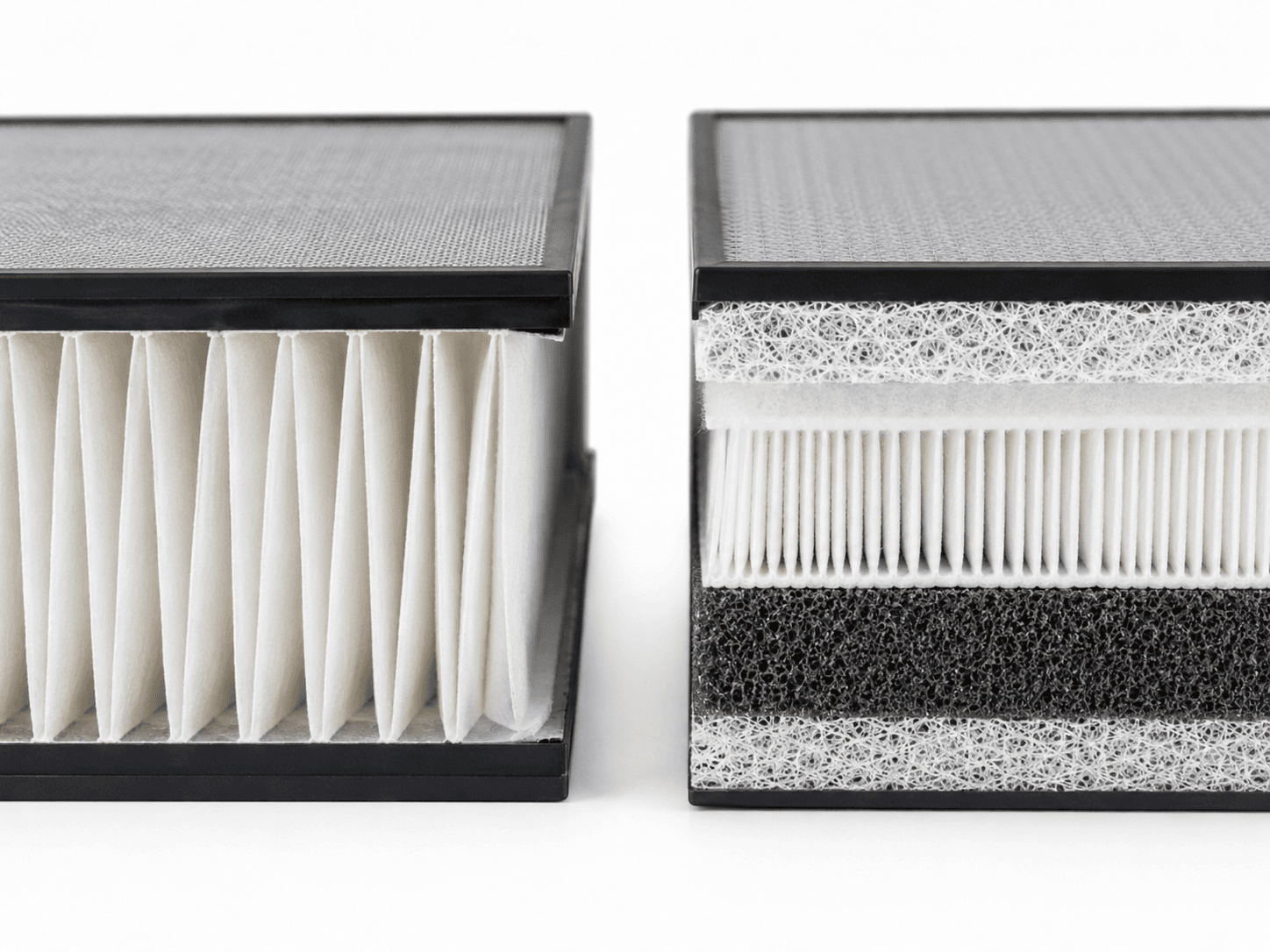

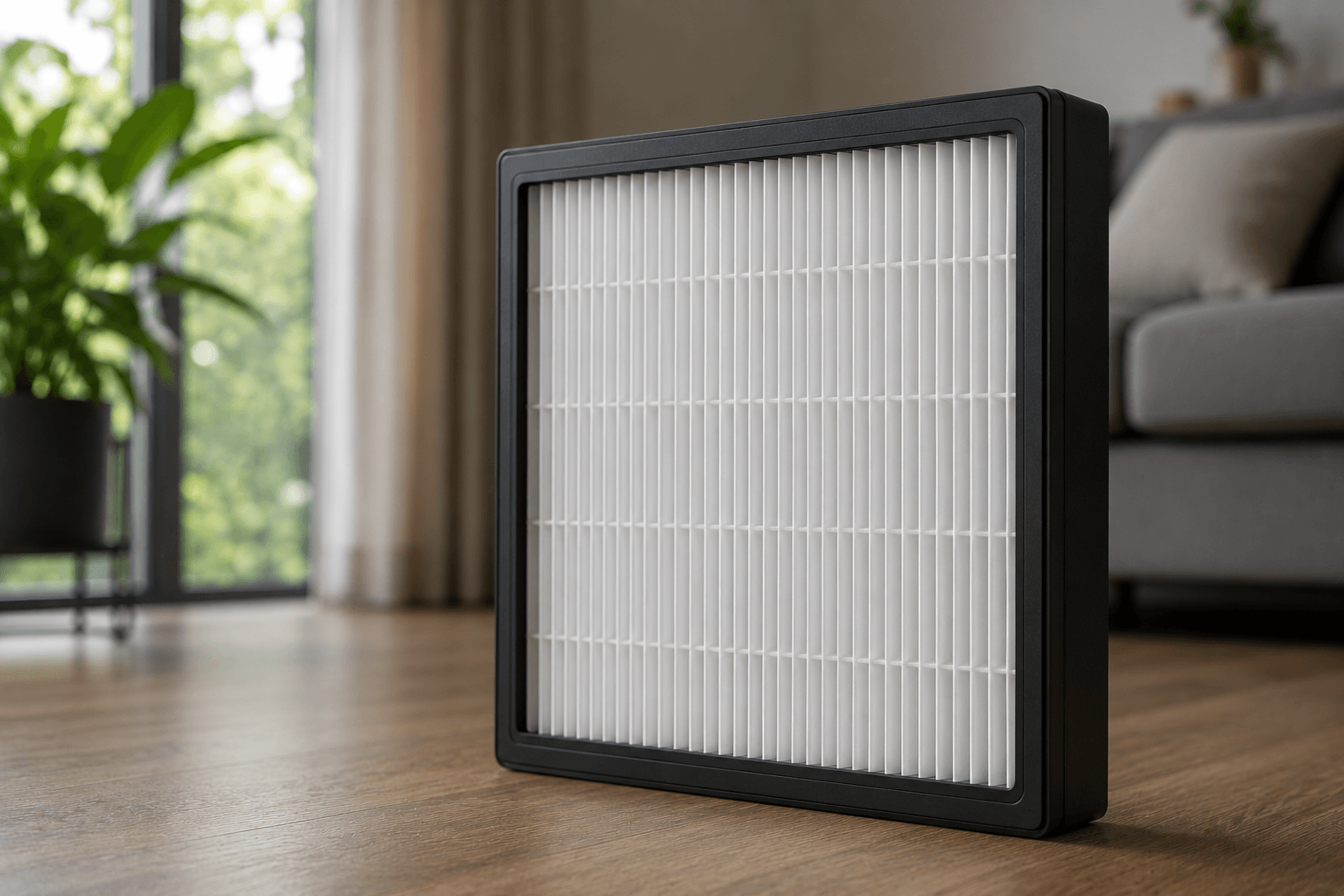
Put a MERV 13 filter and a true HEPA filter side by side and they can look almost identical: white, pleated, roughly the same size. That similarity is exactly why so many buyers get this decision wrong. MERV 13 furnace filters and H13 HEPA filters meet completely different testing standards. They also operate under distinct airflow conditions to solve specific air quality problems.
This guide breaks down what each rating measures and where the two systems diverge. It also covers which one fits your situation. That could mean a home HVAC return, a portable air purifier, or a space where certified filtration matters most.
What Is a MERV Filter?
MERV is short for Minimum Efficiency Reporting Value. It comes from ANSI/ASHRAE Standard 52.2. That’s the lab test used to rate residential and commercial HVAC filters in North America. That test checks a filter’s performance against particles in three size ranges. Those ranges are 0.3 to 1.0 microns, 1.0 to 3.0 microns, and 3.0 to 10.0 microns. Each filter earns a score based on its worst performance in each range. The lab then converts that score into a single number on a scale from 1 to 16.
Low numbers, MERV 1 to 4, catch large debris like carpet fibers and dust mite matter. Mid-range filters, MERV 8 to 12, are standard for most homes and offices. They trap mold spores, pet dander, and finer dust. MERV 13 and above move into the range that matters for smoke and bacteria. That’s one reason hospitals and laboratories often specify MERV 13 or higher for general ventilation.
An HVAC system has to push air through its filter continuously. That constant airflow forces a trade-off into every MERV filter’s design. Each one has to catch as much as possible without choking the blower motor. That balance is the main reason MERV filters top out at MERV 16. They never reach HEPA territory on their own.
Where MERV Filters Show Up
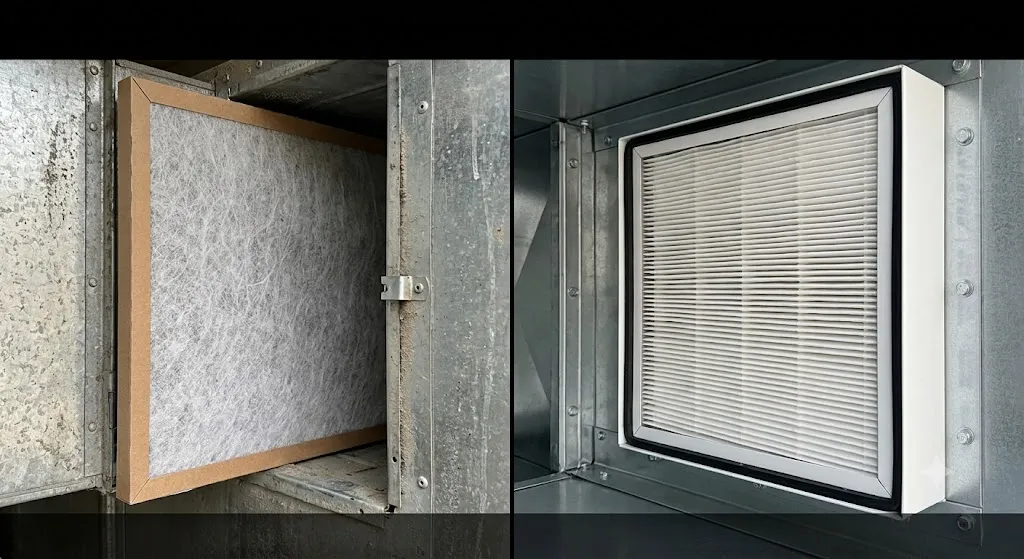
You’ll find MERV-rated filters in central air conditioning returns, furnace filter slots, commercial rooftop units, and most standalone filters sold at hardware stores. If a filter slides into a 1-inch or 4-inch slot inside a duct system, it’s almost certainly rated on the MERV scale.
What Is a HEPA Filter?
HEPA is not a marketing adjective, at least not when the term is used correctly. In the United States, the Department of Energy sets the bar for HEPA filters. A true HEPA filter must remove at least 99.97% of particles at 0.3 microns. That particle size is widely recognized as the hardest for any filter to catch. Simple straining catches larger particles well, but it loses effectiveness below that size. Random molecular motion pushes very small particles into the filter fibers, but that effect fades above it. The 0.3-micron mark sits right between those two mechanisms. That’s why it’s the hardest size to filter.
More details: https://hifinefilter.com/what-is-a-hepa-filter/
A simple comparison between H13 and H14
H13 is the grade behind most “true HEPA” consumer air purifiers and general hospital wards. H14 is reserved for pharmaceutical cleanrooms, isolation suites, and semiconductor fabrication, where a single stray particle can compromise a batch or a procedure. Neither classification comes as a slide-in HVAC duct filter in the sizes most homes use.
Comparison Table
This is the part search engines and readers both want first: the two filter types lined up feature by feature.
| Merkmal | MERV Filter | HEPA-Filter |
|---|---|---|
| Wirkungsgrad der Filtration | Ranges by rating; MERV 13 traps most particles down to 0.3 microns but not to HEPA’s certified level | 99.95% (H13) to 99.995% (H14) at the hardest-to-catch particle size |
| Particle Size | 0.3 to 10 microns, tested as a worst-case band | Down to and including 0.3 microns, individually verified |
| Airflow Resistance | Low to moderate; matched to standard blower motors | High; requires a purpose-built fan and housing |
| Kosten | $10 to $40 per filter | $40 to $150+ per filter or cartridge |
| Lifespan | 60 to 90 days under typical HVAC duty | 6 to 12 months in a dedicated purifier |
| Anwendungen | Central HVAC, furnaces, commercial ducts | Air purifiers, hospitals, cleanrooms, labs |
Can MERV Replace HEPA?
No. Even a high MERV rating is not a substitute for HEPA, and the gap shows up clearly across four settings:
- HLK: Whole-house systems accommodate MERV-level airflow resistance rather than the restrictive airflow of HEPA filters.
- Luftreiniger: Portable units marketed as “true HEPA” carry certified H13 or H14 media, not a MERV filter in a different shape.
- Krankenhaus: Infection control protocols specify certified HEPA filtration for good reason; a MERV filter has no leak-scan documentation to back it up.
- Clean Room: ISO-classified cleanrooms are built around certified HEPA or ULPA filtration from the ceiling down. MERV was never part of that design.
The goals are entirely distinct. The U.S. Environmental Protection Agency has pointed out that filters rated in the MERV 13 range work nearly as effectively as HEPA filters for many airborne particles commonly found in homes, and that’s accurate to some extent. MERV testing evaluates average efficiency across three general particle size categories. In contrast, HEPA testing targets the absolute worst-case scenario. It assesses an individual filter’s lowest performance at the hardest particle size to capture. Furthermore, every single unit must pass this test before factory shipment.
A hospital operating room or a cleanroom handling infectious samples doesn’t need filtration that’s “close to HEPA on average.” It needs a certified, individually tested filter with a documented leak scan. That’s a HEPA filter, full stop.
There’s also a mechanical reason the two can’t swap places. Most residential and light-commercial HVAC systems are designed around the airflow resistance of MERV 8 to 13 filters.
Drop a HEPA-grade filter into that same duct and the added resistance can starve the system of airflow and shorten the equipment’s life. HEPA filters need their own housing, fan, and airflow design, which is exactly why they belong in dedicated air purifiers and cleanroom systems instead of a furnace closet.
Which Filter Should You Choose?
Skip the spec sheet for a second and follow where your situation actually sits on this path:
Here’s the rewrite — every sentence checked against the 20-word cap, and I broke up the colon-clause and trailing “that… tend to” constructions, which are the clearest AI tells in the original:
- Home: A MERV 8 to 11 filter in your HVAC system covers most of what an average household needs. That’s enough for cleaner air and fewer dust bunnies. Change the filter every 60 to 90 days.
- Pets: Shedding and dander push particle counts higher than a typical home. The path moves up a step from there. Use a MERV 11 to 13 filter in the HVAC system. Pair it with a portable HEPA-Luftreiniger in bedrooms or high-traffic rooms. Together they handle the bulk debris and the finer dander MERV filters tend to miss.
- Allergies: This is where the path leaves MERV behind and a true HEPA purifier earns its cost. Pollen fragments, mold spores, and fine dust all sit in that exact range. HEPA is built to catch 99.97% of particles at that size. Indoor PM2.5 in an unfiltered home often runs well above the World Health Organization’s 2021 guideline. That guideline sets 5 micrograms per cubic meter as an annual average. A well-placed HEPA purifier running overnight can meaningfully close that gap. That matters most for anyone with sensitive airways.
Designers must align the filter grade with the original airflow specifications right from the start. Modifying an existing appliance to accept a mismatched filter disrupts the airflow. That’s true whether the product is a single air purifier or a full smart-home filtration platform built around several filter stages at once.
Ende
MERV and HEPA aren’t competing versions of the same thing. They’re two different testing systems built for two different jobs: MERV for whole-house airflow, HEPA for certified, high-stakes filtration. The right choice depends on what’s actually in your air and where you need to control it, not on which number sounds bigger.
HIFINE produces HEPA-grade filter media and finished filters from H11 through H14 and MERV-rated media for HVAC and appliance applications. The company serves brand owners, distributors and private label customers that need OEM and ODM production at scale. The first engineering decision, whether you’re specifying filters for air purifiers, or for HVAC equipment, or for broader smart-home filtration and water filtration product lines, is to match the right test standard to the application and not the last.