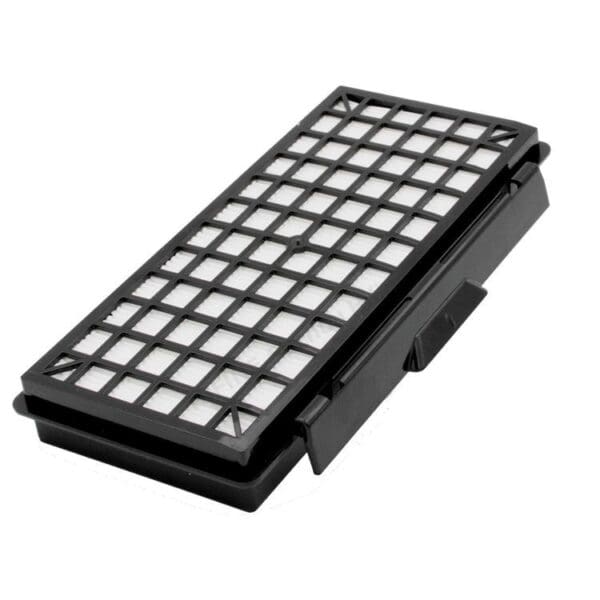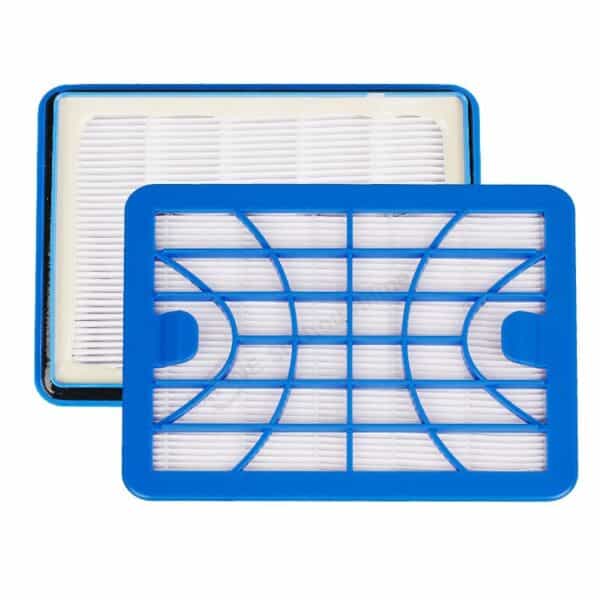

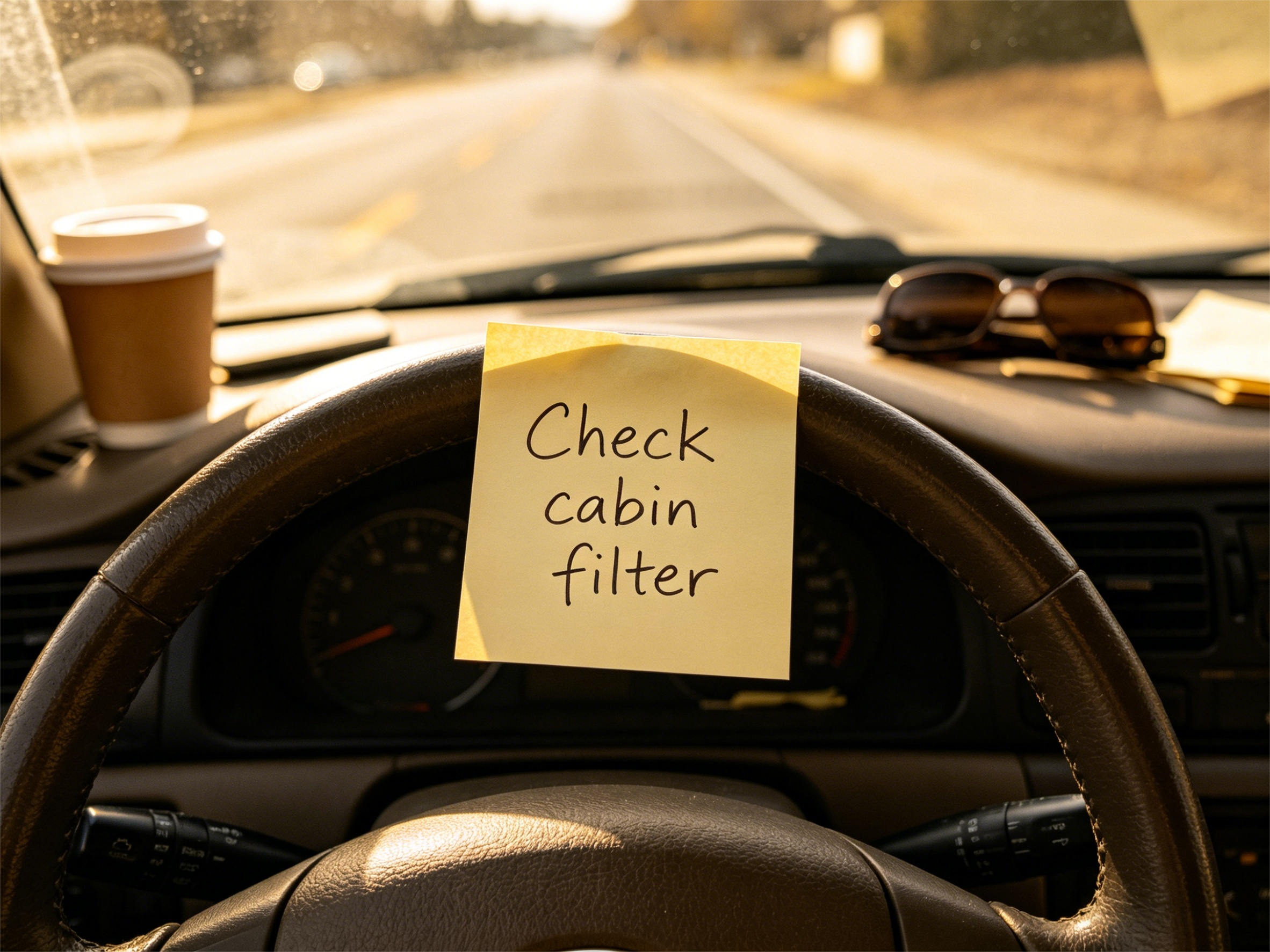
There’s a filter inside almost every car built after 2000. It sits behind your glove box or under your dashboard, and its entire job is to clean the air coming through your vents before it reaches you.
Most drivers have never changed it. Many don’t know it exists.
The average recommended replacement interval is every 12,000–15,000 miles. Industry data suggests the average driver replaces it closer to 45,000 miles — if they replace it at all.
That gap matters more than most people realize. You spend roughly 300 hours a year inside your car. The air quality in that space is not a minor detail.
How a Cabin Air Filter Controls What You Breathe While Driving
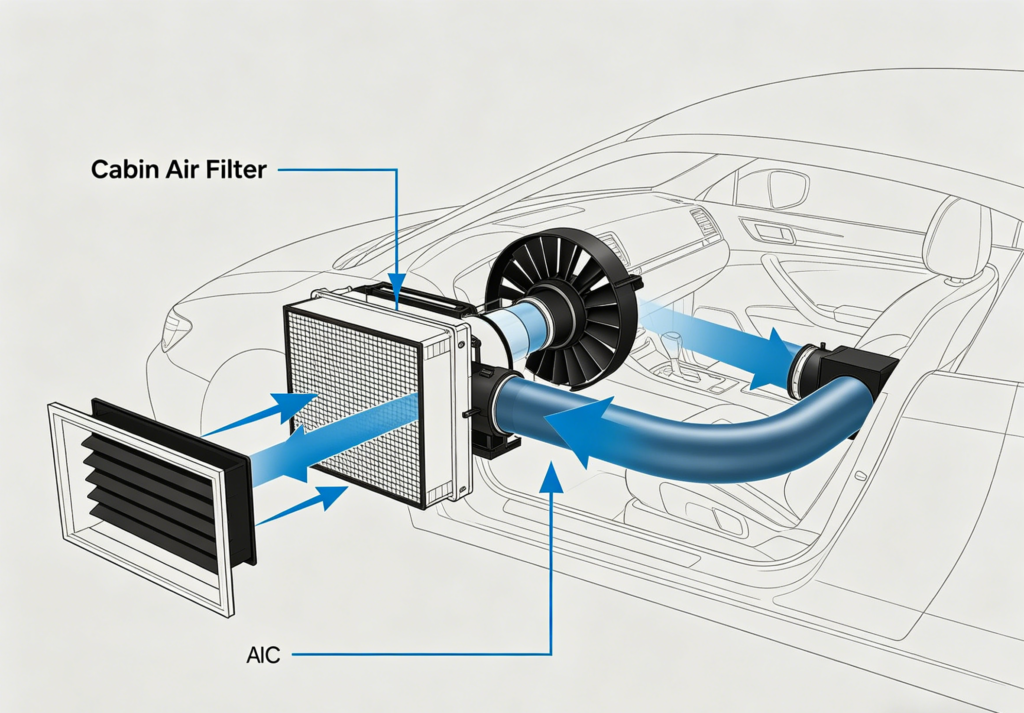
When you turn on your car’s heating or air conditioning, outside air is pulled in through the front of the vehicle — typically through a vent near the base of the windshield. Before that air reaches the cabin, it passes through the cabin air filter, which sits inside the HVAC housing.
A functioning filter traps:
- Road dust and fine particulate matter — including PM2.5, the particle size most associated with respiratory and cardiovascular harm
- Pollen and seasonal allergens — grass, tree, and ragweed pollen are all within filtration range
- Exhaust fumes from traffic ahead — particularly nitrogen dioxide and fine combustion particles in stop-and-go conditions
- Mold spores and bacteria — especially in humid climates or after water enters the filter housing
- Tire rubber and brake dust — generated in heavy traffic and pulled in through the front intake
When the filter is clogged, it no longer traps these effectively. And because a blocked filter restricts the HVAC system’s airflow, drivers often respond by turning the fan higher — which forces more unfiltered air through whatever gaps exist around the saturated media.
Why In-Car Air Quality Is Often Worse Than Outdoors
This is the part that surprises most people. Research from the Environmental Protection Agency (EPA) has shown that concentrations of certain air pollutants can be 2–5 times higher inside vehicles than outside, particularly in stop-and-go traffic. You’re seated inches from the air intake, enclosed in a small volume of air, often with limited ventilation.
In tunnel driving or heavy urban traffic, in-car levels of carbon monoxide, particulate matter, and volatile organic compounds (VOCs) can spike significantly — even with windows closed.
For commuters spending 30–90 minutes a day in the car, this exposure adds up. For people with asthma, rhinitis, cardiovascular conditions, or young children riding regularly, the cumulative effect is worth taking seriously. Cabin air filters are the only barrier between outside traffic air and the enclosed breathing space of a vehicle’s interior — and most drivers are running without one that works.
What a Clogged Cabin Filter Does to Your Car’s Air Quality
A cabin air filter operating beyond 20,000 miles in urban driving conditions can lose up to 40% of its rated filtration efficiency — yet it still looks functional enough that most drivers never think to check it.
At that point, three things are happening simultaneously:
Filtration efficiency has dropped. A filter loaded with particulate can no longer trap new particles effectively. The media is saturated, and fine particles bypass it.
Airflow is restricted. The HVAC blower has to work harder to push air through the blocked media. This is why reduced vent output is one of the first signs of a failing filter.
The filter itself may become a pollution source. Mold growth on a damp, clogged filter gets aerosolized when the fan runs. That’s the musty smell you notice when you first turn on the AC after the car has been sitting — you’re not smelling old dust, you’re breathing mold spores.
The Recirculation Mode Problem
Most cars have a recirculation mode that closes the outside air intake and cycles cabin air instead. Drivers often use this to cool the car faster or to block traffic fumes. The issue: recirculation mode bypasses the cabin air filter entirely in most vehicle designs. Any particulate already in the cabin — including what’s been released from a deteriorating filter — just keeps circulating.
Understanding this is important when choosing how to drive in high-pollution conditions.
HEPA vs Standard Cabin Air Filters: What the Difference Actually Means
Standard cabin air filters use pleated paper or synthetic media. They handle larger particles reasonably well — pollen, large dust, visible debris. Where they fall short is fine particulate: PM2.5, ultrafine combustion particles, and exhaust-related gases.
HEPA-grade cabin filters (H13 or higher) operate to a different standard. They’re independently tested to capture 99.97% of particles at 0.3 microns — the hardest particle size to filter. That includes the fine combustion particulate that dominates urban traffic air and the fine mold spores that standard filters miss. That’s a standard most OEM factory-installed cabin filters don’t meet — which means the filter your car came with was never designed to handle fine urban particulate in the first place.
Some cabin filters combine HEPA media with an activated carbon layer. Carbon adsorbs gaseous pollutants — nitrogen dioxide, benzene, formaldehyde — that even HEPA media can’t capture because those are molecular, not particulate. For drivers in heavily congested urban areas or near industrial zones, a combined HEPA + carbon filter is the most complete protection available.
The cost difference between a standard and HEPA cabin filter is typically $10–25. Given the number of hours most people spend in their vehicles, it’s a reasonable upgrade.
HIFINE 的 car and cabin air filters are built for daily driving conditions with HEPA-grade filtration. For wholesale sourcing or OEM inquiries, visit our product inquiry page.
Cabin Air Filter Replacement Intervals by Driving Condition
The standard replacement recommendation is every 12,000–15,000 miles — but for urban commuters, cumulative particulate exposure from a clogged cabin filter over one year can exceed that of living near a major roadway. The interval isn’t arbitrary; it’s the point where most filters begin losing meaningful efficiency.
Real replacement intervals depend on where and how you drive:
- City drivers in high-traffic, high-pollution environments: replace every 8,000–10,000 miles
- Highway drivers in lower-pollution areas: can extend to 15,000 miles
- Rural drivers on unpaved roads: check at 6,000 miles — dust loading is dramatically higher
- Allergy and asthma sufferers: inspect at every oil change and replace proactively when symptoms worsen in the car
The check itself takes 30 seconds: pull the filter and hold it up to a light source. If light doesn’t pass through it clearly, replace it. Don’t wait for the fan to feel weak — by then, air quality has already been compromised for some time.
How to Replace a Cabin Air Filter Yourself
Cabin air filter replacement is one of the most accessible DIY car maintenance tasks. On most vehicles, it involves:
- Opening the glove box and releasing the retaining clips
- Sliding out the old filter
- Sliding in the new one — noting the airflow direction arrow printed on the filter frame
- Reseating the housing
Total time: 10–15 minutes on most vehicles. No tools required for the majority of models. The filter costs $15–40 depending on grade and vehicle compatibility. Dealerships typically charge $50–100 for the same service.
If you’re replacing a HEPA or carbon-combination filter, confirm the dimensions and housing type match your vehicle before purchasing. A filter that doesn’t seat flush leaves gaps that unfiltered air can bypass.