

The name sounds like something from a chemistry exam. But volatile organic compounds — VOCs — are present in almost every home, releasing from surfaces you’ve touched and breathed near your entire life.
Understanding what they are isn’t just academic. It changes how you think about indoor air quality and what you can actually do about it.
Definition of Volatile Organic Compounds
“Volatile” means evaporates easily at room temperature. “Organic” means carbon-based. Put them together and you get a large family of carbon-based chemicals that turn from liquid or solid into gas without any heat required.
That evaporation process is called off-gassing. It’s why a freshly painted room smells — and why the problem doesn’t necessarily stop once the smell becomes undetectable.
Some VOCs are harmless at typical indoor concentrations. Others — like formaldehyde, benzene, and toluene — are linked to both short-term irritation and long-term health risks at sustained exposures. The challenge is that they’re invisible, often odorless at low levels, and present in combinations that are harder to track than any single compound.
Where VOCs Come From in a Home
The short answer: far more places than most people expect.
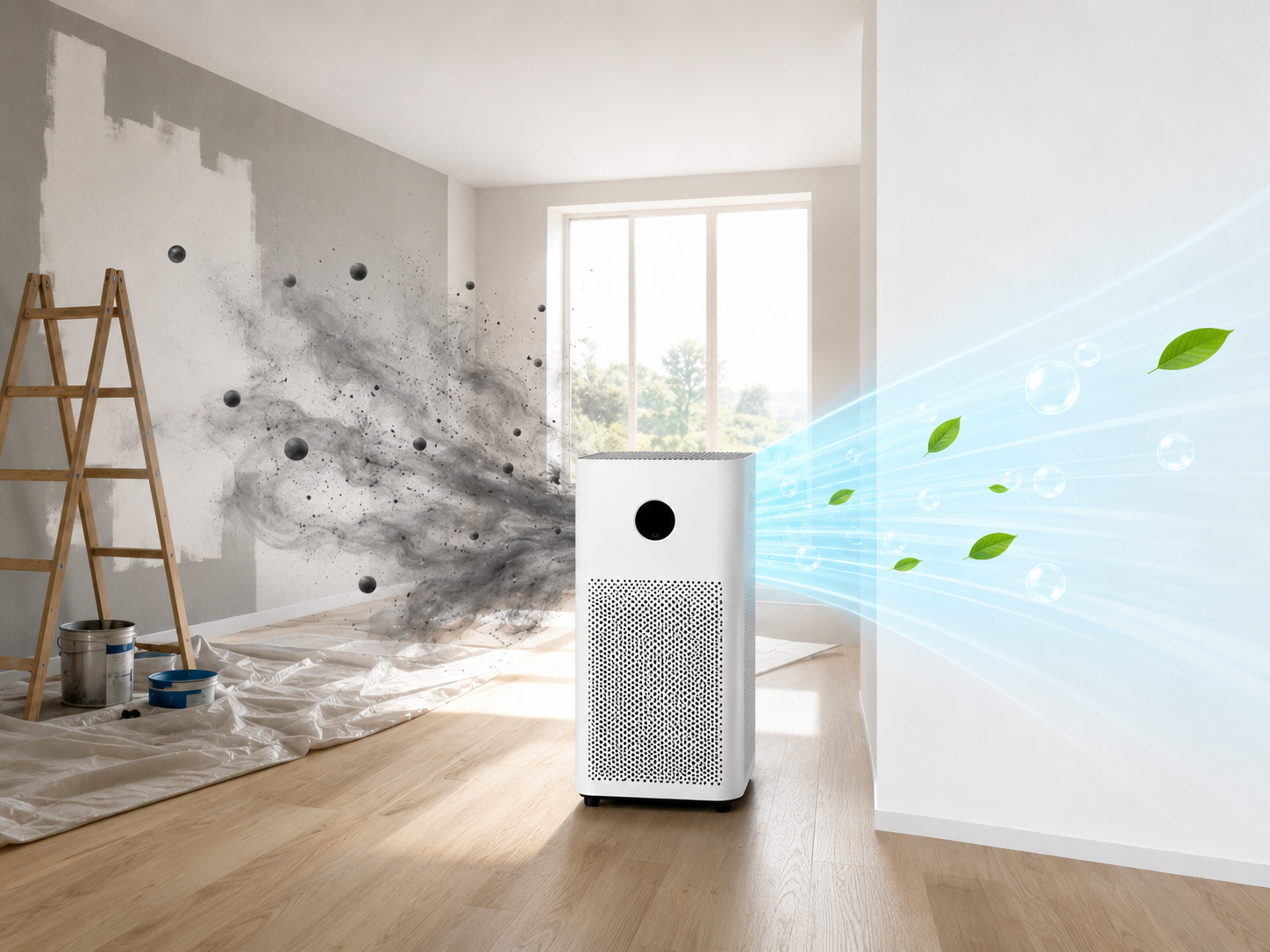
Renovation and construction materials are the most concentrated source. Fresh paint, varnish, primers, adhesives, caulks, and sealants all release VOCs heavily during and after application — some formulations continue off-gassing for months.
New furnishings are a close second. Composite wood products like particleboard and MDF use formaldehyde-based adhesives. Foam cushions, certain synthetic fabrics, and carpeting all off-gas independently of any renovation work.
Everyday household products contribute at lower but consistent levels: cleaning sprays, air fresheners, candles, dry-cleaned clothing, and some personal care products.
The overlap problem
The real issue isn’t any single source — it’s accumulation. A freshly renovated room, furnished with new pieces and cleaned with conventional products, can reach total VOC concentrations well above EPA guidelines even when every individual item is labeled “low VOC.” The EPA has consistently documented that indoor VOC levels run two to five times higher than outdoor levels on average, and can spike significantly higher during and immediately after renovation.
What VOCs Do to Your Body
Effects vary by compound, concentration, and how long exposure lasts. At typical residential levels, the most common responses are:
- Eye, nose, and throat irritation
- Headaches and dizziness
- Fatigue and difficulty concentrating
- Aggravated asthma or existing respiratory conditions
Longer-term exposure to specific compounds raises more serious concerns. Formaldehyde and benzene are both classified as human carcinogens by international health agencies. Children, the elderly, and people with respiratory conditions tend to react at lower thresholds — but in a poorly ventilated, recently renovated space, most healthy adults notice effects within hours.
The “Low VOC” Label Doesn’t Mean VOC-Free
This is where marketing and chemistry part ways.
Paint labeled “low VOC” refers to the base formula before tinting. Tinting agents — required for virtually any custom color — can add meaningful VOC content that isn’t reflected on the can’s label. “Zero VOC” formulations are an improvement, but the term has no standardized regulatory definition. Trace VOCs remain in almost every commercial coating on the market.
Die label is useful context. It isn’t a guarantee.
Why This Matters for How You Filter Indoor Air
VOCs being gas molecules — not particles — is the detail that changes everything about filtration.
Standard HEPA filters capture dust, pollen, and fine particulate matter extremely well. They do nothing for VOC gas molecules, which pass straight through the filter media without any interaction. The technology that actually works is activated carbon filtration, which holds organic compounds through adsorption — binding them to a porous carbon surface rather than trapping them mechanically.
If you’ve recently renovated and you’re relying on a HEPA-only purifier, you’re solving the wrong problem.
For a full breakdown of how activated carbon filtration works for post-renovation air quality — including realistic timelines and what to look for in a replacement filter — see our guide on filtering paint odors after renovation.