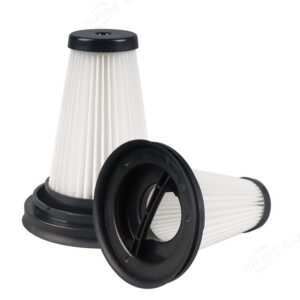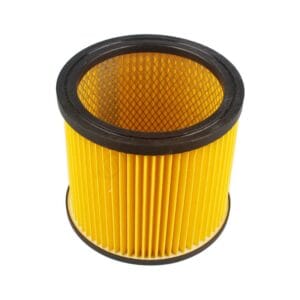

High-speed brushless motors in premium vacuum cleaners operate at 90,000–110,000 RPM. They generate sustained negative pressures and variable-velocity airflow profiles that create operating conditions no standard filter qualification test was designed to simulate.
EN 1822-1:2009 classifies filters by efficiency. IEC 62885-2 tests vacuum system performance. Neither standard, applied alone, fully predicts how a filter element will perform inside a running brushless motor vacuum over a product lifecycle that now routinely includes repeated water washing.
This article maps the standards to what they actually test, identifies the four design gaps between lab classification and field performance, and specifies the qualification data package that closes them.
EN 1822-1:2009: HEPA Classification and Its Scope
EN 1822-1:2009 defines HEPA and ULPA filter grades by efficiency at the Most Penetrating Particle Size—the particle diameter range where mechanical filtration is least effective, sitting between the impaction/interception-dominated coarse regime and the diffusion-dominated fine regime.
| Grade | Overall Efficiency at MPPS | Local Efficiency at MPPS |
|---|---|---|
| H13 | ≥ 99.97% | ≥ 99.75% |
| H14 | ≥ 99.995% | ≥ 99.975% |
| U15 | ≥ 99.9995% | ≥ 99.975% |
The test protocol uses uniform, steady-state airflow through a flat media sample under controlled laboratory temperature and humidity. This setup is appropriate for filter media classification and supplier comparison. It is not a representation of operation inside a vacuum cleaner.
Two divergences between EN 1822-1 test conditions and real vacuum deployment create systematic prediction error:
- Variable and high media-face velocity: Brushless motor vacuum platforms typically drive 15–30 L/s through compact cylindrical filter elements. As the dust cake develops across a cleaning session, actual media-face velocity changes continuously. EN 1822-1 tests clean media at fixed velocity.
- Cyclic mechanical loading: On/off motor cycles, direction changes, and user handling impose pulsed pressure differentials on the filter frame and seal interfaces. Static EN 1822-1 testing doesn’t reproduce this stress.
An H13 classification is a necessary qualification input. It is not a sufficient design specification for a 100,000 RPM brushless motor application.
IEC 62885-2: Performance Under Real Dust Load
IEC 62885-2 provides the closest standardized proxy for vacuum filter performance under operating conditions. The key specification for filter element qualification is suction integrity: ≤10% suction degradation over a standardized dust loading cycle.
What this test actually demands from the filter element, specifically:
- Dust cake permeability must remain above a functional threshold through the full loading cycle—not just at time zero
- The filter frame must maintain dimensional stability under differential pressure without deforming and creating bypass channels
- The seal interface between filter element and vacuum housing must hold integrity throughout
Filters that achieve H13 classification under EN 1822-1 but fail IEC 62885-2 suction integrity targets are documented in aftermarket filter audits. The failure mode is almost never media failure. It is frame deformation or seal bypass—engineering decisions the efficiency test cannot see.
HIFINE vacuum filter elements are validated to IEC 62885-2 suction integrity targets across the full dust loading cycle. View vacuum filter specifications →
Filter Media Selection for Brushless Motor Platforms
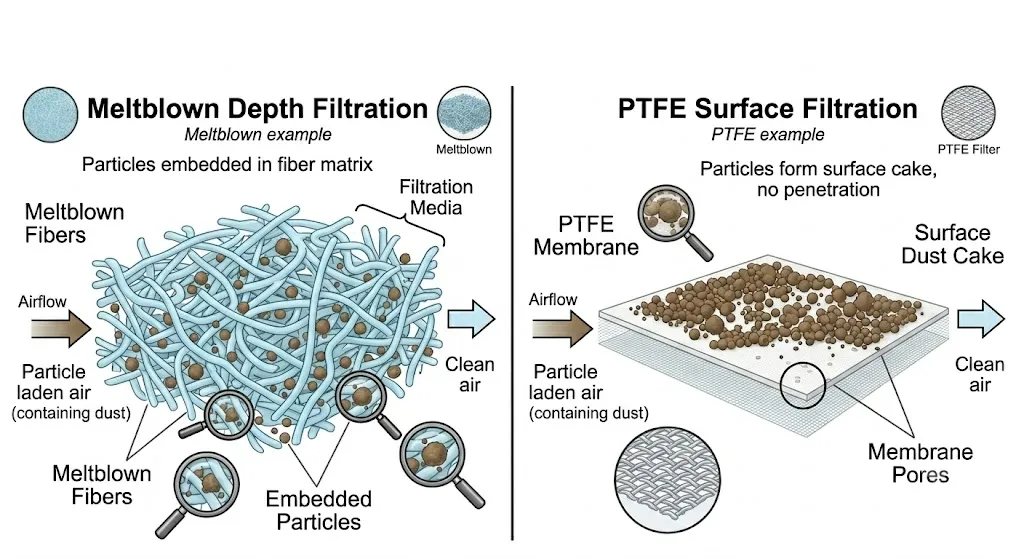
Three media constructions appear in premium vacuum filter elements. Their engineering tradeoffs differ substantially in high-velocity brushless motor applications:
Composite meltblown: Fine polypropylene fiber layers produced by meltblowing achieve H13 efficiency through mechanical filtration—interception, impaction, and diffusion. Good initial performance. Under high negative pressure and sustained dust loading, the fiber matrix compacts progressively, raising pressure drop faster than media with structural support layers. Washability is the critical limitation: water flow and mechanical agitation during cleaning displace fiber orientation, creating efficiency voids in the capture path.
Electrospun nanofiber overlay: A nanofiber layer deposited on a conventional meltblown substrate. The nanofiber surface intercepts fine particles through surface filtration while the coarser substrate provides mechanical support. Better wash resistance than pure meltblown because capture is less dependent on fiber matrix density. Still vulnerable to nanofiber detachment under aggressive wash cycles or high-velocity water rinsing.
PTFE membrane composite: A microporous polytetrafluoroethylene membrane laminated to a structural backing. PTFE’s chemically inert, ultra-smooth surface enables surface filtration—particles arrest on the membrane surface rather than penetrating fiber depth. This is the architecture that enables repeated water washing without efficiency loss: the dust cake releases from a smooth PTFE surface, not from inside a fiber matrix.
For platforms where washability is a product feature, PTFE composite media is the only construction that reliably maintains H12/H13 efficiency across multiple wash cycles. The cost premium over meltblown exists. The prevention of post-wash warranty claims has higher engineering value.
What the 30,000 Pa Specification Actually Covers
ASTM F1977-04 includes a structural enclosure test applying uniform differential pressure to the filter media and frame assembly.
A 30,000 Pa burst pressure target—referenced in premium vacuum filter qualification specifications—represents the structural deflection resistance threshold. At 30,000 Pa:
- Media must not rupture or develop micro-tears that compromise efficiency
- End caps and frame bond lines must not delaminate or shift relative to the media
- The filter geometry must return to original dimensions after pressure release
Context: typical steady-state operating differential pressure in a fully loaded premium vacuum filter runs 2,000–8,000 Pa. A 30,000 Pa burst specification provides approximately 4–15× structural safety margin depending on operating point.
The margin matters because motor surge events—common during blockage clearing, power cycling, or variable-speed operation—generate transient pressure spikes significantly above steady-state differential. Filters rated to efficiency standards only, with no documented burst pressure specification, carry unknown structural margin through these transient events.
Frame material and bond chemistry both contribute to burst resistance in ways that filtration efficiency testing cannot detect. Polypropylene and glass-fiber-reinforced frames retain dimensional stability across thermal and humidity cycling. Frames incorporating paper pulp or standard cardboard components do not.
Washable HEPA filters can withstand repeated washing
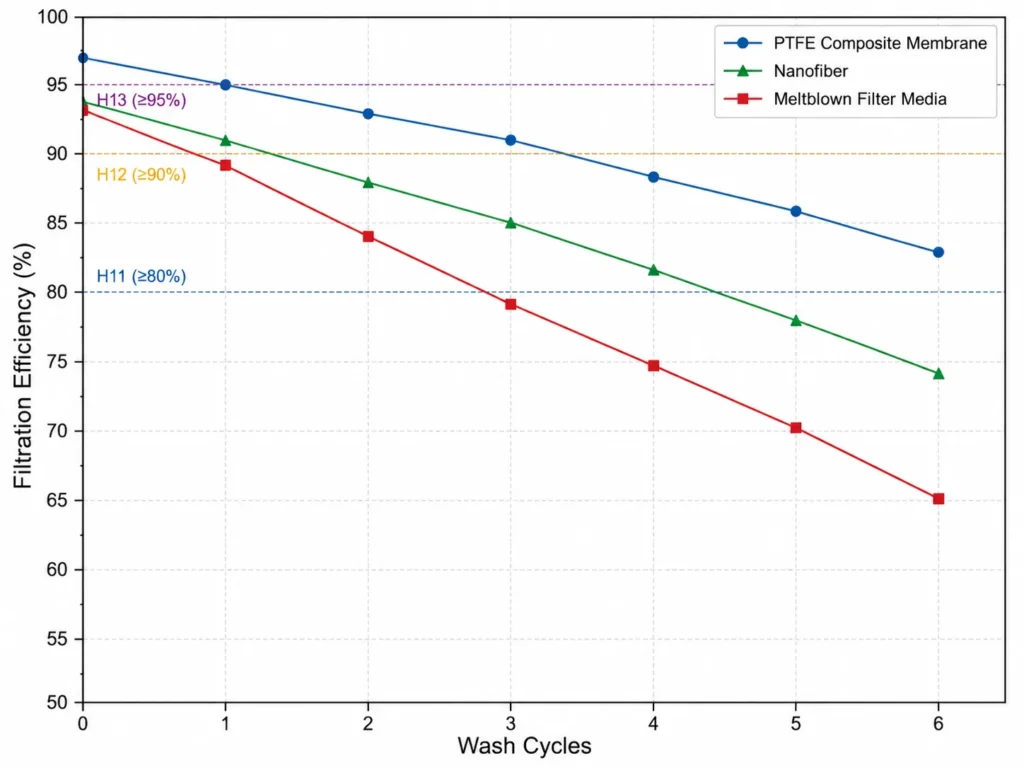
Washable HEPA filter elements are a product category claim that requires specific engineering design to be valid past wash cycle two or three. The failure progression is consistent across standard meltblown filter elements:
- Wash 1: Minor efficiency reduction, typically within H13 range
- Wash 2–3: Fiber matrix disruption becomes measurable, efficiency drops toward H11 or below
- Wash 4+: Efficiency floor becomes unpredictable; bypass path formation from frame dimensional change compounds media degradation
Engineering washability requires three simultaneous conditions:
Surface filtration media: PTFE membranes or intact nanofiber overlays where the dust cake remains on the media surface and rinses clean without disrupting the capture mechanism.
Structural frame stability under wet/dry cycling: Polypropylene or ABS frames hold dimensional stability. Frames with paper composite or expanded cardboard components compress under water exposure, creating permanent bypass channels that persist after drying.
Post-wash validation protocol: HIFINE records the retention of H12/H13 detergent efficiency after 6 wash cycles, with efficiency measurements performed according to EN 1822-1 after each wash and the final dry cycle. Without post-wash efficiency testing and documentation at the specified number of cycles, any claims regarding washability cannot be verified from the end-user’s perspective.
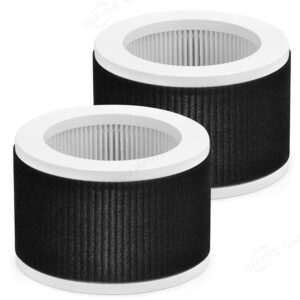
HIFINE PTFE Composite Filter maintains ≥99.997% efficiency at 0.3 μm and retains H12/H13 classification through 6 wash cycles per QA-04 protocol. View PTFE composite filter specifications →
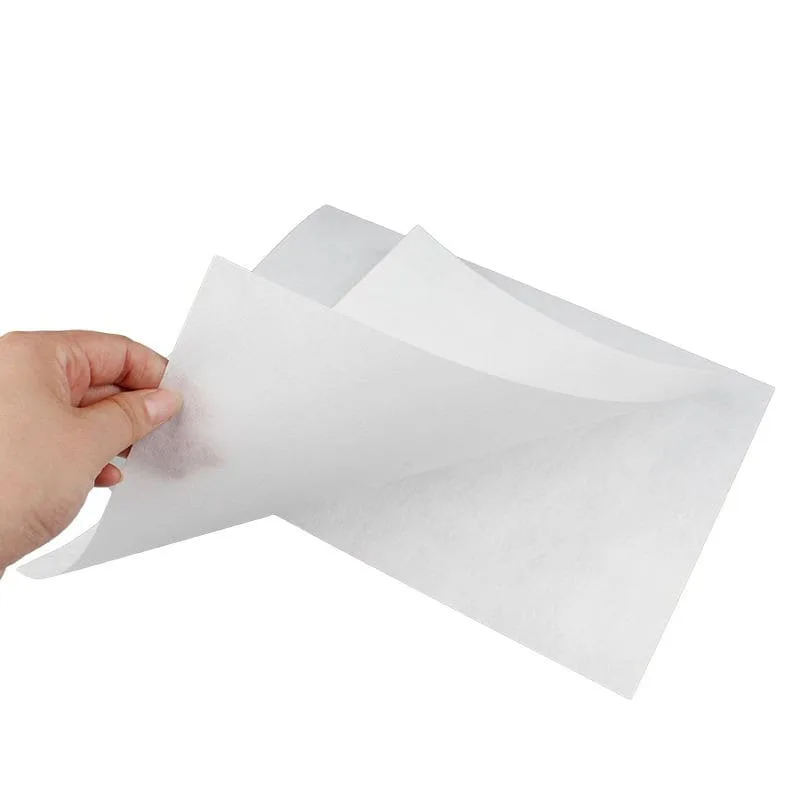
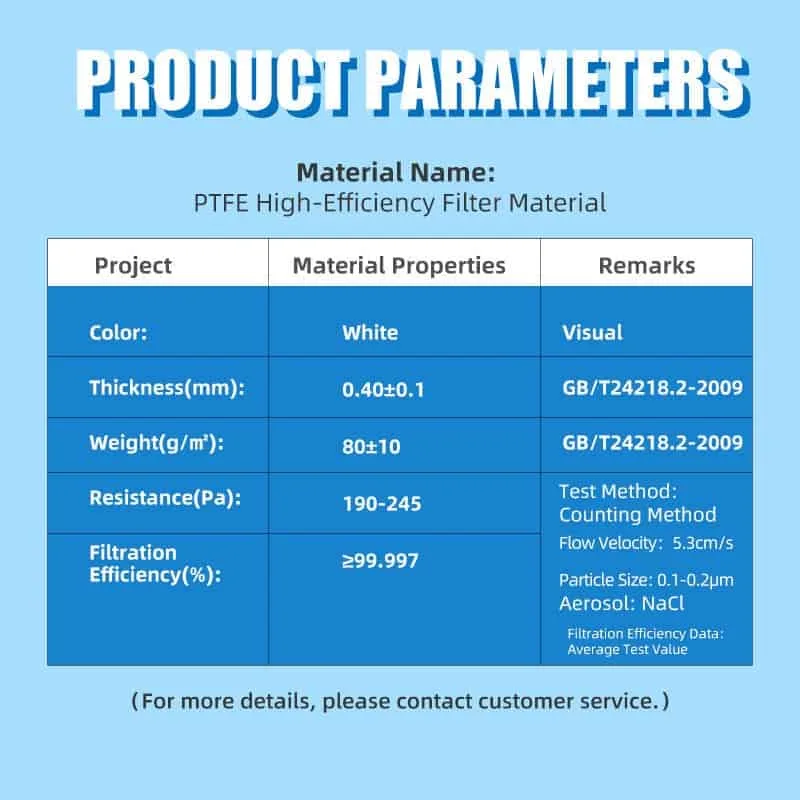
Filtre composite en PTFE à haute efficacité 99,997% HEPA, antibactérien, à base de fibre de verre et de PET laminé, pour filtre à air
Notre filtre composite en PTFE haute efficacité assure une purification de l'air exceptionnelle grâce à son efficacité HEPA de 99,9971 %, capturant les particules ultrafines d'une taille aussi petite que 0,3 micron. Fabriqué à partir de fibre de verre antibactérienne de première qualité et recouvert d'une couche de PET, ce filtre offre une durabilité et une résistance aux micro-organismes supérieures. Parmi ses principales caractéristiques, on peut citer la technologie de membrane en PTFE pour une filtration améliorée, une construction robuste adaptée aux environnements industriels et la conformité à des normes strictes en matière de qualité de l'air. Idéal pour les systèmes CVC commerciaux, les salles blanches, les établissements médicaux et les usines de fabrication où une qualité de l'air supérieure est essentielle. Ce filtre garantit des performances fiables, une durée de vie prolongée et un débit d'air optimal avec une perte de charge minimale.
Specification
| Utilisation | Filtre à air |
| Composants essentiels | automate programmable |
| Poids (kg) | 0.5 |
| Taille de l'emballage par lot | 10 × 10 × 2 cm |
| Poids brut par lot | 0,100 kg |
What to Request
For OEM procurement or aftermarket filter qualification in brushless motor vacuum applications, these are the documents that close the design uncertainty:
- EN 1822-1 full test report: overall and local efficiency at MPPS, initial pressure drop at rated airflow
- IEC 62885-2 suction integrity result: degradation percentage over full dust loading cycle, ≤10% threshold
- Burst pressure certification: per ASTM F1977-04 or equivalent, with pass threshold and frame material documented
- Post-wash efficiency data: EN 1822-1 efficiency after minimum 3 wash cycles; 6-cycle data preferred
- Seal bypass leakage result: filter-to-housing interface integrity under operating differential pressure
- Material compliance documentation: RoHS, REACH, food-contact declarations where applicable
HIFINE can proactively provide efficiency data for electrostatic filter media under different humidity conditions. For elements that rely on electrostatic charge to achieve submicron-level high-efficiency filtration, we recommend providing post-treatment efficiency data measured at 70% relative humidity according to the ISO 16890 pretreatment procedure. In practical applications, charge decay caused by humid environments is often the primary reason for a significant decline in the performance of electrostatically enhanced vacuum filters.
Standards Define the Test
EN 1822-1 and IEC 62885-2 set a shared test vocabulary. They do not set the design that survives 50 cleaning sessions, six wash cycles, and a motor surge event in a humid coastal environment.
The engineering work that prevents field failures—PTFE surface filtration, validated frame geometry, documented post-wash efficiency, structural burst margin—isn’t visible on a standard test report. It’s in the design specification you write before the RFQ goes out.