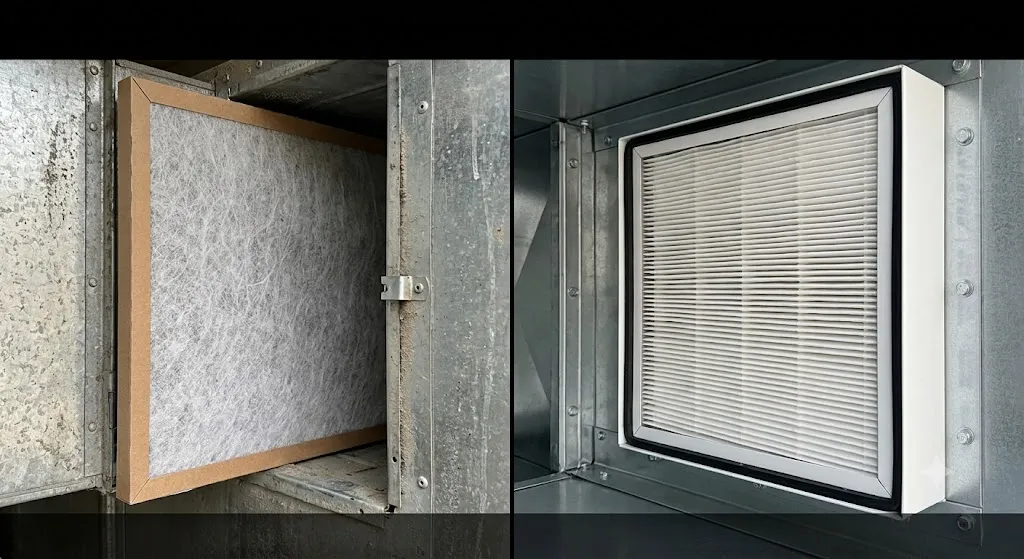

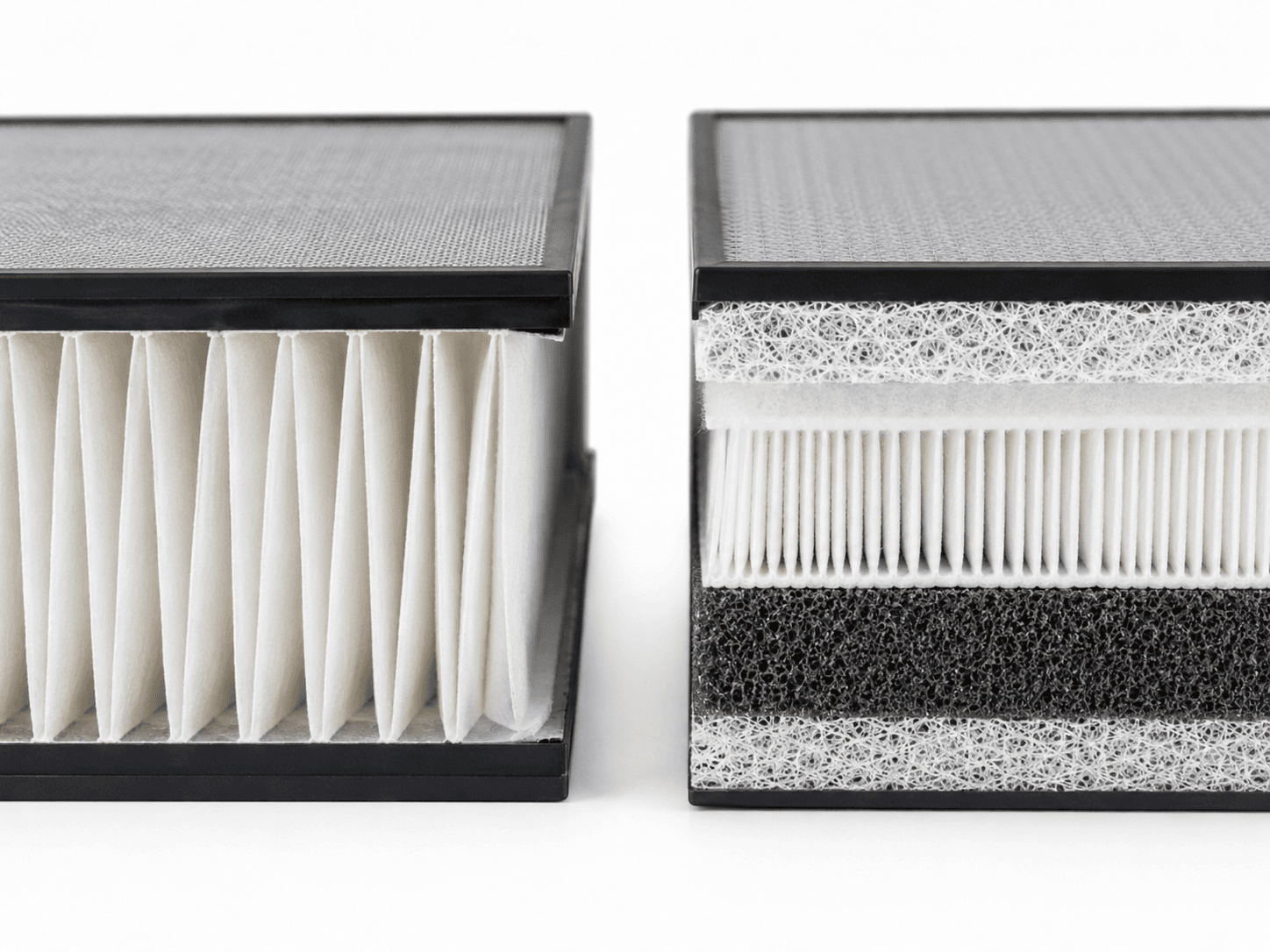
Two filters can carry the exact same “HEPA H13” stamp and still behave nothing alike once they’re installed. One is a single pleated sheet of glass fiber. The other has three or four layers, each doing a different job. The label describes what happens to a 0.3-micron particle. It says nothing about airflow resistance, service life, or whether the filter does anything besides trap dust. For an OEM buyer specifying a private-label air purifier or vacuum, that gap is usually where replacement-rate complaints and warranty costs start.
What is a single-layer HEPA filter?
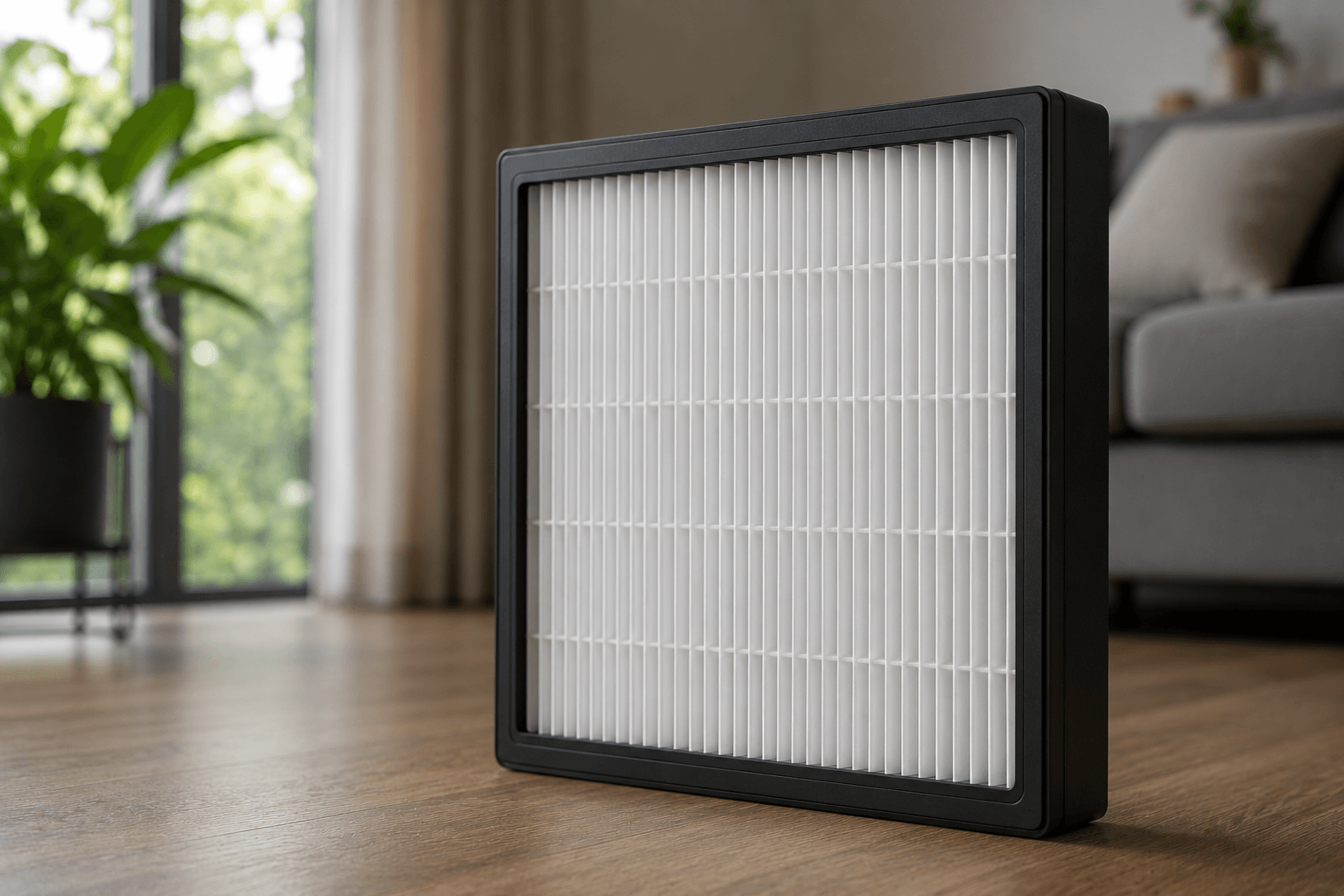
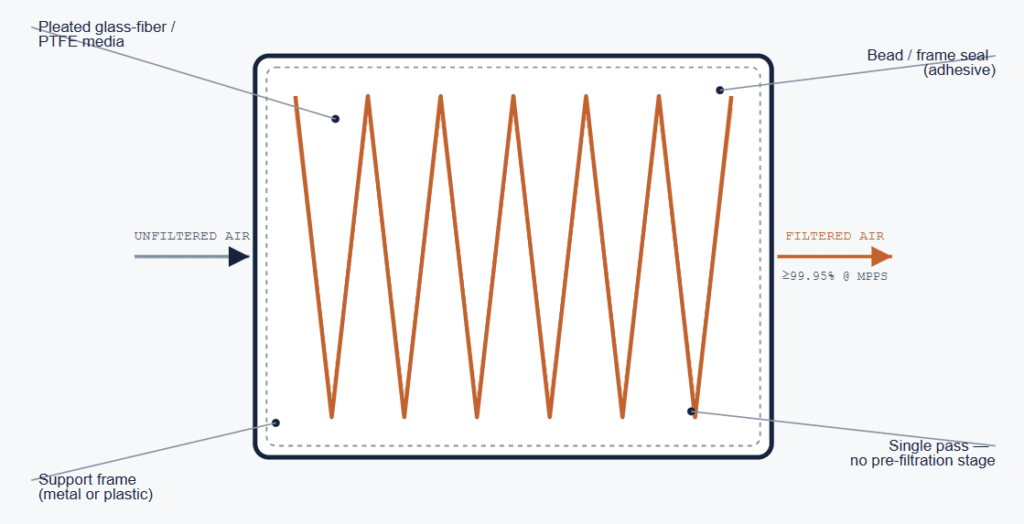
A single-layer HEPA filter is one continuous sheet of pleated media, usually borosilicate glass fiber or PTFE, folded into pleats and sealed into a frame. Nothing else sits in the airstream before or after it.
Its efficiency comes from a test standard, not a marketing claim. Under EN 1822, the European classification system for high-efficiency filters, an H13-grade filter must capture at least 99.95% of particles at the Most Penetrating Particle Size, typically between 0.1 and 0.3 microns. That size range is the hardest for any media to catch, since particles both larger and smaller are captured more easily through interception, impaction, or diffusion. In North America, most manufacturers test against IEST-RP-CC001, which sets the equivalent benchmark at 99.97% efficiency on 0.3-micron particles.
This single-medium build is common in exhaust and motor-protection filters for stick and canister vacuum cleaners, where the airflow path is short and the job is narrow: strip particulates and keep the motor clean. Hifine’s filtres de rechange pour aspirateurs are a typical example of this design.
What Changes When You Stack Layers
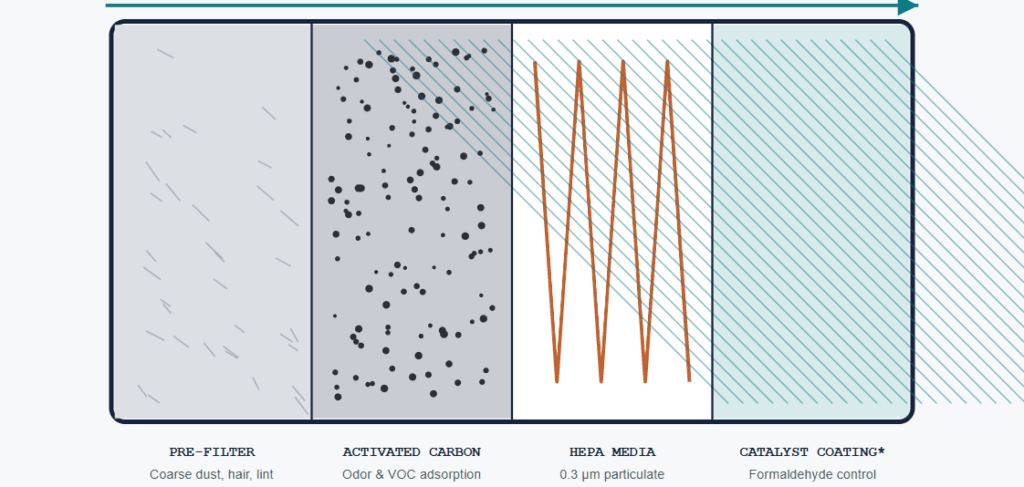
A multi-layer composite filter places two or three additional media in front of, or behind, that same HEPA sheet. Each added layer solves a problem particulate capture alone can’t touch.
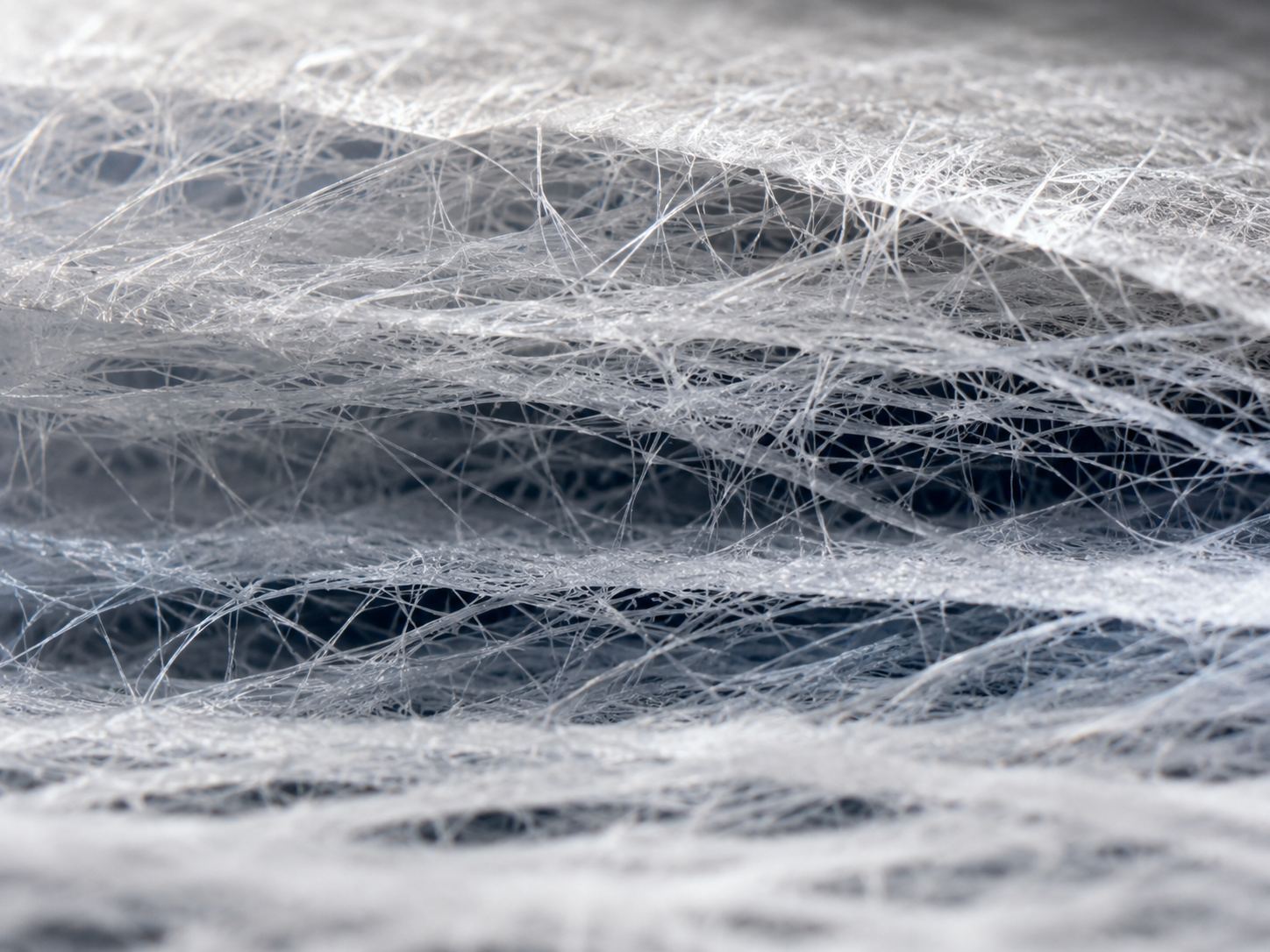
The order usually runs outside-in. A coarse pre-filter, often a spunbond nonwoven or open-cell foam, catches hair, lint, and larger dust first. A middle layer of granular or impregnated activated carbon adsorbs odor molecules and volatile organic compounds through gas-phase adsorption, which is a chemical process, not mechanical trapping. The HEPA layer sits innermost, doing the same 0.3-micron job a single-layer filter does. Some builds add a fourth stage, a cold catalyst or antimicrobial coating, for formaldehyde breakdown or bacterial control.
That pre-filter is doing more than adding a manufacturing step. Published testing on layered nonwoven composites shows dust-holding capacity around 40 g/m² while keeping initial pressure drop under 0.15 mmH2O, because the coarse layer intercepts bulk debris before it reaches the finer HEPA media. One filter-media patent comparing a two-fiber composite structure against a conventional single-medium design recorded dust-holding capacity of roughly 135 g against 60 g under identical airflow, stretching usable life toward about a year instead of a few months.
Why More Layers Doesn’t Automatically Mean “Better HEPA”
This is the part spec sheets tend to blur. Particulate efficiency is set by the finest layer in the stack, not the total layer count. A four-layer composite built around an H13 core still tests at 99.95% at MPPS, the same figure a bare single-layer H13 sheet would post. What the extra layers buy is odor control, gas adsorption, and a longer dust-holding life before airflow drops off. They don’t move a filter from H13 to H14. Only the certified media itself, tested under EN 1822 or IEST-RP-CC001, does that.
How to balance these two aspects?
| Facteur | Single-Layer HEPA | Multi-Layer Composite |
|---|---|---|
| Particulate efficiency | 99.95–99.97% at MPPS / 0.3 µm | Same figure, set by the HEPA layer inside the stack |
| Gas and odor removal | Aucun | Yes, via activated carbon adsorption |
| Initial pressure drop | Lower | Higher, more media in the airstream |
| Dust-holding capacity | Lower, media loads faster | Higher, pre-filter delays HEPA clogging |
| Carbon component lifespan | Not applicable | Roughly 3–6 months under normal indoor odor and VOC load |
| Unit cost | Lower | Higher |
The carbon layer is worth a separate note for anyone writing a replacement-schedule recommendation. It can lose adsorption capacity while pressure drop still looks normal, so a “check the airflow” instruction alone won’t catch a chemically exhausted carbon stage. A practical field routine used across activated-carbon systems is to inspect the pre-filter every 2 to 4 weeks and watch for odor breakthrough separately from airflow readings.
Matching Filter Structure to Product Category
- Stick and canister vacuum cleaners. Motor-protection filters are frequently single-layer H12/H13 media, since suction and noise specs matter more than odor control. Whole-appliance dust pickup performance is tested separately, under IEC 62885-2, which is a different standard from the media efficiency test itself.
- Robot vacuums. Many designs already move to multi-layer synthetic nonwoven media, because the filter runs across many cleaning cycles between changes and needs higher dust-holding capacity before suction drops. This is also reflected in the filter material of robotic vacuum cleaners.
- Home and allergy-focused air purifiers. Multi-layer with activated carbon is close to the default now, since end users judge performance by smell as much as by particle counts. The H13 and H14 HEPA air purifier filters, along with their glass fiber and charbon actif combination panels, are typical reference configurations for this category.
- Post-renovation and formaldehyde scenarios. A composite pairing HEPA with activated carbon or a catalytic layer is the right call over HEPA-only media, since particulate filtration alone does nothing against off-gassing VOCs.
- Cleanroom and medical-grade applications. H14 filters require an additional local efficiency, or leak, test under EN 1822, on top of the overall average. That’s a stricter build requirement regardless of how many layers sit in front of the HEPA media.
Three Questions Before You Lock a Filter Spec
- Will the finished product face odor complaints, such as pet homes, smokers, or cooking, or mainly dust and allergen complaints? Carbon only earns its cost in the first case.
- What replacement cycle do you want printed on the packaging: 3 months, 6 months, or 12 months? That number should come from dust-holding capacity data, not a marketing guess.
- What pressure drop can the motor or fan tolerate before airflow and noise specs fail? Extra layers raise initial resistance before they raise service life.
Both structures are legitimate engineering choices, not a ladder of good and better. The right one matches the product’s real failure mode: motor protection, allergy relief, or gas-phase odor control. Hifine’s OEM and ODM filter engineering team builds both single-layer and multi-layer composite media to private-label specification, with test data attached to every production batch.