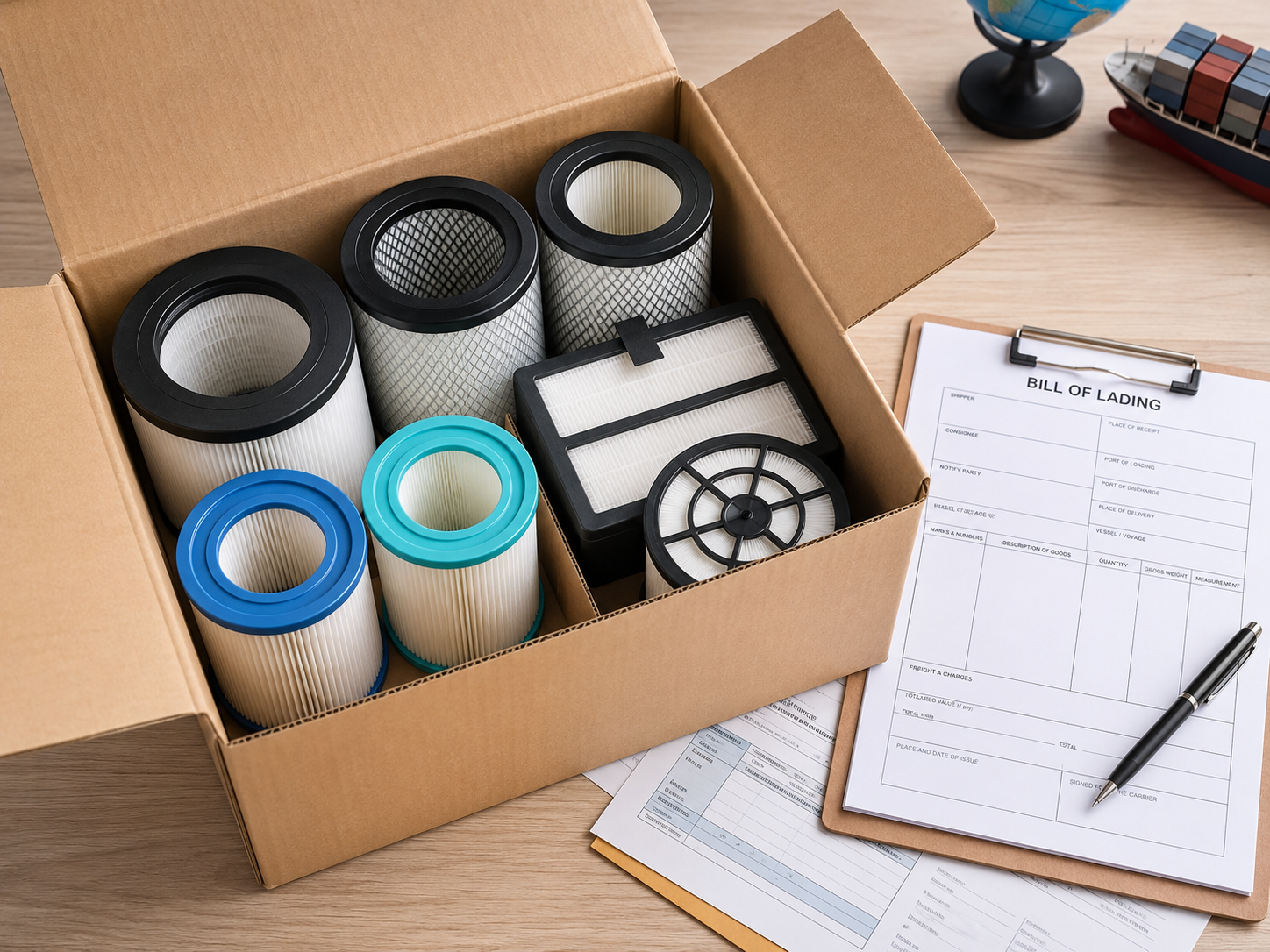

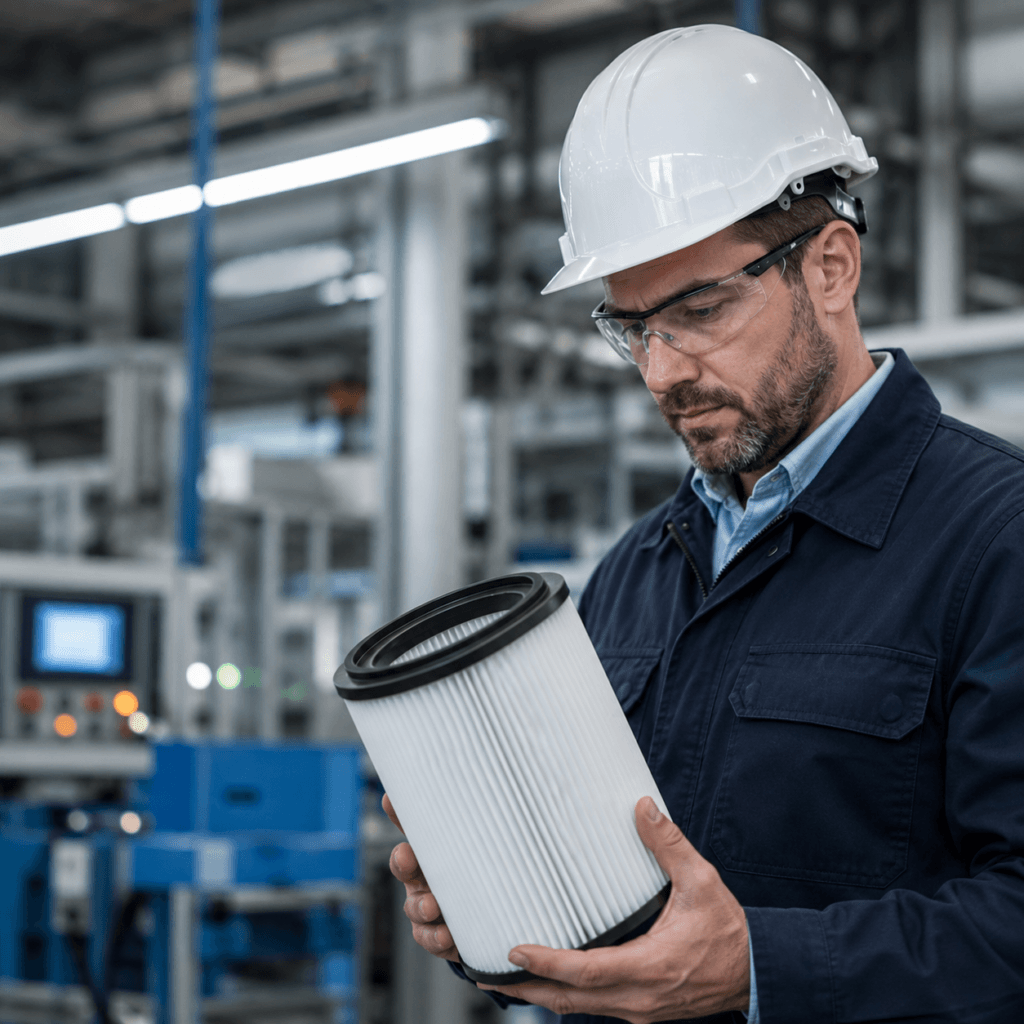
A container of “HEPA-grade” filters is sitting in a bonded warehouse in Rotterdam. The importer has a purchase order, a commercial invoice, and a supplier who insists the media tests at 99.97% efficiency. None of that answers what a customs officer or a retailer’s compliance auditor will actually ask: where is the paperwork?
“HEPA” is not a customs category. It’s a marketing word. What gets a shipment through an EU border, past a vendor audit, or clear of an ECHA spot-check is a specific stack of documents tied to five regulatory frameworks. Here’s what each one requires, and where sourcing teams usually get caught out.
“Made to HEPA Standard” is not a legal assertion
Under EU market surveillance rules, the company whose brand name is on the box is the legal “manufacturer.” The factory that built the product is not. That’s true even if the factory is in Shenzhen and the brand office is in Hamburg. The brand owner signs the Declaration of Conformity and answers to the market surveillance authority if something goes wrong.
That changes what “finding a good factory” actually means. A supplier that hands over a box of filters isn’t enough. You need one that hands over test reports and a paper trail that survives an audit, because that audit lands on your desk, not theirs.
EN1822 or ISO 29463?
EN1822 is Europe’s reference standard for high-efficiency filters. It grades filters at their Most Penetrating Particle Size, the exact particle size, usually between 0.1 and 0.3 microns, where a filter medium is weakest. Testing at the weak point, rather than at a fixed 0.3-micron benchmark, is what separates EN1822 from older US-style test methods.
| EN1822 Class | Overall Efficiency | Local Efficiency |
|---|---|---|
| E10 | ≥ 85% | N/A |
| E11 | ≥ 95% | N/A |
| E12 | ≥ 99.5% | N/A |
| H13 | ≥ 99.95% | ≥ 99.75% |
| H14 | ≥ 99.995% | ≥ 99.975% |
| U15 | ≥ 99.9995% | ≥ 99.9975% |
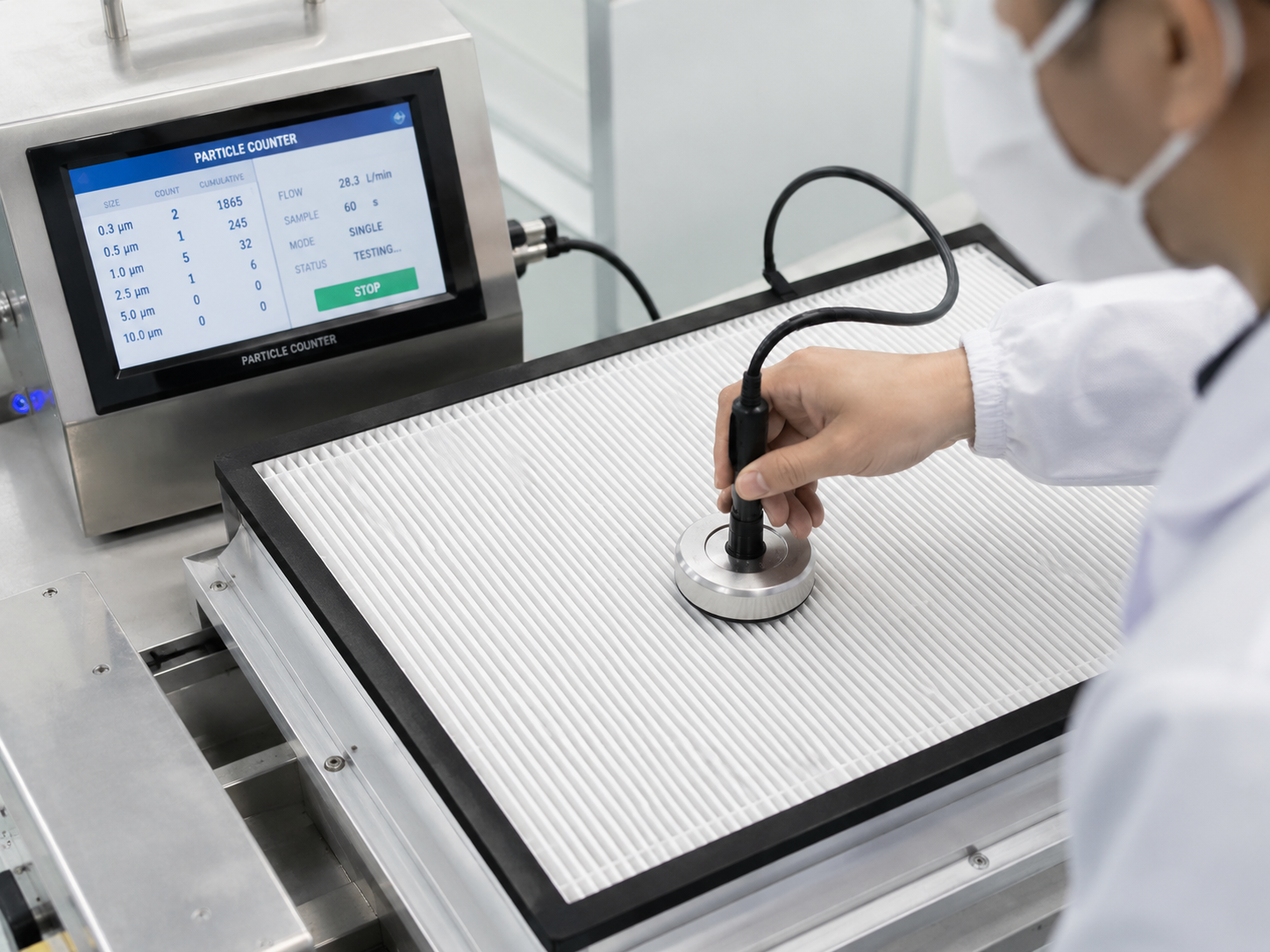
The detail that trips up new exporters: EN1822 requires every individual filter to be scanned for leaks, not a sampled batch. Since 2019, EN1822 has also pointed to ISO 29463 for its test methods, but the two standards don’t always agree on classification. A filter rated H14 under EN1822 can be reclassified as ULPA-grade ISO 50 U under ISO 29463, because the leak-test procedures differ between the two. If a European buyer asks for “an EN1822 report” and receives an ISO 29463 report with a different class number on it, that mismatch can stall a compliance review, even when the filter performs identically.
For H13 and H14 lines, HIFINE runs individual MPPS scan tests rather than batch sampling, so buyers can request scan data tied to the actual H13 True HEPA filters they’re ordering, not a generic spec sheet.
REACH and RoHS: What Your Media, Glue, and Gaskets Must Prove
Two separate EU rulebooks govern what’s allowed inside the filter itself. REACH’s Candidate List of Substances of Very High Concern passed 250 entries in 2025 and stood at 253 as of ECHA’s February 2026 update, with new substances added roughly twice a year. Cross the 0.1% weight threshold for any listed substance, and it triggers a customer-notification duty and a filing in ECHA’s SCIP database.
RoHS is narrower but stricter: ten restricted substances, including lead, cadmium, hexavalent chromium, and four phthalates used to soften PVC, each capped at 0.1% by weight. RoHS applies once the filter is part of an electrical assembly. A plain filter cartridge sits outside its scope, but the fan housing or motor it ships with doesn’t.
What a European buyer will actually ask for: a raw material declaration tracing filter media, adhesives, and seals back to a compliance statement, plus a third-party lab report confirming SVHC and RoHS status. Buyers sourcing custom builds through HIFINE’s OEM/ODM engineering process can request this documentation at the material-selection stage, before tooling starts. That’s far cheaper than retesting after a production run is already built.
CE Marking Gets Complicated the Moment You Add a Fan or a UV Lamp
A bare filter cartridge doesn’t carry CE marking. It’s a component, not a finished electrical product. That changes the instant it’s built into a powered assembly with a fan, motor, or UV-C lamp. At that point the unit falls under the Low Voltage Directive for electrical safety, the EMC Directive for electromagnetic interference, and RoHS for substance restrictions.
For a standard household unit, this is usually self-declared, meaning no notified body is required. But “self-declared” doesn’t mean “unverified.” The brand owner still needs a technical file and a signed EU Declaration of Conformity before the product reaches a shelf. Skip the paperwork, and a market surveillance check can pull the product regardless of how well it actually performs.
Factories building filter-plus-fan or filter-plus-UV assemblies should be able to hand over LVD/EMC test data as an input to that technical file. For brands going through HIFINE’s custom development process, that’s a routine request, not a special one-off.
Customs really looks at labels, packaging, and the paperwork
Private label products often face two main challenges: language barriers and packaging regulations. In the EU, consumer product information usually has to be provided in the buyer’s native language, rather than just in English. Additionally, the packaging is subject to its own set of regulations, separate from the product it contains.
Germany’s Packaging Act is the clearest example. Any company that first places packaged goods on the German market must register with the LUCID Packaging Register and join a recycling “dual system,” regardless of where it’s based. Registration is free, but skipping it isn’t: fines run up to €200,000, and marketplaces such as Amazon now verify a seller’s LUCID number before allowing sales. Several other EU member states run comparable packaging schemes.
None of this is the filter factory’s legal obligation. It belongs to the brand placing goods on the market. But a factory that can supply multilingual pack copy and pre-formatted labeling artwork saves weeks of back-and-forth before launch.
The Real Takeaway
Compliance paperwork isn’t a favor a factory does for you. It’s part of the product spec, the same as dimensions or MOQ. HIFINE has built EN1822 scan testing, REACH/RoHS material traceability, and CE-ready technical documentation into its standard process for H13/H14 production lines supplying brands including Xiaomi, Midea, and Kärcher. If your next sourcing conversation starts with “can you make HEPA filters,” it should end with “can you also hand me the paperwork.” Talk to our engineering team to request a compliance documentation pack before your next PO.