
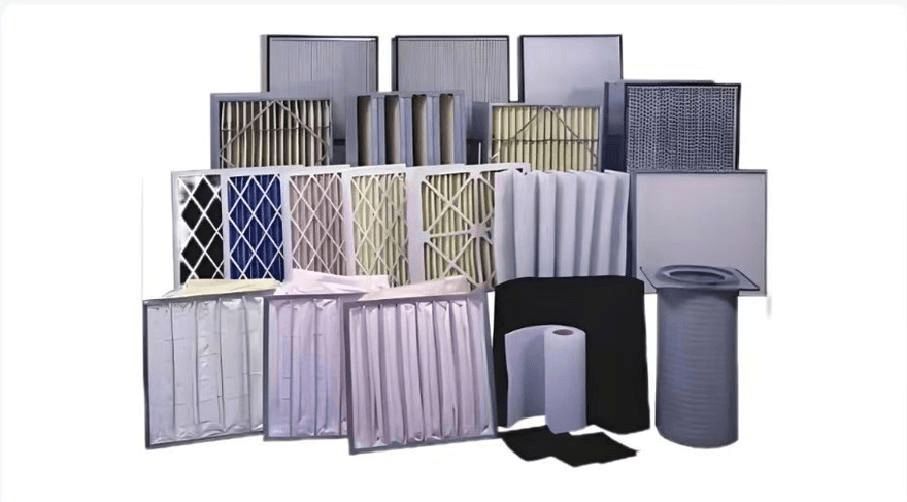
Air filters fall into six broad grades based on filtration efficiency: primary, also called coarse, medium, high-medium, sub-high-efficiency, high-efficiency, and ultra-high-efficiency. China, Europe, and the United States each use their own standards to grade filters. The sections below explain each system.
China
China grades air filters by filtration efficiency. The scale runs from coarse-efficiency up to ultra-high-efficiency: coarse-efficiency, medium-efficiency, high-and-medium-efficiency, sub-high-efficiency, high-efficiency, and ultra-high-efficiency filters.
GB/T 14295-2008: Coarse to Sub-High Efficiency Filters
This standard covers primary, medium, high-medium, and sub-high-efficiency filters. Table 1 lists the wind speed, efficiency, and resistance limits for each grade.
Table 1: Classification of Air Filters Under GB/T 14295-2008
| Performance Category | Code | Frontal Wind Speed, m/s | Test Particle Size | Efficiency at Rated Air Flow, E, % | Initial Resistance at Rated Air Flow, Pa | Final Resistance at Rated Air Flow, Pa |
| Sub-high efficiency | YG | 1.0 | ≥ 0.5 μm | 99.9 > E ≥ 95 | ≤120 | 240 |
| High efficiency | GZ | 1.5 | ≥ 0.5 μm | 95 > E ≥ 70 | ≤100 | 200 |
| Medium efficiency 1 | Z1 | 2.0 | ≥ 0.5 μm | 70 > E ≥ 60 | ≤80 | 160 |
| Medium efficiency 2 | Z2 | 2.0 | ≥ 0.5 μm | 60 > E ≥ 40 | ≤80 | 160 |
| Medium efficiency 3 | Z3 | 2.0 | ≥ 0.5 μm | 40 > E ≥ 20 | ≤80 | 160 |
| Primary effect 1 | C1 | 2.5 | ≥ 2.0 μm | E ≥ 50 | ≤50 | 100 |
| Primary effect 2 | C2 | 2.5 | ≥ 2.0 μm | 50 > E ≥ 20 | ≤50 | 100 |
| High efficiency 3 | C3 | 2.5 | Standard manual dust measurement efficiency | E ≥ 50 | ≤50 | 100 |
| High efficiency 4 | C4 | 2.5 | Standard manual dust measurement efficiency | 50 > E ≥ 10 | ≤50 | 100 |
When a filter’s measured efficiency fits two categories at once, the higher category applies.
GB/T 13554-2008: High and Ultra-High Efficiency Filters
This standard covers high-efficiency and ultra-high-efficiency filters. Table 2 lists the efficiency and resistance limits for each class.
Table 2: Classification of High-Efficiency and Ultra-High-Efficiency Filters Under GB/T 13554-2008
| Class | Efficiency at Rated Air Flow, % | Efficiency at 20% Rated Air Flow, % | Initial Resistance at Rated Air Flow, Pa | Remarks |
| AHighly active | 99.99 > E ≥ 99.9 | No requirement | ≤190 | 1 |
| BHighly active | 99.999 > E ≥ 99.99 | 99.99 | ≤220 | 1 |
| CHighly active | E ≥ 99.999 | 99.999 | ≤250 | 1 |
| DUltra-High Efficiency | 99.999 | 1 | ≤250 | Scan for leaks |
| EUltra-High Efficiency | 99.9999 | 1 | ≤250 | Scan for leaks |
| FUltra-High Efficiency | 99.99999 | 1 | ≤250 | Scan for leaks |
Test method: high-efficiency filters are tested with the sodium flame method. Ultra-high-efficiency filters are tested with the particle counting method. Replace an HEPA or ULPA filter once its resistance reaches 1.5 to 2.0 times the initial value.
Europe
Europe uses two standards for air filters: EN 779, which covers primary through high-efficiency filters, and EN 1822, which covers sub-high-efficiency through ultra-high-efficiency filters.
EN 779-2012: Primary Through High-Efficiency Filters
This standard applies to primary, medium, and high-efficiency filters. Table 3 lists the resistance and dust removal efficiency for each class, from G1 through F9.
Table 3: Air Filter Classification Under European Standard EN 779-2012
| Class | Final Resistance, Test Value, Pa | Average Weighted Dust Removal Efficiency, Am, % | 0.4 μm Particle Average Counting Efficiency, Em, % | 0.4 μm Particle Minimum Counting Efficiency, % |
| G1 | 250 | Am < 65 | – | – |
| G2 | 250 | 65 ≤ Am < 80 | – | – |
| G3 | 250 | 80 ≤ Am < 90 | – | – |
| G4 | 250 | 90 ≤ Am | – | – |
| M5 | 450 | – | 40 ≤ Em < 60 | – |
| M6 | 450 | – | 60 ≤ Em < 80 | – |
| F7 | 450 | – | 80 ≤ Em < 90 | 35 |
| F8 | 450 | – | 90 ≤ Em < 95 | 55 |
| F9 | 450 | – | 95 ≤ Em | 70 |
EN 1822-2009: HEPA and ULPA Filters
This standard covers sub-high-efficiency through ultra-high-efficiency filters, rated E10 through U17. Table 4 lists the counting efficiency and penetration rate for each class, both overall and at the most penetrating particle size.
Table 4: High-Efficiency Air Filter Classification Under European Standard EN 1822-2009
| Class | Overall Value | Local Value | ||
| Counting Efficiency, MPPS, % | Penetration Rate, % | Counting Efficiency, MPPS, % | Penetration Rate, % | |
| E10 | ≥85 | ≤15 | – | – |
| E11 | ≥95 | ≤5 | – | – |
| E12 | ≥99.5 | ≤0.5 | – | – |
| H13 | ≥99.95 | ≤0.05 | ≥99.75 | ≤0.25 |
| H14 | ≥99.995 | ≤0.005 | ≥99.975 | ≤0.025 |
| U15 | ≥99.9995 | ≤0.0005 | ≥99.9975 | ≤0.0025 |
| U16 | ≥99.99995 | ≤0.00005 | ≥99.99975 | ≤0.00025 |
| U17 | ≥99.999995 | ≤0.000005 | ≥99.9999 | ≤0.0001 |
America
The United States uses two standards for air filters: ASHRAE 52.2, which covers primary and sub-high-efficiency filters, and IEST-RP-CC001, which covers high-efficiency and ultra-high-efficiency filters.
ASHRAE 52.2-2007: MERV Ratings
This standard applies to primary, medium, high-medium, and sub-high-efficiency filters. It rates filters from MERV 1 to MERV 16 across three particle size ranges. Table 5 lists the counting efficiency, weight-based efficiency, and minimum resistance for each rating.
Table 5: Air Filter Classification Under American National Standard ASHRAE 52.2-2007
| Specification | Comprehensive Counting Efficiency for Average Particle Size Range, % | Weight-Based Efficiency, % | Minimum Terminal Resistance, Pa | ||
| Scope 1: 0.30–1.0 μm | Scope 2: 1.0–3.0 μm | Scope 3: 3.0–10.0 μm | |||
| MERV 1 | N/A | N/A | E3 < 20 | E < 65 | 75 |
| MERV 2 | N/A | N/A | E3 < 20 | 65 ≤ E < 70 | 75 |
| MERV 3 | N/A | N/A | E3 < 20 | 70 ≤ E < 75 | 75 |
| MERV 4 | N/A | N/A | E3 < 20 | 75 ≤ E | 75 |
| MERV 5 | N/A | N/A | 20 ≤ E3 < 35 | – | 150 |
| MERV 6 | N/A | N/A | 35 ≤ E3 < 50 | – | 150 |
| MERV 7 | N/A | N/A | 50 ≤ E3 < 70 | – | 150 |
| MERV 8 | N/A | N/A | 70 ≤ E3 < 80 | – | 150 |
| MERV 9 | N/A | E2 < 50 | 85 ≤ E3 | – | 250 |
| MERV 10 | N/A | 50 ≤ E2 < 65 | 85 ≤ E3 | – | 250 |
| MERV 11 | N/A | 65 ≤ E2 < 80 | 85 ≤ E3 | – | 250 |
| MERV 12 | N/A | 80 ≤ E2 < 90 | 90 ≤ E3 | – | 250 |
| MERV 13 | E1 < 75 | 90 ≤ E2 | 90 ≤ E3 | – | 350 |
| MERV 14 | 75 ≤ E1 < 85 | 90 ≤ E2 | 90 ≤ E3 | – | 350 |
| MERV 15 | 85 ≤ E1 < 95 | 90 ≤ E2 | 90 ≤ E3 | – | 350 |
| MERV 16 | 95 ≤ E1 | 90 ≤ E2 | 90 ≤ E3 | – | – |
IEST-RP-CC001: HEPA and ULPA Classes
This standard covers high-efficiency and ultra-high-efficiency filters. Table 6 lists the counting yield and leak test method for each class.
Table 6: Classification of High-Efficiency Air Filters Under US Standard IEST-RP-CC001
| Class | Counting Yield | Remarks |
| HEPA Type A | ≥99.97% | – |
| HEPA Type B | ≥99.97% | Two flow leak detection tests |
| HEPA Type C | ≥99.99% | Photometer leak detection |
| HEPA Type D | ≥99.999% at 0.3 μm | Photometer leak detection |
| HEPA Type E | ≥99.97% | Two flow leak detection tests |
| ULPA Type F | ≥99.999% at 0.1–0.2 μm or 0.2–0.3 μm | Particle counter or photometer for leak detection |
| Super ULPA Type G | ≥99.9999% at 0.1–0.2 μm or 0.2–0.3 μm | Particle counter leak detection |
| HEPA H-Type | ≥99.97% at 0.1–0.2 μm or 0.2–0.3 μm | Photometer leak detection |
| HEPA Type | ≥99.97% at 0.1–0.2 μm or 0.2–0.3 μm | Two types of flow leak detection tests |
| HEPA Type | ≥99.99% at 0.1–0.2 μm or 0.2–0.3 μm | Particle counter or photometer for leak detection |
| ULPA Type K | ≥99.995% at 0.1–0.2 μm or 0.2–0.3 μm | Particle counting, photometer |
Download the complete file
Contact us now
Let’s work together to accelerate your project progress.