If you source filters for consumer appliances or HVAC equipment, you have seen the MERV number printed on every filter box. It looks simple. A single digit from 1 to 20. But what does it actually measure, and how does it relate to the HEPA grades your engineering team talks about?
MERV stands for Minimum Efficiency Reporting Value. It is a rating system defined by ASHRAE Standard 52.2. The standard tests how well a filter captures particles in three size ranges. The worst performance across those ranges sets the MERV number. This matters because a filter that catches large dust balls well may still let fine particles pass straight through.
How MERV is actually measured
The ASHRAE 52.2 test challenges a filter with particles of known sizes. It then groups the results into three bands.
- E1 covers particles from 0.3 to 1.0 micrometers. These are the fine particles that matter most for health, including bacteria, smoke, and virus-carrying droplets.
- E2 covers 1.0 to 3.0 micrometers. This range includes mold spores, fine dust, and pet dander.
- E3 covers 3.0 to 10.0 micrometers. These are larger particles like pollen, sanding dust, and mite debris.
A filter earns its MERV rating based on the lowest efficiency it shows in any of these bands. So a MERV 13 filter must capture at least 50 percent of E1 particles, 85 percent of E2, and 90 percent of E3. Miss one band and the rating drops.
MERV rating chart
The table below summarizes the full MERV scale, the particles each level controls, and where you commonly find these filters.
| MERV Rating | Particle Size Controlled | Typical Efficiency | Common Products and Uses |
|---|---|---|---|
| 1 to 4 | Larger than 10 μm | Below 20% | Basic fiberglass furnace filters, window AC pre-filters |
| 5 to 8 | 3 to 10 μm | 20% to 85% | Residential HVAC pleated filters, apartment fresh air intakes |
| 9 to 12 | 1 to 10 μm | 80% to 95% | Mid-range air purifiers, office HVAC, pet-friendly homes |
| 13 to 16 | 0.3 to 10 μm | 50% to 95%+ | Hospitals, schools, commercial buildings, high-end purifiers |
| 17 to 20 | 0.3 μm and smaller | 99.97% to 99.999%+ | True HEPA air purifiers, vacuum cleaner HEPA filters, clean rooms |
ASHRAE itself recommends a minimum of MERV 13 for general building ventilation. That level captures at least 85 percent of particles in the 1 to 3 micrometer band, the range most relevant to respiratory aerosols.
MERV vs HEPA what the numbers mean for your products
MERV and HEPA are not competing systems. They measure similar things under different standards. MERV comes from ASHRAE 52.2 and is common in North American HVAC. HEPA grades come from EN 1822 and are used globally for high-efficiency filters.
The rough overlap looks like this. MERV 16 sits near EN 1822 class E11, at roughly 95 percent efficiency at the most penetrating particle size. MERV 17 to 18 corresponds to H13 HEPA, which requires at least 99.95 percent efficiency. MERV 18 to 20 lines up with H14 HEPA, at 99.995 percent or better.
For your product line, this means a vacuum cleaner filter marketed as HEPA usually operates at MERV 17 or above. An air purifier filter with an H13 grade will test beyond the top of the standard MERV scale. A residential HVAC panel at MERV 11 is a good filter, but it is not HEPA.
MERV ratings in everyday products
You encounter MERV levels every day, often without noticing.
A cheap fiberglass filter behind a home thermostat is usually MERV 1 to 4. It protects the fan coil from large lint and dust. It does almost nothing for fine particles.
The pleated filter in most residential HVAC systems runs MERV 8. It catches pollen and household dust. It is the default builder-grade filter in much of North America.
Better air purifiers and newer apartment fresh air systems use MERV 11 or 13. These start to capture pet dander, mold spores, and fine combustion particles.
A vacuum cleaner HEPA filter sits at MERV 17 or higher. It prevents the vacuum from blowing fine dust back into the room, which is why allergy sufferers specifically look for the HEPA label.
Hospital isolation rooms and pharmaceutical clean rooms use MERV 17 to 20 filters, often with full H14 certification and individual scan testing.
How HIFINE builds filters across the MERV and HEPA range
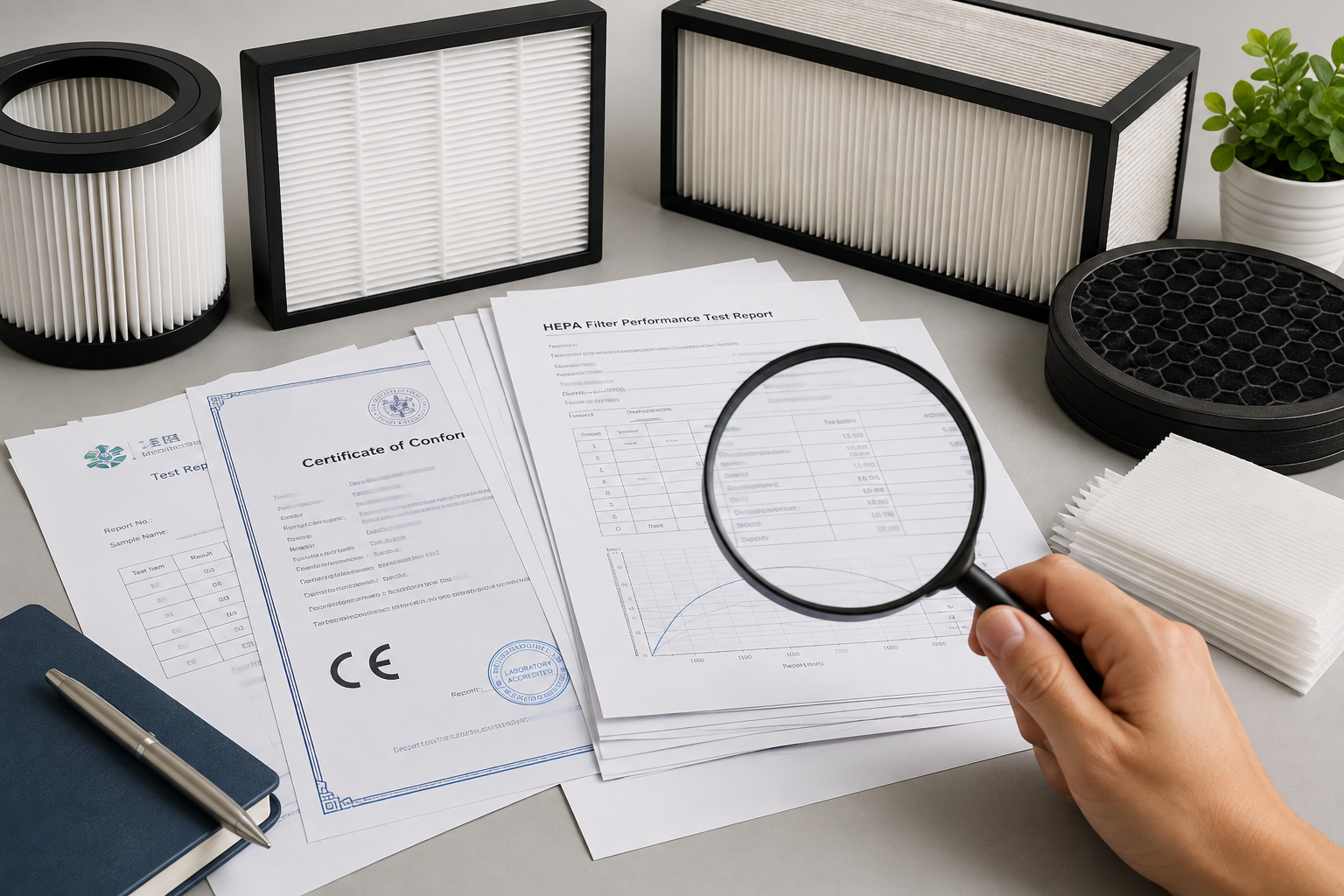
At HIFINE we manufacture custom HEPA filters and replacement cartridges that span from MERV 11 residential panels to H14 medical-grade elements. We pleat media to your dimensions, seal gaskets to your housing, and can provide EN 1822 test data on production batches.
If your product needs a MERV 13 HVAC panel for a North American retail line, we build it. If you need an H13 cartridge for a vacuum cleaner or air purifier sold in Europe, we build that too. We can also advise on when a MERV rating is enough for your market and when a HEPA grade is the right specification.
Tell us your target rating, dimensions, and application. We will recommend the media and send sample filters for your own airflow and efficiency testing.