Most people who smoke indoors know it smells. What’s less obvious is the scale of what’s actually happening to the air in the room, and how long it keeps happening after the cigarette is out.
This isn’t a lecture about smoking. It’s a breakdown of the air quality data, because the numbers are specific enough to be worth knowing. If you are looking for an effective air purifier for smoke, you need to understand that tobacco contamination is more complex than just a bad smell. The numbers below explain why standard filtration often fails and what specifications actually work to clear the air.
What One Cigarette Does to PM2.5 Levels
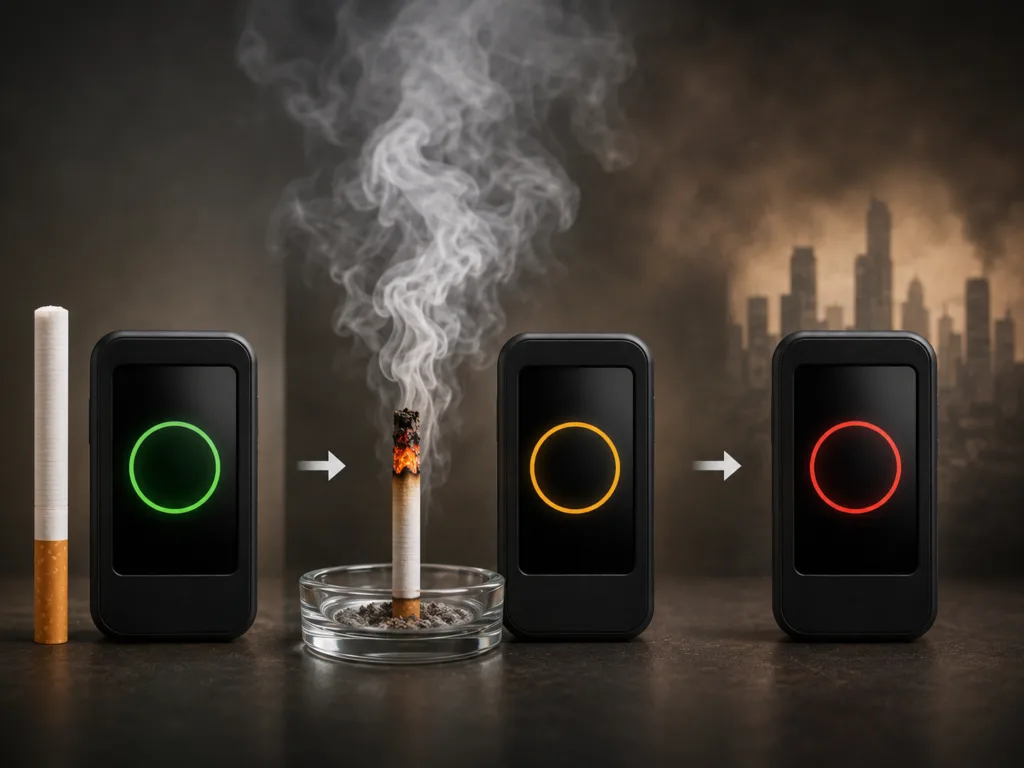
PM2.5 refers to particles smaller than 2.5 microns in diameter, small enough to pass through the upper airways and reach the lung tissue directly. The WHO’s recommended safe limit for indoor air is 15 µg/m³ over 24 hours.
Median PM2.5 concentrations in smoking homes measure around 31 µg/m³, compared to 3 µg/m³ in non-smoking homes, roughly ten times higher. That baseline figure reflects ambient levels between smoking events. During active smoking, concentrations spike sharply above that median.
A single cigarette burned under controlled conditions generates mean PM2.5 concentrations of approximately 1,700 to 2,000 µg/m³ in the immediate smoke stream. In a closed room, that disperses and dilutes, but it doesn’t disappear. It distributes through the room air, settles on surfaces, and re-suspends with air movement.
Indoor PM2.5 is the most reliable marker for the presence of tobacco smoke, and research has directly linked elevated indoor PM2.5 to chronic lung diseases. The correlation holds even at concentrations below the acute exposure thresholds. Long-term, low-level exposure, not just peak events, is where the health burden accumulates.
For context: Berkeley Earth’s benchmark equates 22 µg/m³ of PM2.5 concentration to approximately one cigarette per day of exposure. A smoker’s home running at median levels is, by that measure, equivalent to passive exposure of roughly 1.4 cigarettes daily for anyone else in the household, including children and non-smoking adults, simply from living there.
The Three Stages of Indoor Tobacco Contamination
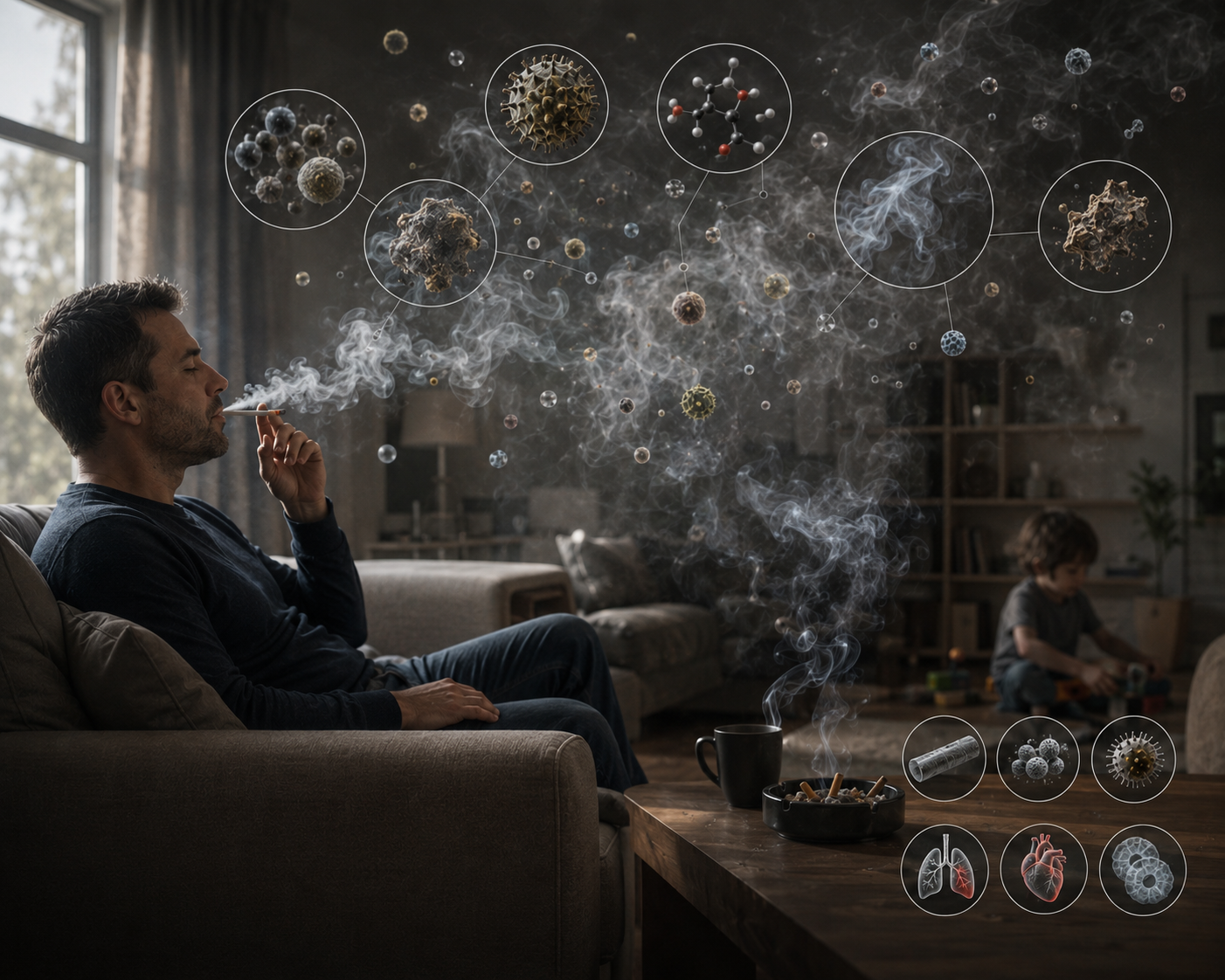
Most people think of indoor tobacco smoke in one stage: the smoke itself. The contamination actually operates across three distinct phases, each with a different timeframe and a different filtration challenge.
Firsthand Smoke
The direct inhaled stream from the cigarette: highest concentration, shortest duration. The person smoking is absorbing the greatest exposure during this phase.
Secondhand Smoke
The sidestream smoke and exhaled smoke that disperses into room air. This is what non-smokers in the same room are breathing. It contains the same compounds as firsthand smoke at lower but still medically significant concentrations. Children, whose respiratory systems are still developing, absorb these compounds at higher effective doses per kilogram of body weight than adults.
Secondhand smoke disperses relatively quickly with ventilation. Opening a window after smoking meaningfully reduces airborne concentrations. This is the phase most people think of when they consider indoor smoking’s effects.
Thirdhand Smoke
Thirdhand smoke is the toxic residue from tobacco smoke that adheres to surfaces such as walls, furniture, carpets, and curtains. Unlike secondhand smoke, which is inhaled directly from the air, this contamination embeds itself in indoor environments and continuously re-emits particles and gases back into the air, undergoing chemical changes over time.
Porous materials like wool carpets and fabric upholstery act as deep reservoirs, absorbing tobacco-related chemicals and then slowly releasing them back into the air, making thirdhand smoke highly resistant to simple ventilation, with contamination persisting for hours or even days after a single smoking event.
This is the stage that catches most people off guard. You can ventilate the room, spray air freshener, and open every window, and the contamination persists in the materials themselves, re-releasing slowly into the air you continue to breathe.
What’s Actually in the Air
Tobacco smoke contains over 7,000 chemical compounds. The ones that matter most for indoor air quality fall into two categories: particles and gases.
Particles: PM2.5 is the primary concern. Ultrafine particles below 0.1 microns are also present in tobacco smoke and penetrate deep into lung tissue. These are captured effectively by H13 HEPA filters. Particle removal is the strongest application of HEPA technology in smoking environments.
Gases and VOCs: Formaldehyde, benzene, toluene, xylene, acrolein, hydrogen cyanide, and nicotine vapor, all present in secondhand and thirdhand smoke. Sixty-six components of sidestream cigarette smoke have been identified in thirdhand smoke on clothing fabrics, including benzene, toluene, xylene, pyridine, naphthalene, and nicotine, several of which carry high toxicity.
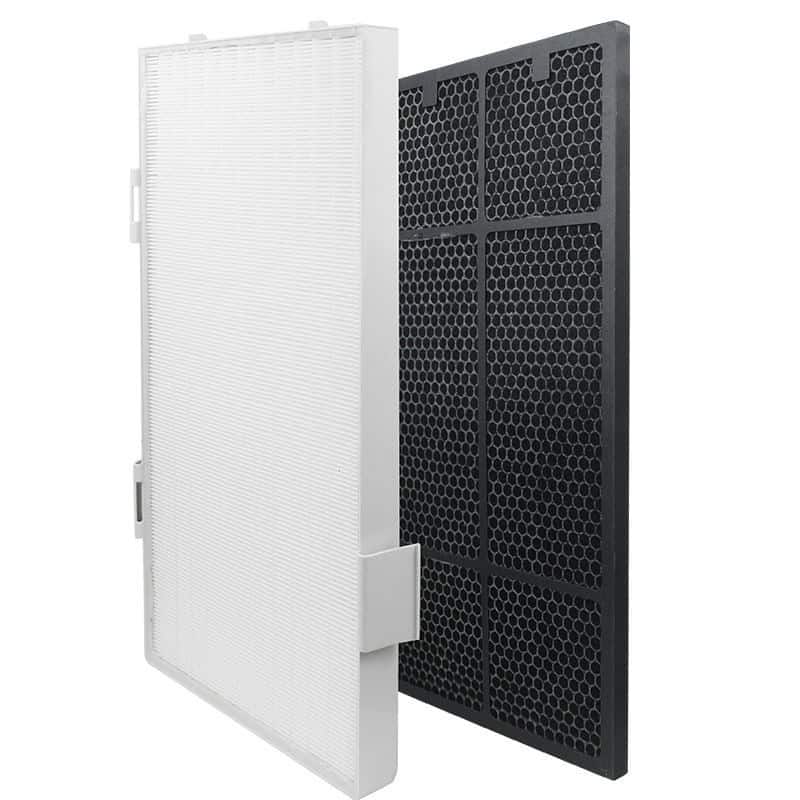
These gases are not captured by HEPA alone. Activated carbon is required to adsorb VOCs, but it has specific limitations depending on the chemical structure. This is precisely why the combination of HEPA plus a heavy activated carbon bed is the relevant filtration architecture for smoking environments, not HEPA-only. A purifier with a thin carbon layer will exhaust that capacity quickly in a regularly smoking household, at which point gas-phase contaminants pass through unaddressed.
Carbon monoxide: CO is a colorless, odorless gas produced by tobacco combustion. Standard air purifiers do not remove CO. In a poorly ventilated room with regular smoking, CO levels can reach concentrations that impair cognitive function at sub-acute levels. CO requires ventilation and a dedicated CO monitor, not a filter.
What Ventilation Does and Doesn’t Fix
Opening windows is the most effective single intervention for secondhand smoke. Airflow exchange dilutes and removes airborne particles and gases faster than any residential purifier alone. This matters because air purifier CADR is rated for a specific room volume. A small purifier in a large room with active smoking cannot keep pace with the generation rate.
What ventilation doesn’t address:
Thirdhand smoke contamination in surfaces is unaffected by opening windows. The compounds are embedded in materials, not floating in air. Ventilation removes what’s airborne; it doesn’t extract what’s already adsorbed into carpet, curtains, or wall paint.
Re-emission continues after ventilation stops. A room that was smoked in for years, then cleaned and ventilated, will still show elevated VOC levels from surface off-gassing. This is documented in spaces like hotel rooms and purchased used furniture from smoking households. The air quality signature of tobacco contamination persists long after the smoking stops.
What Air Filtration Can and Cannot Do in a Smoking Environment
Air purifiers with HEPA and activated carbon filtration meaningfully reduce airborne contaminants from tobacco smoke, with specific limits worth understanding before relying on them.
What They Handle Well
PM2.5 and ultrafine particles during and after smoking events. H13 HEPA removes 99.95% of particles at 0.3 microns. For particle load in a smoking environment, HEPA is effective when the purifier has sufficient CADR for the room volume and is running continuously, not only when smoke is visible.
VOCs and odors through activated carbon adsorption. Benzene, toluene, formaldehyde: these adsorb onto activated carbon surfaces. The critical variable is carbon mass. A filter with 50g of carbon in a household with daily smoking will saturate quickly. Environments with regular smoke require higher carbon mass and more frequent replacement intervals than standard.
What They Don’t Address
Carbon monoxide. HEPA and carbon filters don’t remove CO. If CO levels are a concern, and in regularly smoked, poorly ventilated spaces they should be, a standalone CO detector and adequate ventilation are the required response.
Surface contamination. A purifier filters airborne contaminants. It does nothing about what’s already embedded in carpet, fabric, and walls. Thirdhand smoke off-gassing from surfaces adds a constant low-level load to the airborne contamination, which the purifier can partially address as those compounds re-enter the air, but can’t eliminate at the source.
Purifiers are not a substitute for ventilation or smoking outdoors in households with children or people with respiratory conditions. They’re a complementary layer that reduces exposure, not a solution that eliminates it.
The Relevant Numbers for Filter Selection in Smoking Households
If you smoke indoors and are choosing a filtration system, three specifications matter more than brand:
Carbon mass: For smoking environments, target purifiers with at least 1 to 2 lbs of activated carbon. Thin carbon pre-filters found in budget purifiers will exhaust within weeks under regular smoke load.
CADR matched to room size: CADR for smoke is typically listed separately from dust and pollen. The Association of Home Appliance Manufacturers recommends CADR of at least two-thirds the room’s square footage for smoke removal. A 300 sq ft room needs a smoke CADR of at least 200 cfm.
Replacement interval adjusted for load: Manufacturers specify replacement schedules based on average household conditions. A smoking household is not average. Carbon replacement at half the stated interval is a reasonable starting point; actual saturation depends on smoking frequency and room volume.
What can we do for you?
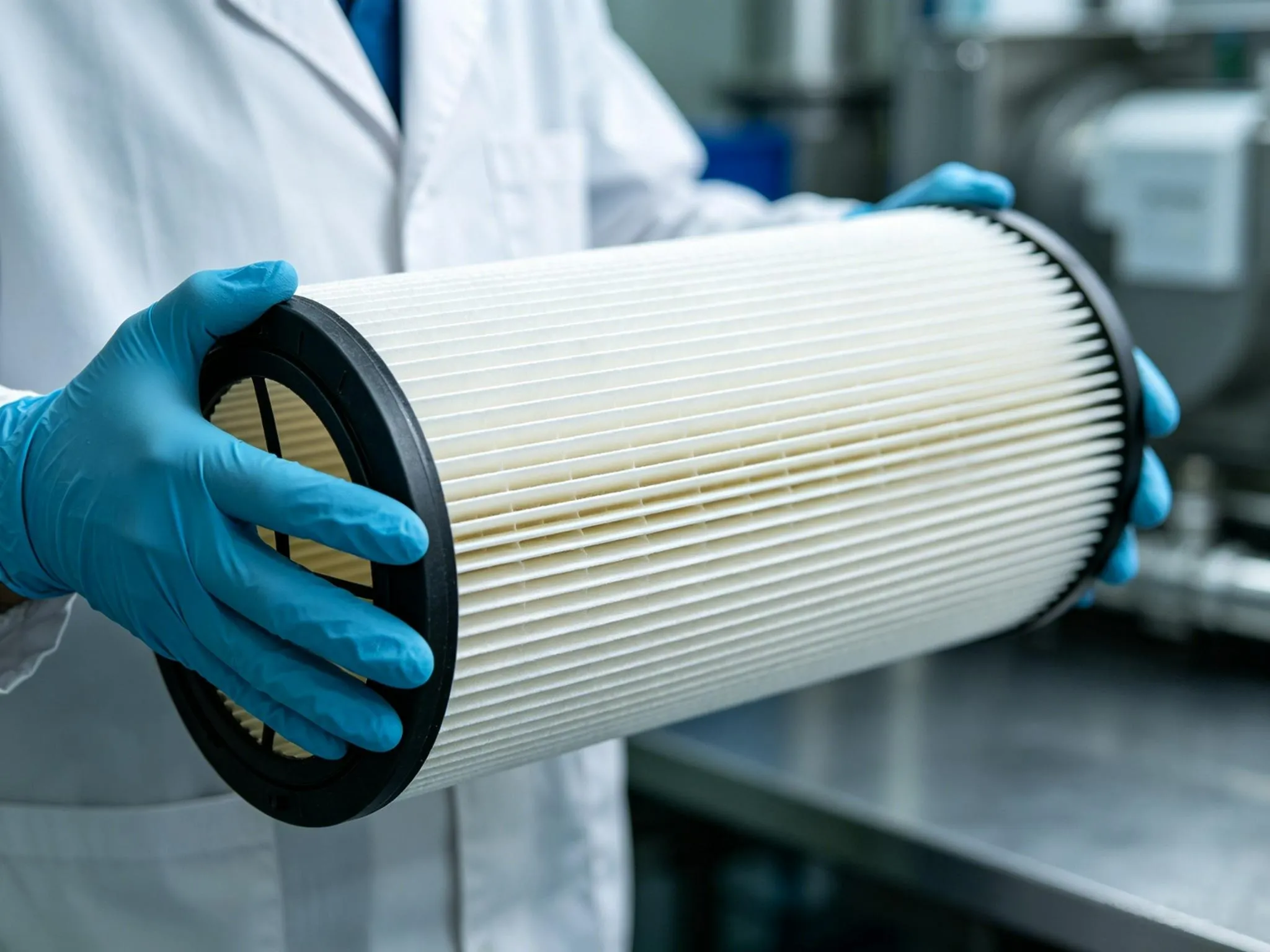
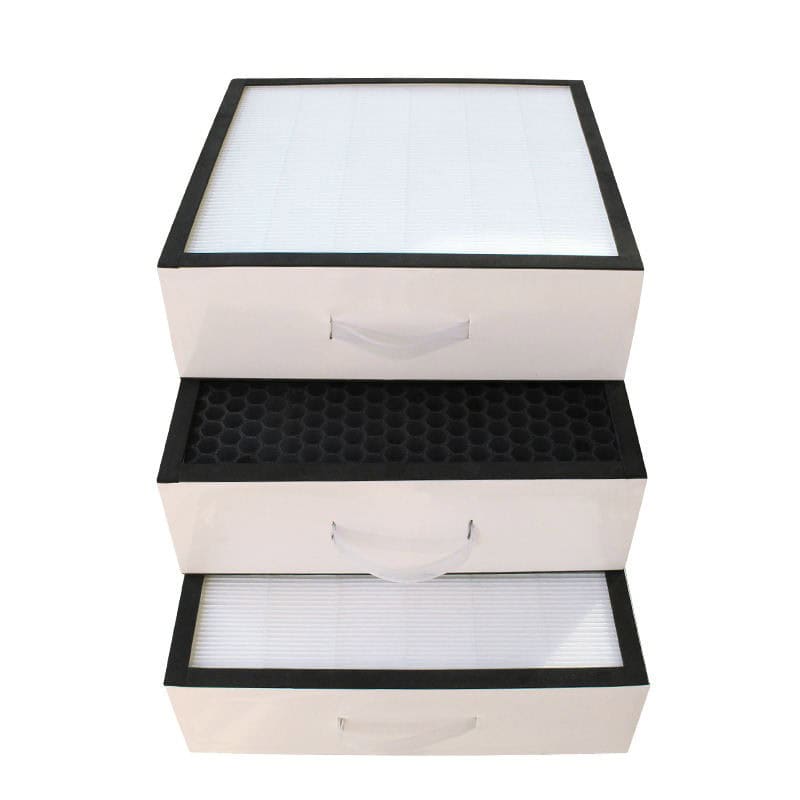
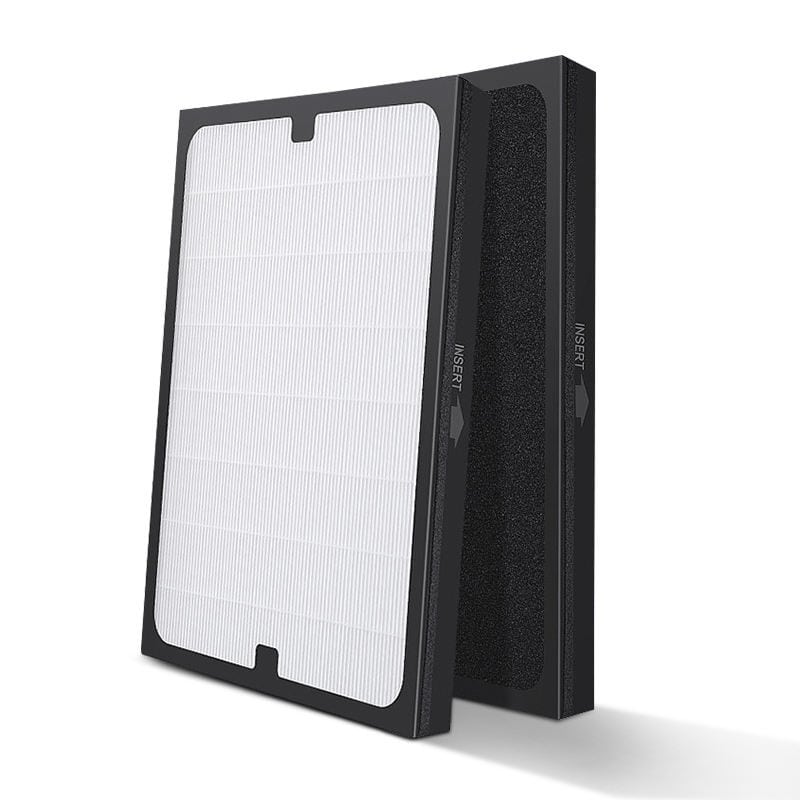
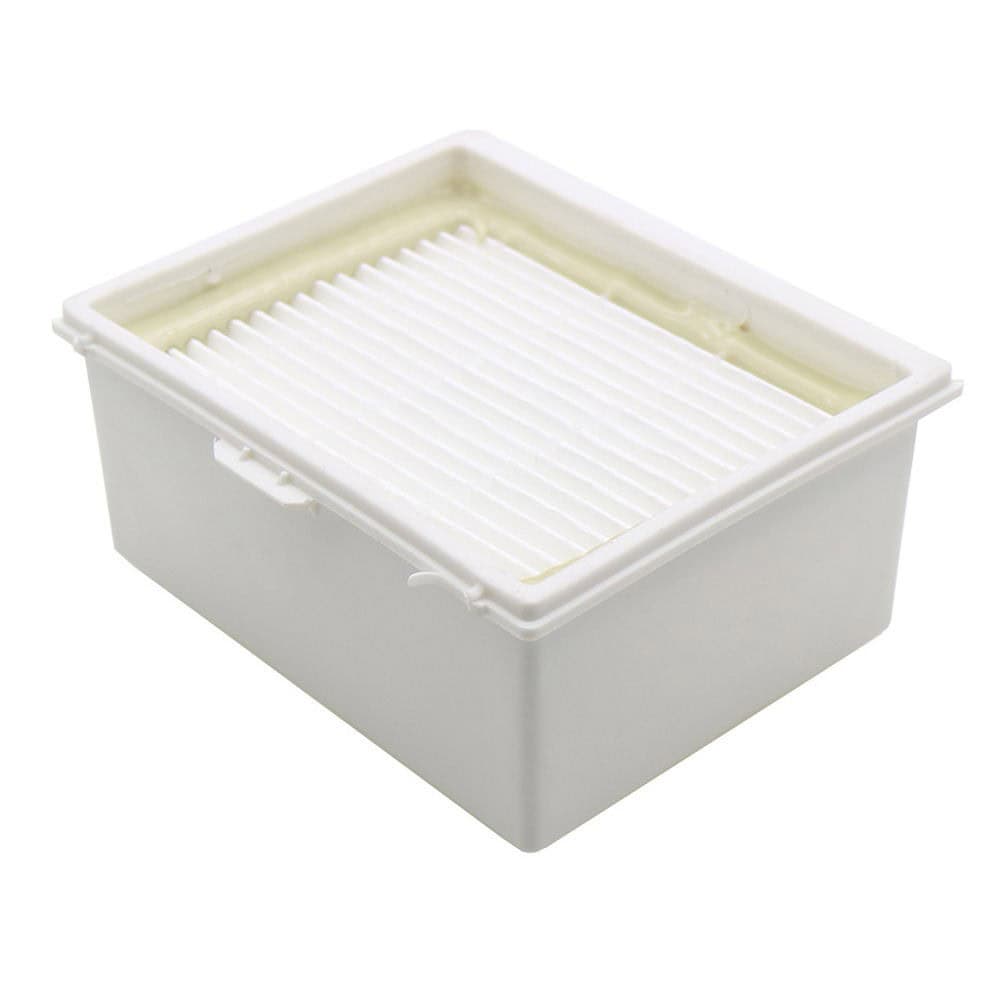
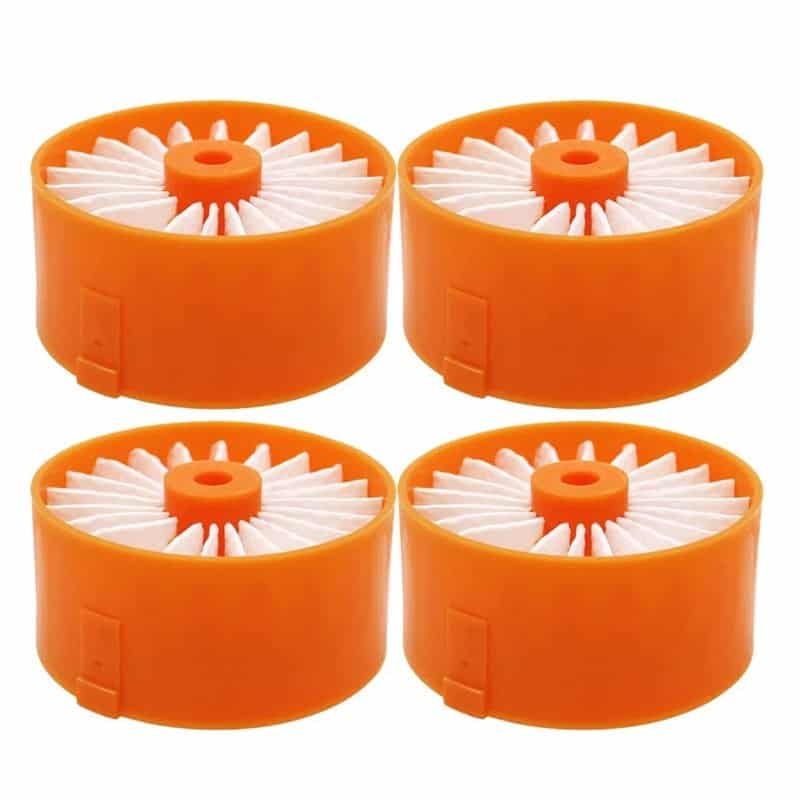
We produce HEPA and activated carbon filter cartridges for air purifier OEM and ODM applications. Smoking environments represent one of the highest-demand use cases for both filter technologies: high particle load for HEPA, high VOC load for carbon, both operating simultaneously.
The engineering trade-off in filter design for smoking environments comes down to airflow resistance versus capture efficiency. Denser HEPA media and thicker carbon beds remove more particles and VOCs, but they also increase pressure drop across the filter, which forces the purifier’s fan to work harder to hold its rated CADR. Push carbon mass up without adjusting media pleating and fan curve accordingly, and airflow drops, noise increases, and effective CADR falls even though the filter is more capable on paper.
This is the balance we work through with OEM and ODM partners: matching carbon mass, HEPA grade, and media pleat depth to the target CADR, room volume, and noise specification a given product needs, rather than defaulting to a standard configuration that wasn’t designed for high-load smoking environments. Because we support low minimum order quantities and keep R&D in-house, filter specs can be adjusted and sampled quickly, without requiring a full production run just to test one configuration change.
For manufacturers building or upgrading air purifiers for the smoking-household segment, that flexibility on carbon mass, filter architecture, and MOQ is often what separates a filter that meets a spec sheet from one that actually performs in a real smoking environment.