
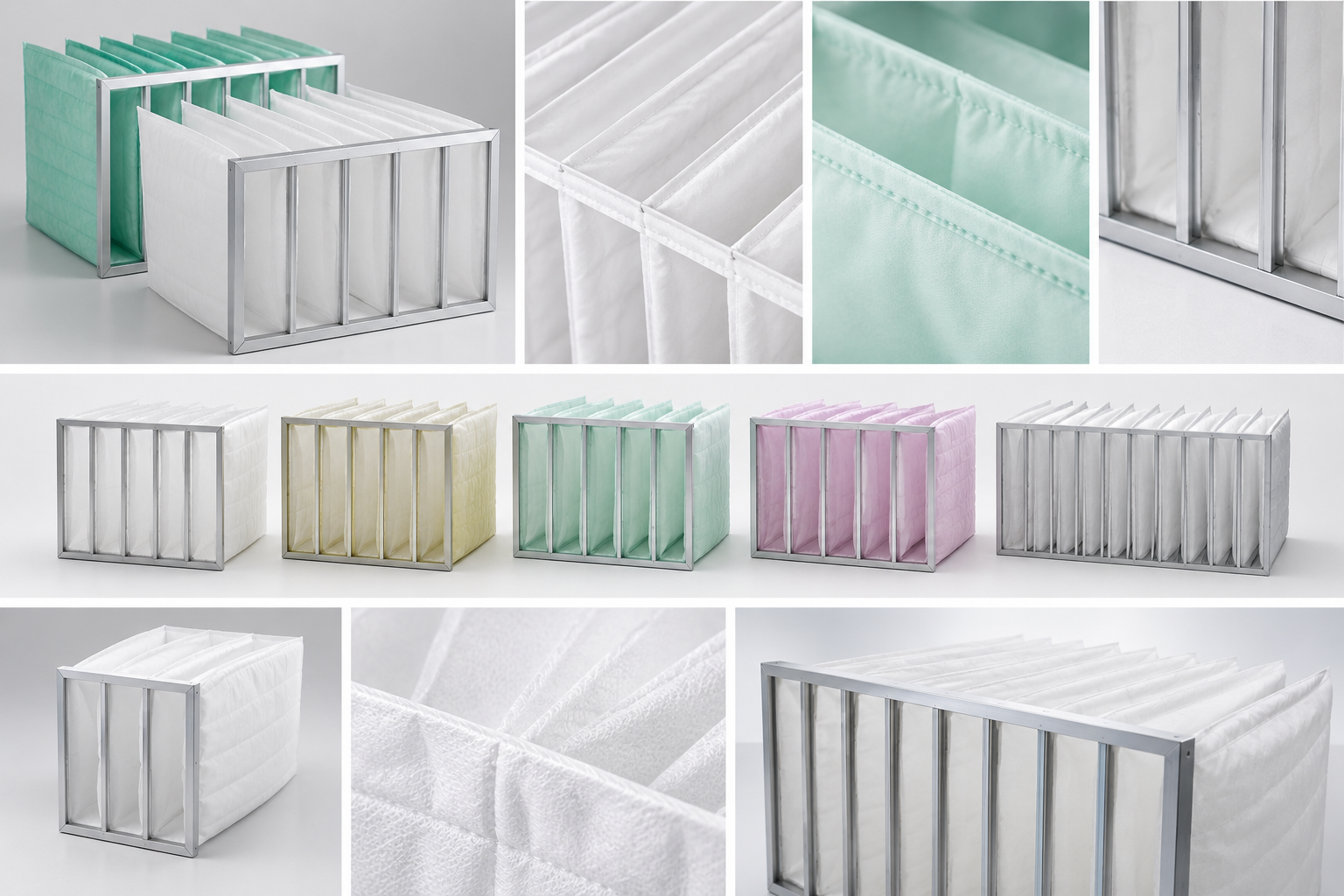
Multi-bag synthetic and glass fiber filter bags for the final filtration stage of commercial treatment systems, available in standard and custom frame sizes.
Why pocket geometry is used
A flat panel filter and a pocket filter can use the exact same media, yet perform completely differently. The pocket shape is really a trick for fitting more surface area into a fixed duct opening. Each pocket is a sealed sleeve of media running back from the frame. A typical multi-pocket filter has somewhere between six and twelve of these sleeves, stitched or welded side by side. Unfolding all of them gives several times more media area than the frame’s face dimensions would suggest. More media area spreads the same airflow across a much larger surface. That lowers pressure drop and lets dust build up over a longer period before the filter needs changing. This is the whole reason pocket filters replaced flat panels as the standard final stage in commercial air handling: better dust-holding capacity per filter change, at a lower long-term pressure penalty.
Media and frame options
Synthetic filter media are a common choice for general commercial buildings such as office buildings and retail stores due to their lighter weight, better moisture absorption, and lower unit price. Glass fiber filter media have a finer and denser fiber structure and are typically used in places where higher filtration efficiency and stability are required, such as hospitals, laboratories, and certain pharmaceutical manufacturing facilities. The table below compares the two.
| Property | Synthetic media | Glass fiber media |
|---|---|---|
| Weight | Lighter | Heavier |
| Moisture handling | Handles moisture well | More sensitive to moisture |
| Fiber structure | Coarser | Finer, denser |
| Cost per filter | Lower | Higher |
| Efficiency | Good, general-purpose | Higher, more consistent |
| Typical settings | Offices, retail | Hospitals, labs, pharma |
Frame material follows a similar split. Galvanized steel headers are standard for permanent AHU installations and hold their shape through repeated filter changes. Cardboard or plastic headers are common on lower-cost, shorter-service filters, where the frame gets disposed of along with the media.
Reading efficiency classes correctly
Bag and pocket filters are most often specified in the F7 to F9 range under the older EN 779 classification. That roughly corresponds to the ePM1 and ePM2.5 categories under the current ISO 16890 standard, which most new specifications use instead. Here’s the practical difference buyers should know: EN 779 rated efficiency against a single reference particle size. ISO 16890 reports performance across a spread of particle sizes (PM1, PM2.5, PM10), which gives a more realistic picture of how a filter behaves against real outdoor and indoor air. If your project spec still references F7/F8/F9, we can supply against either standard and note the approximate ISO 16890 equivalent on the data sheet, since more building certifications now ask for ISO ratings specifically.
Sizing pocket count and depth
Two filters with identical face dimensions can have very different capacity, depending on pocket count and pocket depth. More pockets and deeper pockets both add media area. Deeper pockets need more clearance behind the frame, though, and that clearance isn’t always available in a retrofit. New AHU designs have more freedom to use deep, high-pocket-count filters for maximum service life. For retrofits replacing an existing filter bank, we match pocket depth to the available housing clearance first, then optimize media area within that limit.
Supplying facility-scale volumes
Building owners and facility management contractors typically order on a replacement schedule rather than making a one-off purchase. That’s a different planning problem than a single production run. We set up recurring orders against a fixed frame size and efficiency class, so buyers aren’t re-quoting the same part every quarter. We also keep header tooling on file for repeat sizes, so lead time on reorders is shorter than on a first-time custom size.