Ask five HEPA filter suppliers for a wholesale quote, and you’ll likely get five different numbers, even for what looks like the same spec sheet. The gap usually comes down to a handful of cost drivers buyers don’t always ask about upfront: which media grade you’re actually buying, what the frame is made from, where your order sits on the volume curve, and how much freight and tariffs add once the filters leave the factory.
This guide breaks down what moves the price per unit on a wholesale HEPA filter order in 2026, with a sample cost breakdown to show how the pieces add up, and a checklist for getting an accurate quote without a dozen rounds of back-and-forth.
Why Does H13 Media Cost More Than H11?
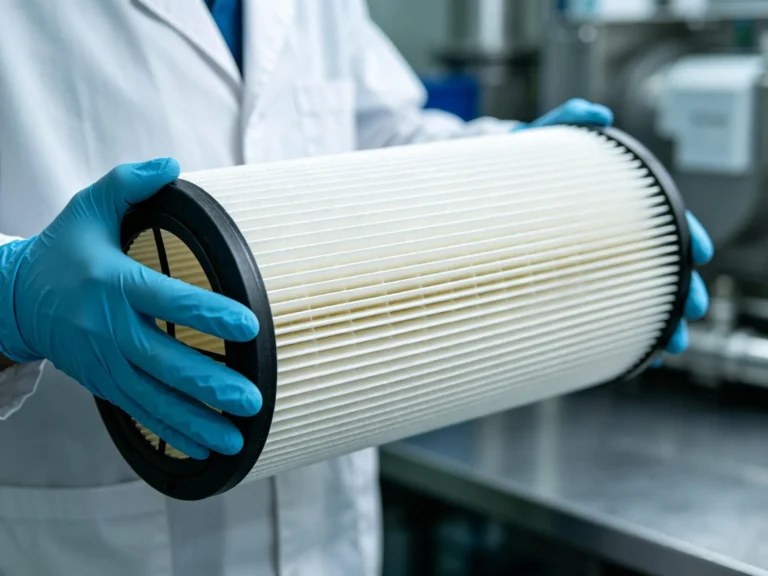
Media grade is the single biggest lever on cost per unit, and it starts with the EN1822 classification system. H10 through H12 filters trap a high share of particles, but H13 and H14 are the true HEPA tiers most buyers mean when they say “HEPA” today. Moving from H11 to H13 usually means finer glass microfibers, a denser fiber mat, and tighter tolerances during pleating and sealing.
Those finer fibers cost more to source and are harder to run through production without tearing or gapping, which slows the line and raises the reject rate. Buyers who compare quotes without checking the media class often end up comparing an H11 filter against an H13 filter and wondering why one price is so much higher. As a rough guide, H13 media typically runs 30% to 50% more per square meter than H11 media, though the gap narrows at higher volumes as fixed costs spread across more units. HIFINE runs both H11 and H13 media lines, and the cost gap described here reflects real tooling and material differences, not an arbitrary markup.
If your end customer doesn’t need true HEPA performance, an H11 or H12 filter can cut your per-unit cost meaningfully without giving up much real-world benefit in a residential air purifier. If the filter is going into a medical, lab, or cleanroom application, H13 or H14 usually isn’t optional, so it’s worth confirming which class your end use actually requires before you compare quotes.
Find the perfect product for you in our catalog now!
What Frame Material Should You Choose?
The frame holding the filter media in place is the second-biggest swing factor, and it comes down to three common choices.
Cardboard or kraft paper frames are the cheapest option and the fastest to produce, since they don’t need injection molding or metal stamping. They work well for filters that stay indoors in stable humidity, but they can warp or lose rigidity in damp shipping containers or humid climates, so they’re a weaker fit for long ocean freight routes without extra moisture protection.
Plastic frames, usually molded ABS or PP, sit in the middle. They hold their shape better in transit and can be molded to fit odd or curved housings, but they need dedicated tooling if the shape isn’t already in a factory’s mold library. That tooling cost gets built into your first order and usually isn’t repeated on reorders of the same shape.
Aluminum frames are the most expensive and are mostly used for industrial or cleanroom-grade filters that need to handle higher airflow, higher temperatures, or repeated washing and reuse. For most consumer air purifier and vacuum filter programs, aluminum offers more durability than the application needs, adding cost without a matching benefit for the end customer.
How Do MOQ and Volume Breaks Affect Price?
Per-unit price drops as order size grows, but not in a straight line. Most factories price wholesale HEPA filters in tiers, and the biggest jump usually happens between a trial order and the first real production run.
A small trial order, often a few hundred to a thousand units, carries the highest per-unit cost because setup time, tooling amortization, and material waste get spread across a small batch. Once you cross into a standard production run, commonly a few thousand units depending on the filter type, the per-unit price usually drops by a noticeable margin because the factory is running the line efficiently and buying raw materials in bulk.
A second break tends to show up at higher volumes, often tied to full container loads, where freight cost per unit drops sharply because you’re filling a container instead of paying a partial-load rate. This is where the volume curve bends the most for buyers moving from a few thousand units to tens of thousands.
Ask your factory to show you the price at two or three volume tiers rather than a single number. Seeing where the curve bends helps you decide whether it’s worth ordering a bit more now to land in a better pricing tier, rather than reordering twice at the smaller rate.
How Much Do Freight and Tariffs Really Add?
Factory price and landed cost are two different numbers, and the gap between them is often bigger than buyers expect.
Ocean freight rates swing with fuel prices and container demand, and HEPA filters are bulky relative to their weight, so you’re often paying for volume rather than mass. A filter order that looks cheap at the factory gate can lose most of that advantage once you calculate cost per cubic meter of container space, especially for larger panel or cartridge filters that don’t stack efficiently.
Tariffs add another layer, and they depend on your destination country, the product’s HS code classification, and current trade policy, which shifts often enough that it’s worth confirming rates close to your order date rather than relying on a number from a past shipment. Buyers who only budget for the factory price, and not the landed cost after freight and duties, are often surprised when the final number lands 15% to 30% higher than the quote they started with.
Ask your factory or freight forwarder for a landed cost estimate to your specific port, not just an FOB price. It’s a better number to build your retail or B2B pricing around.
What Does a Sample Cost Breakdown Look Like?
Every factory’s cost structure is different, but a rough breakdown helps show where the money in a wholesale HEPA filter actually goes. The numbers below are illustrative only, reflecting the general cost structure HIFINE uses when quoting wholesale and private label orders alike, and they will shift based on media grade, frame type, and order size.
| Cost Component | Approx. Share of Unit Cost |
|---|---|
| Filter media | 35–45% |
| Frame and housing | 15–20% |
| Labor and assembly | 15–20% |
| Packaging | 5–10% |
| Freight (FOB to landed) | 10–20% |
| Factory margin | 10–15% |
Media and freight are the two components most likely to move a quote significantly, which is why buyers who only negotiate on factory margin often miss the bigger levers. Asking your supplier for a breakdown like this, even a rough one, makes it much easier to see where a competitor’s lower quote is coming from before you assume it’s simply a better deal.
How Do You Get an Accurate Quote Fast?
The fastest way to get a real number instead of a placeholder estimate is to hand your supplier a complete spec sheet upfront, rather than trading emails back and forth for a week.
At minimum, confirm the filter dimensions and airflow rating, the required media class, the frame material, the packaging tier you want, and your destination port or country. HIFINE, for example, can usually turn around a firm quote within a day or two once these details are confirmed, compared to a much longer back-and-forth when specs come in piecemeal.
It also helps to ask for pricing at more than one volume tier in the same request, so you can see the curve instead of a single number. If you’re building a private label program alongside a standard wholesale order, mention that upfront too, since packaging and barcode requirements change the quote.
HIFINE manufactures HEPA filter media and OEM filter components for air purifier, vacuum cleaner and water purifier brands, and its OEM customer base extends to other home appliance categories, so its quoting process is designed to handle mixed product lines in a single request.
For related reading, see our guide on calculating your annual HEPA filter spend and our breakdown of China vs US manufacturing costs.
Ready to see where your order lands on the pricing curve? Request a quote with your specs, and we’ll get back to you with a real number, not a placeholder.