
A container gets held at the port. The importer pulls the paperwork, and the efficiency number on the test report doesn’t match the number printed on the retail box. Now the shipment sits in a compliance review, and nobody can say for certain whether the filters inside actually meet the grade the supplier promised.
This happens more often than most first-time OEM buyers expect, and it almost always traces back to one thing: someone checked that a test report existed, but nobody actually read what it said.
If you buy HEPA filters, air purifier filters, or vacuum filters for a private-label or OEM program, this one-page report is what decides whether your shipment passes a retail compliance audit, an EU customs check, or a customer’s own lab retest. Two standards govern nearly everything written on it: EN1822, used across Europe and much of Asia, and the DOE-style definition, used across North America. They are not interchangeable, and a supplier who blends the two without saying so is either careless or hoping you won’t notice.
EN1822 and DOE Are Answering Two Different Questions
EN1822:2019 doesn’t ask “does this filter catch 99.97% of particles.” It asks a harder question: at the one particle size this specific filter struggles with most — its Most Penetrating Particle Size, or MPPS, usually somewhere between 0.1 and 0.3 microns — how much gets through? The filter is then classified from E10 up to U17 based on that single number.
The DOE-style approach, which underlies the U.S. IEST-RP-CC001 standard, works differently. It fixes the test particle at 0.3 microns and asks a simpler question: does the filter catch at least 99.97% of particles at that one fixed size? This is the figure most American consumers recognize, and it’s also the baseline the U.S. Department of Energy has required for its own nuclear-grade filter testing programs for decades.
Neither test is “better” in isolation. But a report that says “H13” and a report that says “99.97% at 0.3 micron” describe two different tests, on two different particle sizes, using two different pass-fail rules. Treating the two numbers as interchangeable is where most sourcing mistakes begin.
What “H13” or “H14” Actually Means on an EN1822 Certificate
Under EN1822, H13 requires 99.95% overall efficiency at MPPS. H14 requires 99.995% — a jump that looks small on paper but is actually a tenfold cut in leakage. A second requirement kicks in only at H14 and above: local efficiency. The filter can’t just perform well on average; a scan test hunts for the single weakest point on the entire filter face, and that one spot has to clear its own, stricter threshold too. An EN1822 report for H14 or higher that shows just one efficiency figure, with no scan or local-efficiency result, is missing half the story.
What “99.97% at 0.3 Micron” Means on a DOE-Style Report
Under IEST-RP-CC001, this baseline is labeled Type A. Higher tiers, Type B through K, exist for filters that must hold their efficiency at both full and reduced airflow, or that have passed an additional scan/leak test for cleanroom use. A report that simply states “99.97%” with no type letter and no named test method is repeating a marketing line, not a test result.
How the Classes Line Up
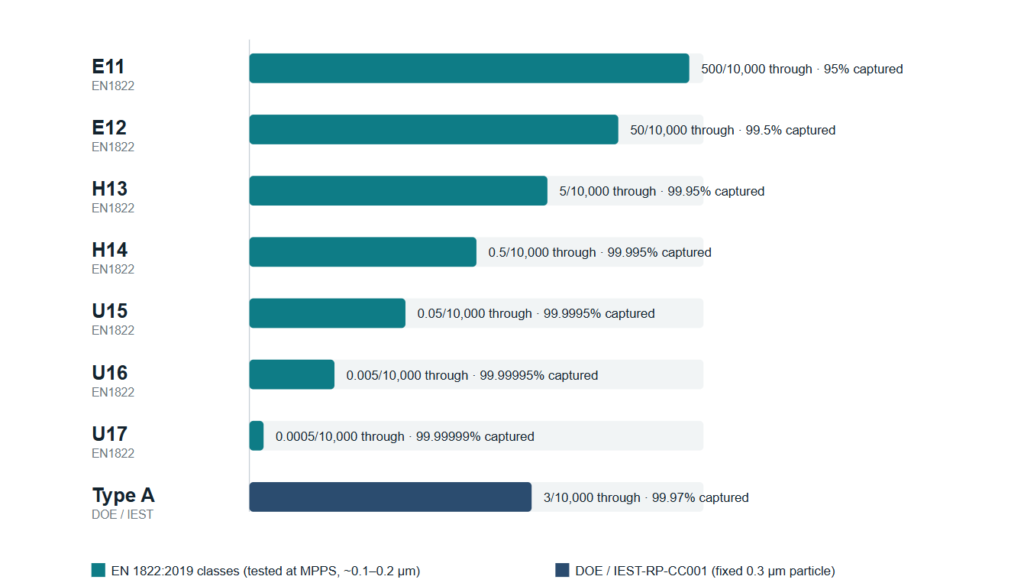
| Class | Standard | Overall Efficiency | Local Efficiency | Roughly Comparable To |
|---|---|---|---|---|
| E11 | EN1822 | 95% | — | Pre-filter grade |
| E12 | EN1822 | 99.5% | — | Fine filter |
| H13 | EN1822 | 99.95% | 99.75% | DOE Type A range |
| H14 | EN1822 | 99.995% | 99.975% | DOE Type B/C range |
| U15 | EN1822 | 99.9995% | 99.9975% | Cleanroom grade |
| Type A | DOE / IEST | 99.97% at 0.3µm | — | General HVAC |
| Type C | DOE / IEST | 99.99% at 0.3µm | Scan tested | Pharma / cleanroom |
These are close approximations, not exact conversions. The two systems test different particle sizes, so a one-to-one match doesn’t exist — treat this table as a way to sanity-check a claim, not to translate one number into the other.
Five Fields a Legitimate Report Must Show
- The exact standard and version cited — “EN 1822-1:2019,” not just “EN1822,” and “IEST-RP-CC001.6,” not just “IEST.”
- The actual MPPS value tested, or the fixed particle size used, stated in microns — not just “sub-micron.”
- Overall efficiency, and for H14+ or Type C+, a separate local or leak-scan result.
- The name of the testing lab and its accreditation number, ideally ISO/IEC 17025 — the accreditation standard that lets a lab’s results be trusted across borders.
- The airflow or face velocity the test ran at. Efficiency changes with flow rate, so a report with no stated airflow is missing the condition its own number depends on.
Three Signs a Report Might Be Recycled
The filter dimensions or model number on the report don’t match the batch you’re buying. Suppliers sometimes reuse an old report from a similarly sized filter, because a fresh third-party test costs money and takes weeks.
The listed accreditation body doesn’t check out in its own public registry. A genuine ISO/IEC 17025 accreditation is searchable by lab name; if it isn’t there, the claim is unverifiable.
The report is dated before your custom specification was finalized. If you asked for a custom frame, media pack, or gasket design, a real test for that exact filter can’t predate the tooling that made it.
Cross-Check the Paper Against the Physical Sample
Before approving mass production, ask for one more thing: a short video of the scan or leak test on your actual production batch, or a retest through a neutral third party such as SGS, Intertek, or TÜV. Manufacturers confident in their filters would not object to this cost being negligible compared to the subsequent losses from failed customs inspections or retailer rejections.
For buyers building a private-label air purifier or vacuum line, this verification step matters more than the printed number itself. Hifine’s H13 HEPA filters and H14 HEPA filters ship with lab reports tied to the exact batch and dimensions on the purchase order, and our OEM/ODM filtration solutions team can arrange an independent retest before your production run starts, if your program requires it.