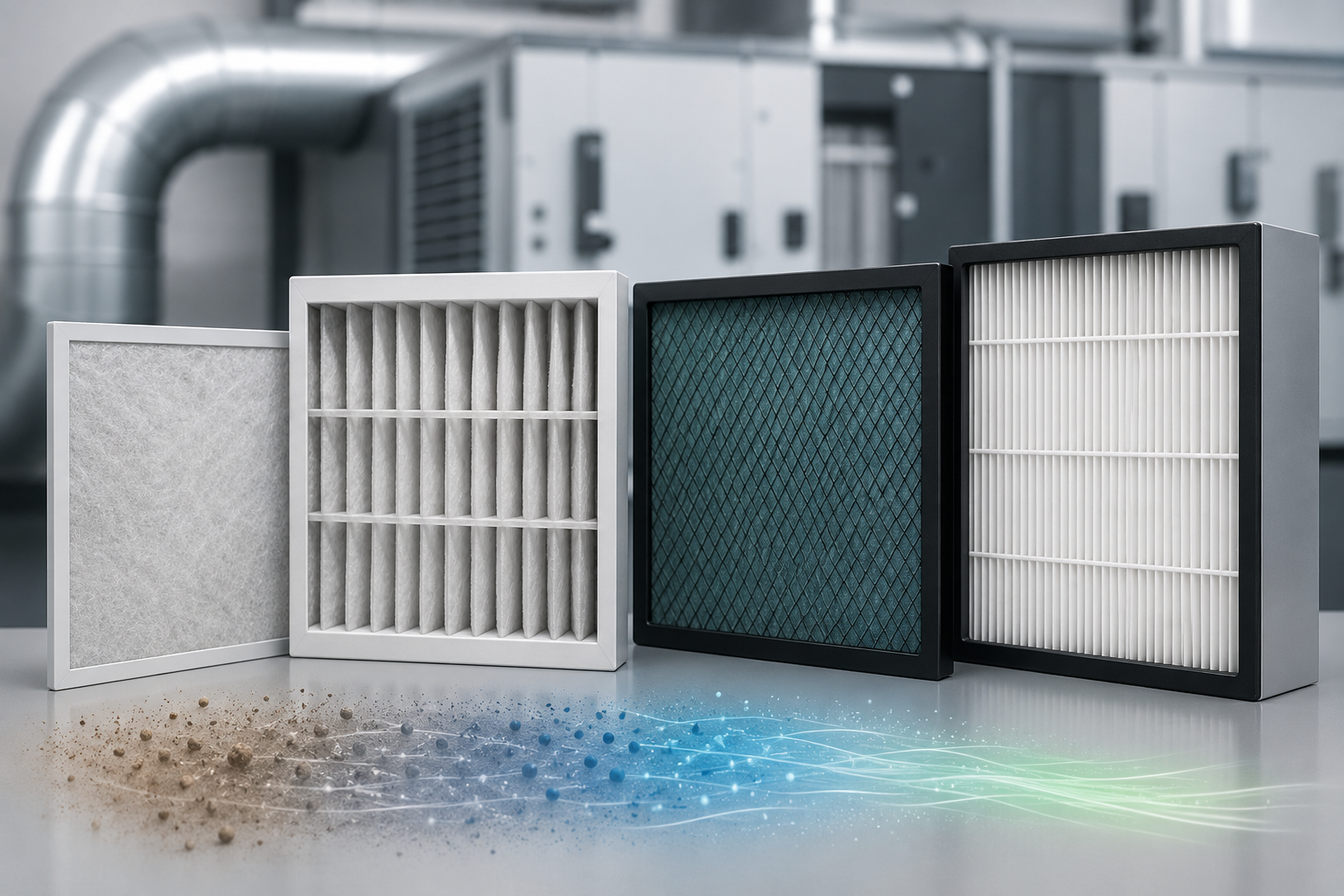

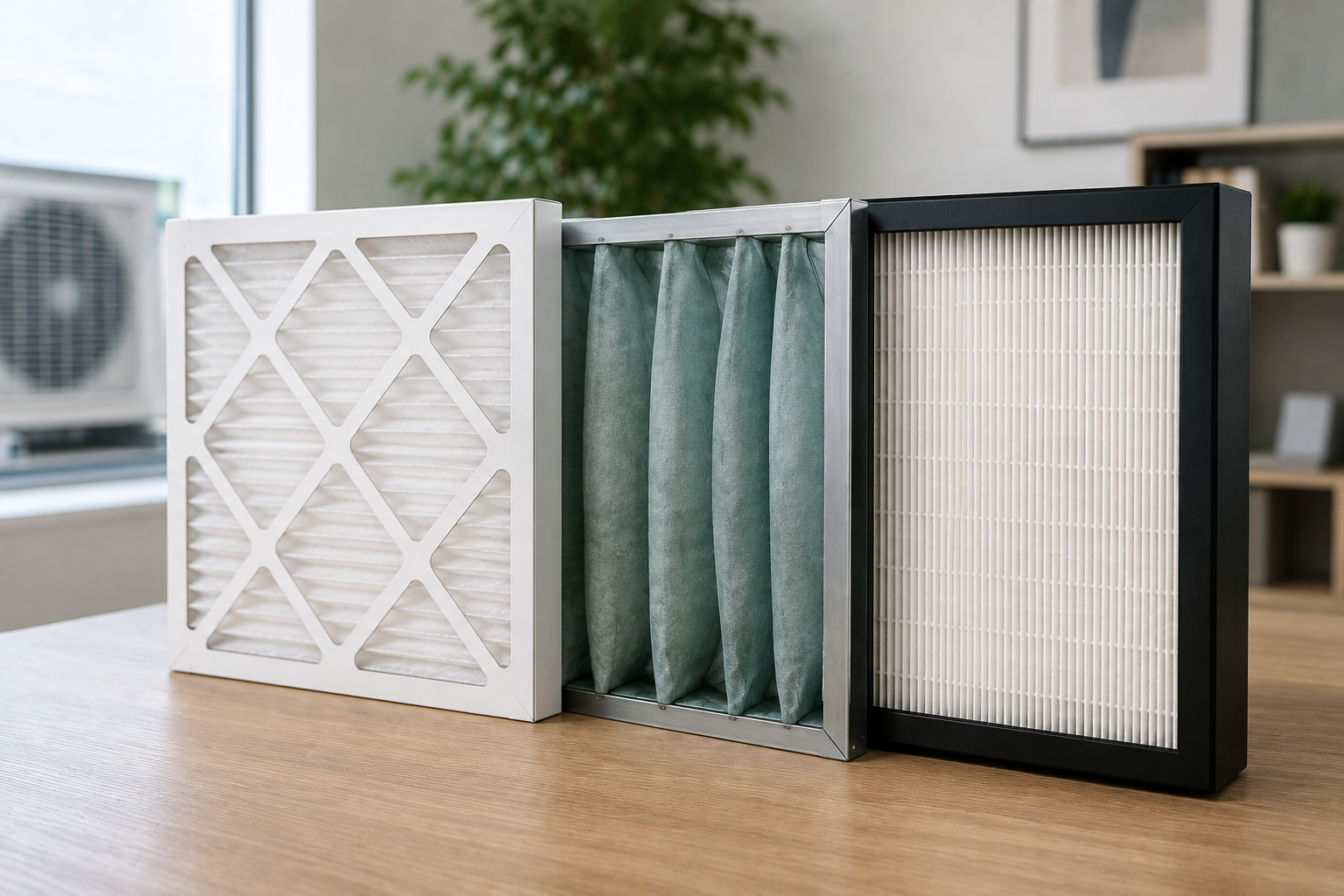
One of the first things HVAC buyers do when evaluating filter specs is compare effectiveness ratings. A distributor quote may list MERV, HEPA or ISO 16890 categories, but those numbers are not measured the same way.
This is a common problem with world-wide a/c projects where a filter that looks good on paper may not necessarily be the best match for the actual air handling system.
By understanding the difference between MERV, HEPA and ISO 16890 ratings, building owners, representatives and cooling and heating providers can select filters that are fit for purpose, not just the highest ranking.
Why HVAC Filter Ratings Often Produce Confusion
The rating of an ac system filter tells how well a filter can remove particles from the air. However, each standard uses different testing methods and applications.
The three main filtration classification systems are:
- MERV: Used mainly in North America
- ISO 16890: International standard for filters in general ventilation
- HEPA Classification: For high efficiency air purification applications
The difference matters because HVAC systems are designed for more than filtration efficiency.
A filter also influences:
- air flow efficiency
- fan energy use
- substitution ratio
- indoor air quality
- total cost of ownership
For commercial buildings, selecting the correct rating requires balancing filtration performance with system limitations.
MERV Rating: The Common HVAC Standard in North America
ASHRAE Standard 52.2 is used to calculate MERV ratings, which measure filter efficiency for various particle sizes.
The MERV scale typically ranges from MERV 1 to MERV 16. Higher ratings mean better particle removal performance.
Common applications include:
| MERV Rating | Typical Application |
|---|---|
| MERV 8 | Basic commercial and residential HVAC filtration |
| MERV 11 | Improved indoor air quality applications |
| MERV 13 | Offices, schools, healthcare-related spaces |
| MERV 14-16 | Higher efficiency commercial filtration |
But a higher MERV rating doesn’t always mean better HVAC performance.
More efficient filters tend to more restrict airflow. If the HVAC system isn’t designed for that resistance, it may result in higher energy usage or less air volume.
Thus, in the professional filter selection the efficiency and pressure drop are considered.
ISO 16890: A Global Approach to HVAC Filter Classification
ISO 16890 was introduced to provide a more realistic classification method for ventilation filters.
Unlike MERV, which uses specific particle size testing categories, ISO 16890 evaluates filter performance based on particulate matter groups:
- ePM10
- ePM2.5
- ePM1
These classifications are related to the size of particulate matter in the air.
For example:
- ISO ePM10 focuses on larger particles such as dust
- ISO ePM2.5 evaluates fine particles
- ISO ePM1 targets smaller airborne particles that are more difficult to capture
According to ISO 16890, ventilation filters are classified according to their fractional efficiency against particulate matter ranges.
This makes ISO 16890 especially useful for international HVAC projects where outdoor air pollution levels and building requirements vary.
MERV to ISO 16890 Conversion: Why There Is No Exact Match
Many HVAC buyers look for a MERV to ISO 16890 conversion chart, but these standards are not convertible with complete accuracy.
A general comparison is often used:
| MERV | Approximate ISO 16890 Classification |
|---|---|
| MERV 8 | ISO ePM10 range |
| MERV 11 | ISO ePM2.5 / ePM10 range |
| MERV 13 | ISO ePM1 range |
| MERV 14-16 | Higher ISO ePM1 efficiency |
The reason is simple: the testing procedures are different.
MERV and ISO 16890 test filters with different particle distributions and calculation approaches. The conversion should therefore be used only as a reference.
When designing an OEM filter, manufacturers will typically select the filter media, pleat design and thickness based on the HVAC system they are designing for, rather than translating the ratings directly.
Why HEPA Filters Are Different From HVAC Ratings
HEPA filters are often considered “better filters than MERV filters.” But this is not the case.
HEPA filters are used in applications where a very high particle removal efficiency is required. HEPA filters are generally tested according to standards such as EN 1822 or ISO 29463.
Typical HEPA applications are:
- healthcare environments
- Laboratories Clean-rooms Pharmaceutical premises
- high-tech air filters
Many commercial HVAC systems do not require HEPA filtration in all locations and may add to operating costs .
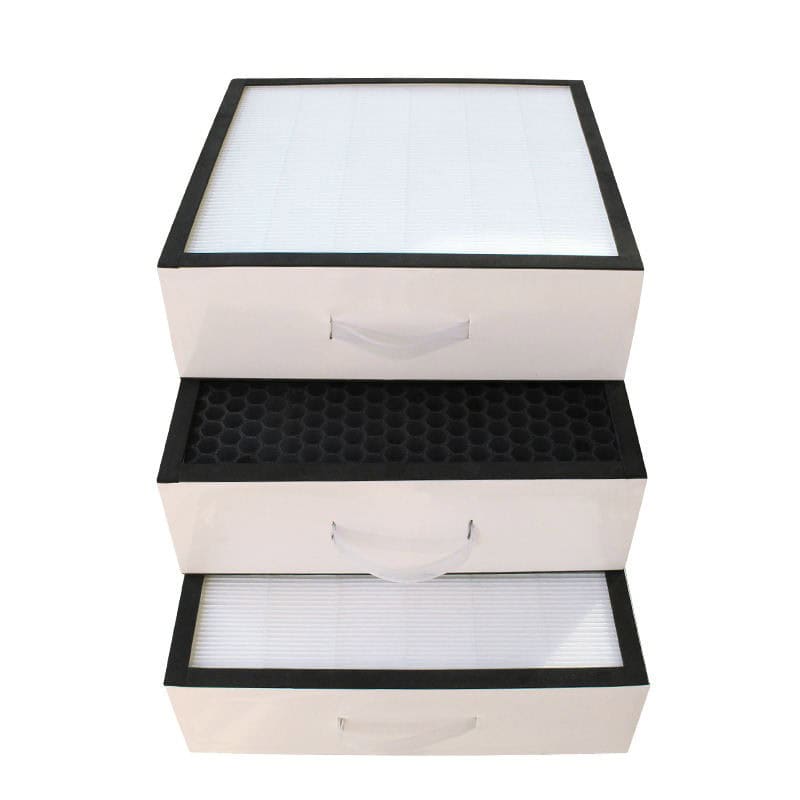
A more practical design might involve multiple stages of filtration:
Pre-filter → Fine filter → Final HEPA filter
This method protects the HEPA filter, extends the service life and lowers the maintenance costs.
How HVAC Manufacturers Select the Right Filter Rating
In real filter customization projects, efficiency is only one part of the decision.
Engineers usually evaluate:
Airflow Requirements
The filter must provide sufficient air movement without creating excessive resistance.
Filter Media Performance
Synthetic fibers, Glass fiber and advanced composite media are different materials with different efficiency and loading characteristics.
Installation Space
A deeper pleat design may improve dust-holding capacity without increasing the filter footprint.
Maintenance Requirements
A commercial building may prioritize longer service life, while healthcare applications may prioritize maximum particle control.
This is why selecting a filter is an engineering decision rather than simply choosing the highest available rating.
HIFINE provides customized filtration solutions for commercial HVAC applications, including filter media selection, structural optimization, and OEM/ODM manufacturing support.
Learn more about our commercial building HVAC filter solutions.
The Right HVAC Filter Rating Depends on the Application
MERV, HEPA, and ISO 16890 are not competing ranking systems.
Each standard was created for different purposes.
For general HVAC applications:
- MERV is widely used in North America
- ISO 16890 is preferred for international ventilation projects
- HEPA is selected for high-cleanliness environments
The best air conditioner filter rating is the one that matches the building requirements, airflow conditions, and operating goals.
For HVAC brands, distributors, and private label buyers, understanding these standards helps create better filter specifications and avoid costly product mismatches.