
Search “Blueair 211 replacement filter” and two very different shapes show up: a round, drum-style cartridge and a flat, foldable panel. Both get marketed as compatible with a Blue Pure “211” model. Only one of them fits a 211i Max, and the shape is the fastest way to tell them apart, before a buyer even gets to the spec sheet.
Why the 211i Max Filter Is Round Instead of Flat
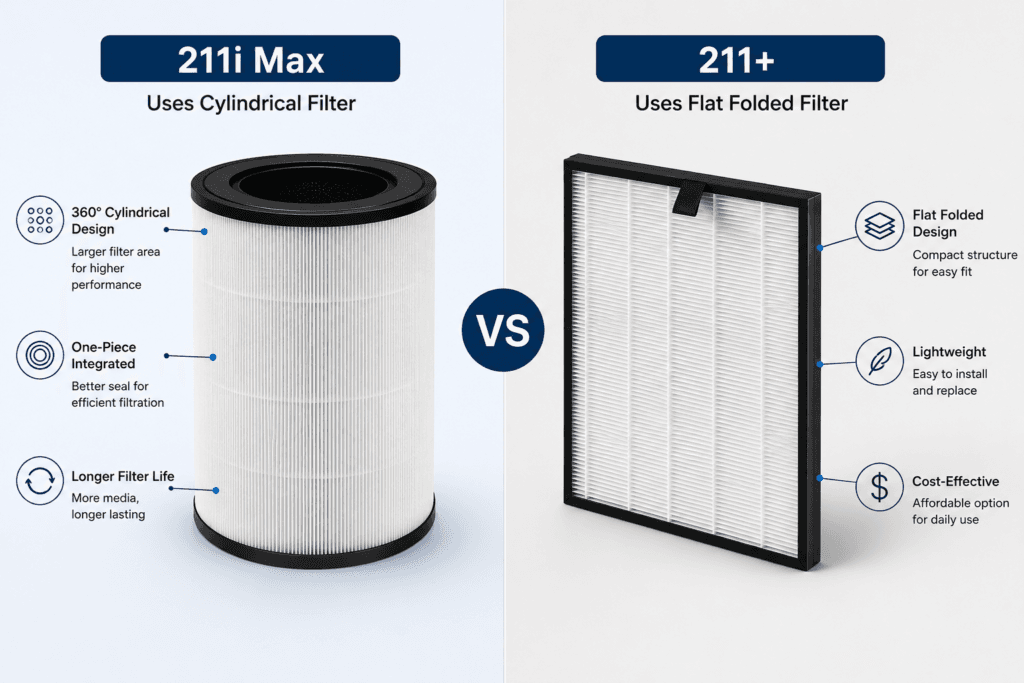
The Blue Pure 211i Max houses a round, cylindrical filter cartridge: pleated media wrapped around a drum core, with an activated carbon layer visible along the top rim. That’s a different physical format from the flat, foldable rectangular filters built for the classic 211+ line. A listing that shows a flat, accordion-style panel and calls itself compatible with “Blue Pure 211” is worth a second look before ordering, because the two shapes aren’t interchangeable no matter what the title says. HIFINE’s 211i Max replacement is built to the round drum format specifically, not adapted from a flat-panel mold to fit a different housing.
What “H11 High-Efficiency” Means Next to H13 Claims
Most third-party replacement filters marketed for the Blue Pure 211i Max advertise H13 True HEPA performance. HIFINE’s current 211i Max filter is specified at H11. That’s not a small difference on paper. Under EN 1822, H13-grade media is tested to remove at least 99.95 percent of particles at the most penetrating particle size, while H11-grade media is tested to roughly 95 percent at that same benchmark. Genuine Blueair filters go further still, marketed under the HEPASilent name at 99.97 percent capture down to 0.1 microns, a proprietary combination of mechanical media and electrostatic charge rather than a standard EN 1822 HEPA class on its own.
None of these numbers sit on the same scale. A buyer comparing “H13,” “H11,” and “HEPASilent” across three listings is comparing three different testing frameworks, not three points on one ladder. How MERV, HEPA, and ISO 16890 ratings actually get tested runs into the same confusion at the HVAC level, for the same underlying reason: an efficiency number only means what the test standard behind it says it means.
What Activated Coconut Carbon Adds to the Filter
HIFINE’s 211i Max replacement pairs the particle layer with an activated coconut carbon layer rather than a generic carbon blend. Coconut-shell carbon is valued in filtration for its higher micropore density compared with coal-based carbon, which gives it more surface area to adsorb odor-causing gases per gram of material. That layer handles what particle filtration can’t: cooking odors, pet smells, and everyday sources like a shared kitchen running induction cookers, rather than dust and allergens.
How Long Should This Filter Actually Last?
Retailer documentation for the 211i Max filter format consistently points to a 6-to-9-month replacement window on the genuine Blueair unit, tracked through Blueair’s RealTrack algorithm, which estimates remaining filter life from fan speed, runtime, and pollution load rather than a fixed calendar date. That detail matters for anyone sourcing a compatible replacement: because RealTrack partly infers filter loading from airflow resistance, a replacement filter with meaningfully different resistance characteristics than the original spec can throw off how accurately that countdown reads, independent of which HEPA grade is installed.
What This Means for Buyers Sourcing This Filter in Bulk
For distributors and private label buyers comparing Blue Pure 211i Max replacement options, two variables actually matter: shape, round drum versus flat panel, and rated grade, H11, H13, or genuine HEPASilent, not the word “compatible” sitting alone in a listing title. HIFINE manufactures the round-format, H11, coconut-carbon version as an OEM and private label supplier, built for hotel and household accounts rather than industrial duty. Full specs and bulk options for this SKU are available on our Blue Pure 211i Max compatible filter page, and buyers with grade requirements outside the standard H11 spec can raise that directly through our private label HEPA filter program.
Getting shape and grade right at the sourcing stage avoids the same problem end buyers run into when they order the wrong filter for their unit: a product that arrives, doesn’t fit, and generates a return instead of a repeat customer.