The cheapest HEPA filter is seldom the one with the lowest factory quote.
Brands, distributors, wholesalers, and private label businesses also have to contend with sampling, failed batches, packaging, shipping volume, storage, replacement rates, and changes in specifications, which all contribute to the real procurement cost. Instead of just negotiating the lowest unit price, a better approach is to lower the cost of getting an approved filter to your warehouse.
In this guide you will learn where HEPA filter buyers can actually save money and which cost reductions should not come at the expense of filtration performance.
Begin with the Specification, not the Price
The first mistake when sourcing for HEPA filters is asking for a price before defining the product.
If one quote is based on H13 media, another on a different media configuration, and a third uses a smaller filter pack with fewer airflow requirements, the supplier can’t give you a meaningful comparison.
HEPA filters are mechanical filters, and the EPA defines HEPA as a filter that can theoretically remove at least 99.97% of particles at 0.3 microns under the relevant test definition.
That doesn’t mean that every product that calls itself “HEPA” is built the same or that it performs the same.
Before you ask for a quotation for an OEM HEPA filter, define at least:
| Requirement | What to specify |
|---|---|
| Filter grade | H12, H13, H14, or required classification |
| Dimensions | Length × width × height |
| Airflow | Rated operating airflow |
| Pressure drop | Maximum acceptable resistance |
| Frame | Plastic, paperboard, metal, or molded structure |
| Seal | Gasket, PU sealant, or other sealing method |
| Packaging | Bulk, retail box, or private label |
| Quantity | Monthly and annual demand |
This information makes supplier quotations much easier to compare.
Reduce Cost by Designing the Filter Properly
One of the most overlooked ways to cut the cost of HEPA filters is to change the design instead of just changing the supplier.
More filter media is not necessarily better.
Increasing the media area can improve the airflow and the lifespan, but it may also increase the amount of material and the size of the product. A compact design can reduce material use, but too much restriction can reduce airflow through the system.
ASHRAE said higher filtration efficiency can increase pressure drop, which can reduce airflow or require additional fan energy, depending on the system.
Therefore, optimize the filter manufacturer experience:
media section + pleat depth + pleat spacing + air flow + pressure drop + available housing space
rather than simply maximizing the efficiency rating.
This is especially true for air purifiers, robotic vacuums, and other small appliances where the fan has limited power.
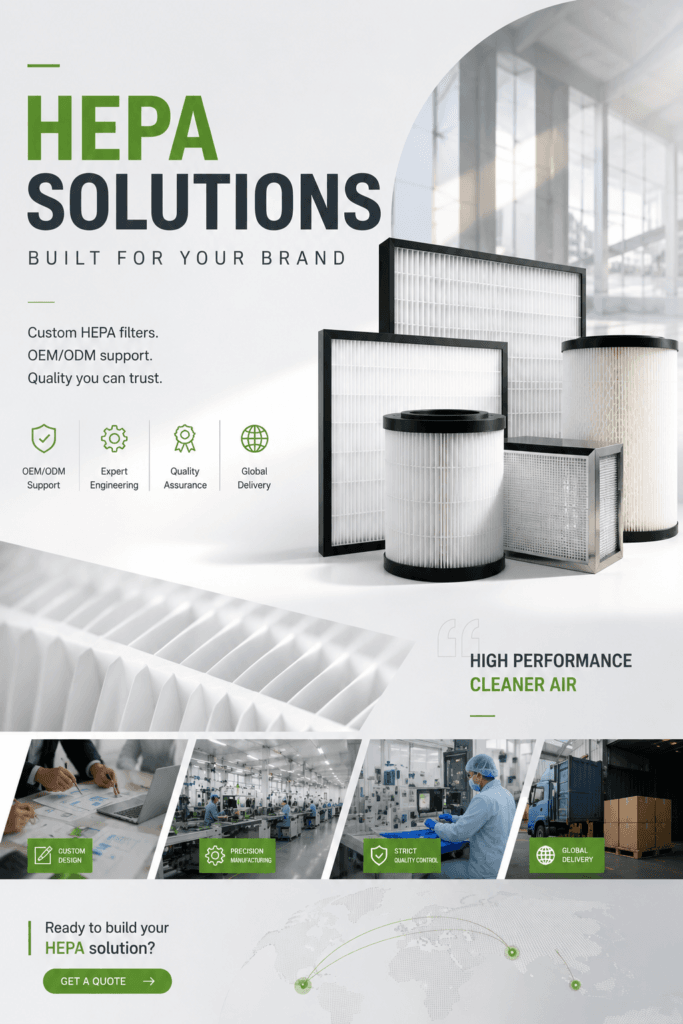
HIFINE provides custom filter structures based on dimensions, airflow, media, sealing, and application requirements rather than trying to fit every project into a standard filter configuration.
Explore HIFINE custom filter solutions.
Avoid Over-Specifying the HEPA Grade
A higher grade can sound attractive in a product spec, but procurement should start with the performance requirement.
ISO 29463-1:2024 specifies classification, performance, testing, and marking of high-efficiency filters, and ISO 29463-5:2022 specifies testing of filter elements at their most penetrating particle size.
This means buyers should compare suppliers on the same testing basis, not just compare labels such as H13 or H14.
For instance, a consumer air purifier might make more commercial sense with a well-designed H13 filter with the appropriate airflow and pressure drop than paying for a higher specification that the appliance does not need.
The target is not the top specification.
The target is the lowest spec that reliably meets your product requirement.
Buy more than the minimum but don’t create dead stock.
Another place where HEPA filter buyers can cut costs is on the MOQ.
You can lower the price by ordering more units, but if you carry too much inventory, you incur a different cost.
For private label brands, a good calculation is
The actual procurement cost = unit price + packaging + freight + inspection + storage + defect cost + inventory risk
A supplier with a 5% lower unit price is not necessarily cheaper if the MOQ forces you to hold six months of slow-moving stock.
A better way is to negotiate on your annual demand but to break deliveries into sensible production lots.
This gives the manufacturer enough volume to schedule material buying and the buyer enough to reduce his warehouse inventory unnecessarily.
HIFINE can now support custom filter projects from 500 pcs; the final MOQ depends on structure, materials, and customization requirements.
Standardization for Lower Costs
If you have more than one similar model of air purifier or vacuum cleaner to sell, look for ways to standardize parts.
For example, three products may have different outer dimensions but share:
- the same HEPA filter
- the same seal material
- similar type of pleat technology
- the same stuff for the frame
- the like packaging components
Standardization can lead to simplifications in purchases of materials and planning of production.
It also simplifies quality control because there are fewer materials and processes to manage.
And for brands on the rise, this could be worth more than a few cents off the filter itself.
Don’t trust product labels; ask for testing data.
When suppliers provide differing amounts of technical documentation, price comparisons are unreliable.
A professional HEPA filter RFQ should request the agreed efficiency test method, rated airflow, pressure drop, and applicable test report.
High-efficiency filter classification and testing, including filter-element testing and leakage-related procedures, are provided in ISO 29463.
This is important because two filters that make similar marketing claims can behave very differently in actual use in the appliance.
In OEM procurement, the crucial question is not
“Which vendor gives the lowest price?
It’s:
“Which supplier can consistently produce the same approved filter?”
That difference is very important when your product goes into mass production.
Factory Direct OEM Sourcing May Lower Hidden Costs
You can do better than just save the middleman’s margin by dealing directly with the maker.
It can also decrease the communication between engineering, sampling, production, and quality control.
This is particularly useful when you need:
custom sizes, multiple SKUs, private label packaging, updated filter media, prototype samples, or ongoing wholesale production.
HIFINE offers HEPA filters and filtration products for home appliances for OEM, ODM, wholesale, and private-label customers with production and engineering support based on customers’ specifications.
The Best HEPA Filter Price Is the Cost of an Approved Filter
This is a simple way to reimagine procurement.
If Supplier A quotes $2.80 per filter and Supplier B quotes $3.05 per filter.
At first glance, supplier A looks cheaper.
But what if Supplier A needs more samples, has a higher defect rate, uses larger packaging, and generates more shipping volume? Supplier B has a consistent specification; packaging efficiency has been improved with fewer rejected units.
That $0.25 spread could go away fast.
This is why serious buyers should compare suppliers using:
Unit cost + logistics costs + quality costs + inventory costs approved
than the price of the factory alone.
This is particularly the case when sourcing replacement HEPA filters or building a recurring private label product line.
Better RFQ Can Save More Than Price Negotiation
Create a simple procurement sheet for the HEPA filter manufacturer:
Air flow → Pressure drop → Frame → Sealing → Packaging → MOQ → Annual demand → HEPA grade → Filter size
Send the same information to all suppliers.
You get cleaner quotations, better technical comparisons, and fewer specification changes later.
It would be even better if the brand developing a new product sent a sample of an existing product or a drawing or product housing information. HIFINE provides OEM and ODM development from drawings, samples, product dimensions, and application requirements.
Final Takeaway
Reducing the cost of HEPA filter procurement is not purchasing the lowest-priced filter.
The greatest savings are typically achieved by improving specifications, optimizing filter design, using standardized materials, sensible MOQ planning, consistent testing, and direct communication with the manufacturer.
The best supplier for overseas brands, wholesalers, distributors, and private-label businesses is one who can hold your approved specification while giving you a competitive cost at your required production volume.
That’s what cheap HEPA filter procurement is based on.