
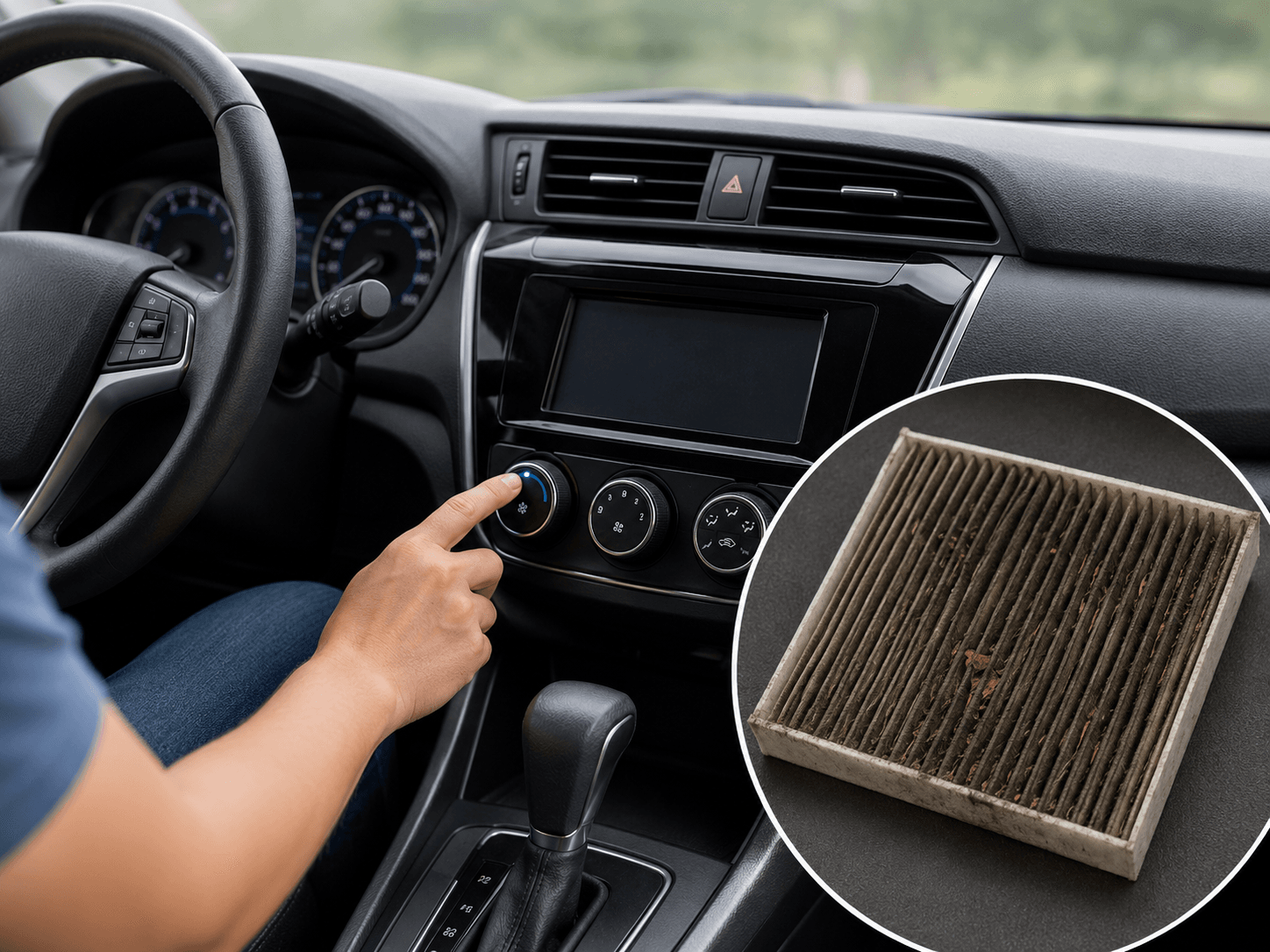


Most drivers are used to it. You start your car, turn on the air conditioning or heater, and within seconds you’ll smell that stale, faint musty smell, sometimes quite pungent. Then the smell dissipates. This isn’t a weird problem with your car. It has a specific root cause, and the longer you ignore it, the more serious the root cause becomes.
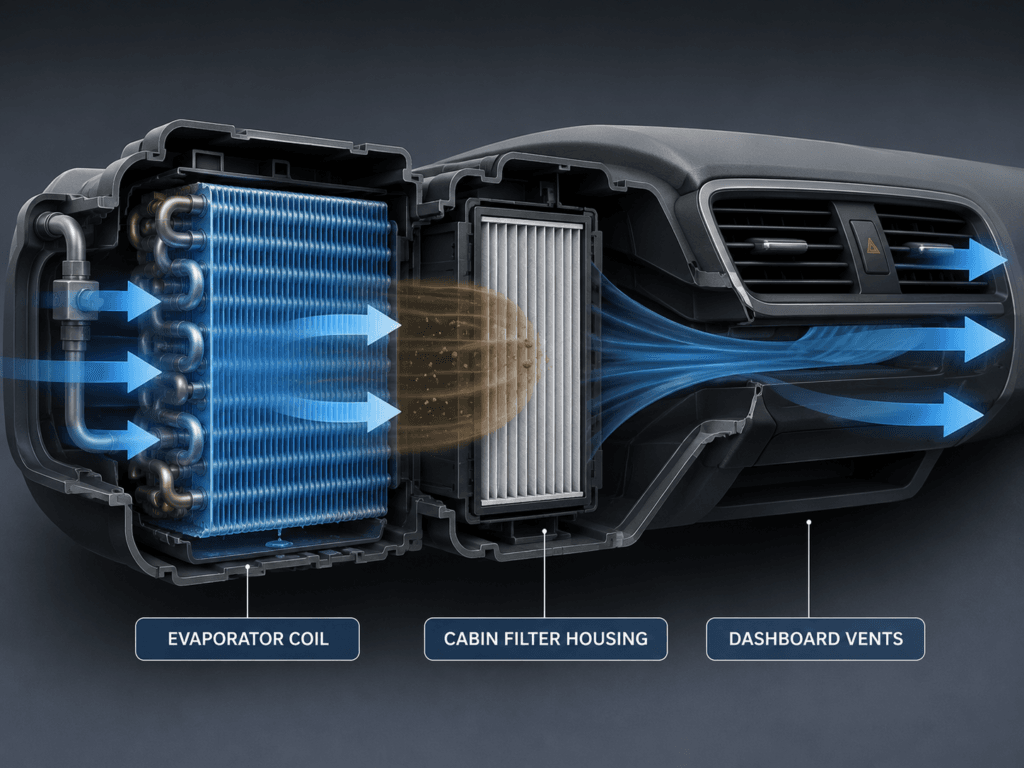
Mold. Your cabin air filter sits in a damp housing where the HVAC evaporator coil sheds condensation. Organic debris — pollen, exhaust particulate, road dust — collects in the filter media. Add moisture and no airflow between drives, and the conditions for microbial growth are close to ideal. When you turn on the AC for the first time that day, you’re forcing air through a filter that may be actively colonized with mold and bacteria.
Here’s what that means for your air quality, how to diagnose it, and the filter upgrade that actually solves it.
Why Car AC Smells Worst in the First 30 Seconds of Startup
The timing isn’t coincidental. Mold and bacteria on a contaminated cabin filter release volatile organic compounds — microbial VOCs — as they metabolize. Cold, stagnant air in the HVAC housing concentrates those compounds overnight. The first blast of the fan pushes that concentrated air directly into the cabin before the system has time to draw fresh air and dilute it.
After a minute or two, the smell fades. That leads most drivers to assume the problem resolved itself. It didn’t — you’ve just hit a steady state where dilution masks the odor. The microbial load is still there, and you’re still breathing it.
Why the Musty Car AC Smell Gets Worse Over Time
Each drive adds more organic material to the filter. Each period of inactivity gives that material more time to break down in a damp environment. The smell that was barely noticeable six months ago and now hits you immediately before you’ve even left the driveway is the same process running further along the curve.
Seasonality matters too. Spring driving loads the filter with pollen — a dense, organic particle that degrades slowly and feeds microbial growth. Humid summer months keep the evaporator housing wet longer. By late summer, a filter installed the previous year in a warm, humid climate is often well past the point of no return.
What a Smelly Cabin Air Filter Is Actually Catching — and Growing
A functioning cabin air filter is one of the more underappreciated components in a vehicle. In a single commute it intercepts material from multiple sources:
- PM2.5 combustion particles: fine exhaust byproducts from surrounding traffic, under 2.5 micrometers in diameter
- Pollen and mold spores: biological particles that can germinate directly on the filter surface when moisture is present
- Brake and tire microparticles: increasingly flagged by environmental researchers as a significant urban particulate source
- Road grit and construction debris: coarser particles that fill the outer filter layers first
- Gaseous pollutants including NOx and benzene: only captured by activated carbon models; pass straight through standard media
The issue isn’t just accumulation. Organic material — pollen, microbial matter, exhaust carbons — breaks down over time. In a damp housing with limited airflow, decomposing organic matter is the feedstock for mold. The filter catches the particles that make it grow faster.
The Health Risk Behind a Dirty Car Cabin Filter Smell
A 2021 study in Environmental Science & Technology found that particulate concentrations inside vehicles in traffic could reach 5 to 6 times higher than ambient roadside levels. The World Health Organization’s 2021 air quality guidelines set the annual PM2.5 mean at 5 μg/m³ — a threshold urban commute corridors routinely exceed before most people have finished their morning coffee.
Research from the University of Surrey found that drivers using a functional cabin filter in recirculation mode had PM2.5 exposure up to 76% lower than those running fresh-air intake through a degraded filter. The musty smell is also a signal that microbial VOC concentrations are elevated — compounds linked to headaches, eye irritation, and respiratory symptoms in enclosed spaces.
Dirty Cabin Air Filter Symptoms to Check Before You Assume the Smell Is Normal
The startup smell is the most obvious sign, but a degraded cabin air filter produces several other symptoms that usually get misattributed or ignored:
- Weaker airflow from vents on maximum fan: the filter is restricting the HVAC system, not the fan motor
- Windshield fog that takes longer to clear: reduced airflow through a clogged filter degrades defroster performance
- Sneezing or congestion that tracks with your commute: starts when you get in, clears shortly after you arrive
- Visible fine dust on dashboard surfaces near vents: particles bypassing or being pushed around an overloaded filter
- Fan noise at lower settings: the HVAC motor is working harder against restricted airflow
How to Tell If Your Cabin Filter Is the Source of the Car AC Smell
A quick check: on a dry day, turn the AC to maximum fan and hold a piece of white paper near a center vent for 60 seconds. Visible particles or an immediate smell intensification points directly at the filter. The filter itself is accessible in about 10 minutes — remove the glovebox, pull the housing panel, and look at the intake face. Gray-brown color, matted debris, or any visible discoloration means it’s overdue.
One thing worth knowing: a filter can look moderately dirty and still be past effective life. The loading effect — where accumulated particles temporarily improve fine-particle capture — has a ceiling. Past that point, airflow restriction and mold growth accelerate simultaneously, and the filter stops doing either job well.
Cabin Air Filter Replacement Schedule: How Often Is Actually Enough
Most manufacturers set cabin air filter replacement at 15,000 to 25,000 miles, or once a year — whichever comes first. Those intervals were designed around average driving conditions, which is a reasonable baseline for a suburban driver on low-traffic roads in a moderate climate.
It’s not a reasonable baseline for most people who actually develop the smell problem.
When to Replace Your Cabin Filter More Often Than the Manual Says
If you’re experiencing the startup smell, 12,000 miles should be your ceiling regardless of what the manual specifies. But certain conditions shorten that further:
- Urban or highway commuting in heavy traffic — higher exhaust load, faster filter saturation
- High-pollen region or spring/summer driving — biological material on the filter media accelerates mold growth
- Wildfire smoke exposure — fine carbon particles clog filter media and carry organic compounds that feed microbial activity
- High-humidity climate — the evaporator housing stays wet longer, extending the window for mold colonization
A 2019 vehicle maintenance survey by the American Automobile Maintenance Association found that about a quarter of the air filters on American roads are past their lifespan. Many car owners don’t even realize their filters are there until an engineer takes them out to replace them.
Which Cabin Air Filter Type Actually Eliminates the Car AC Smell
Replacing any filter removes the smell source temporarily. Which type you choose determines whether it comes back in three months or stays solved for a year.
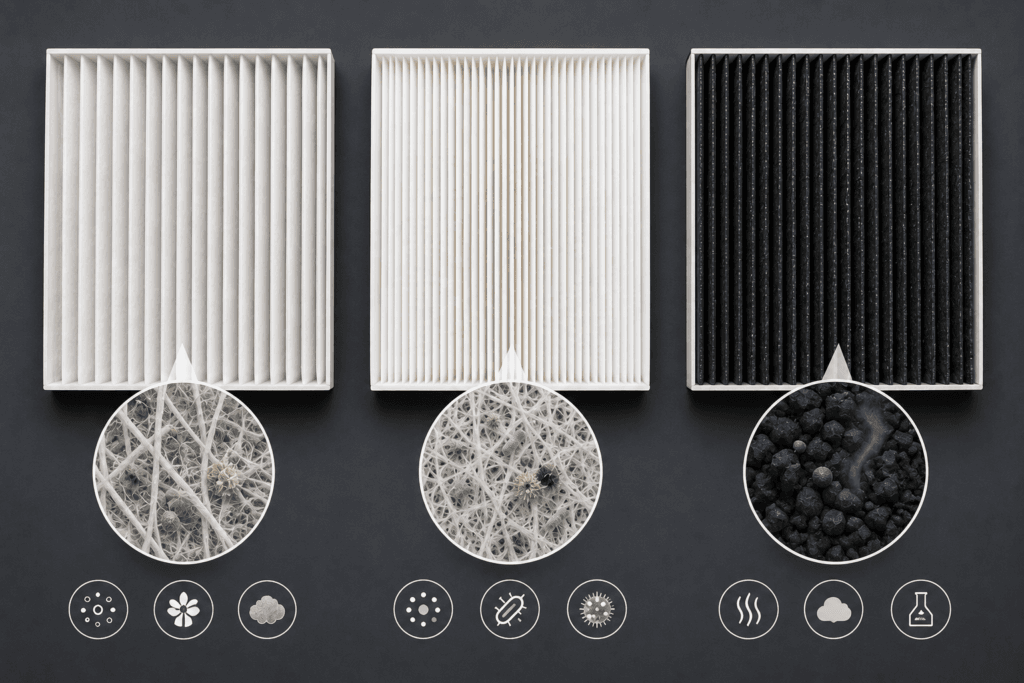
Standard particulate filters capture pollen, road dust, and debris above roughly 10 microns. They don’t address gaseous odors or the microbial VOCs produced by mold activity. For a driver who’s never had the startup smell, they’re adequate. For anyone whose car already smells, they’re the wrong specification for the environment.
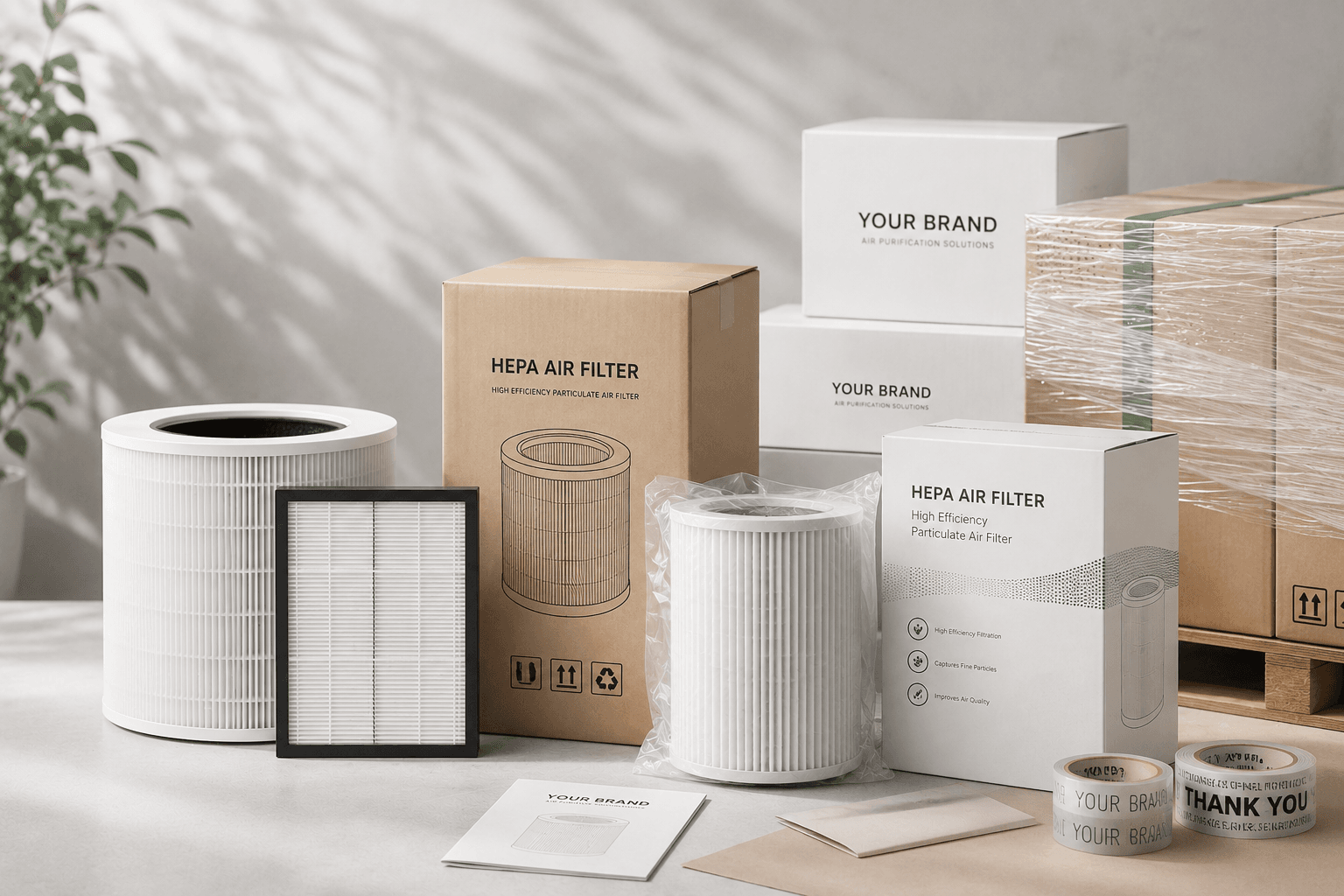
HEPA-grade cabin filters capture 99.97% of particles at 0.3 microns — including the fine mold spores and PM2.5 particles that standard media passes. If the smell is caused by biological particulate cycling through the system, a HEPA-grade filter catches the spores before they re-colonize the media and housing.
Activated Carbon Cabin Filter vs. Standard HEPA
For drivers whose primary complaint is the odor, this is the decision that matters most. Activated carbon filters add a charcoal adsorption layer that captures what particulate media cannot: the gaseous compounds mold and bacteria emit as they break down — microbial VOCs, nitrogen dioxide, benzene, formaldehyde.
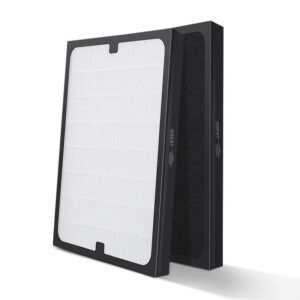
A HEPA-grade filter catches more particles. An activated carbon filter eliminates the smell at its molecular source. For the startup odor problem specifically, an activated carbon combination filter — which layers carbon adsorption onto a HEPA-grade base — addresses both simultaneously. Grand View Research projects this segment to grow at a 9.2% CAGR through 2030, driven by rising consumer awareness of what in-cabin air actually contains.
How Engine Valve Condition Affects Your Cabin Filter Smell
This connection rarely makes it into cabin filter guides, but it directly affects how fast the smell problem develops.
A combustion engine running efficiently produces significantly less particulate exhaust than one with worn or degraded components. The engine valve controls the flow of combustion gases inside the cylinder — when valves are worn or not seating cleanly, incomplete combustion increases, and exhaust particulate output rises. More organic-loaded exhaust in the immediate air around your vehicle means a heavier biological burden on your cabin filter every mile.
In practice: a vehicle running rough or failing emissions should have its cabin filter replaced on a shorter interval than usual. The smell that develops quickly in a mechanically marginal vehicle isn’t bad luck — it’s a downstream symptom of what’s happening upstream in the engine. Address both, and the filter stays effective longer.
Car Cabin Air Quality Doesn’t Stop When You Park
Fine particles and microbial compounds from a contaminated cabin filter don’t stay in the car. They settle on clothing, hair, and upholstery, then migrate indoors when you get home — where they accumulate without a filtration layer unless one is in place.
Americans spend an average of 293 hours per year behind the wheel, according to the AAA Foundation for Traffic Safety. That’s over 12 full days annually inside a sealed air environment. Whatever the cabin filter misses or releases becomes part of the air you carry home.
For families who value indoor air quality, HIFINE adheres to the same philosophy: every stage matters, not just the stage you can see.
The smell your car makes when the AC turns on is one of those things that’s easy to normalize and difficult to un-notice once you understand what it actually is. It’s a filter telling you it needs to be replaced. The fix is straightforward. The choice of replacement — the right type for your driving environment, not just your vehicle model — is where most drivers leave performance on the table.
Replace it on a schedule that matches where you actually drive. Your commute will smell like nothing. That’s exactly the point.