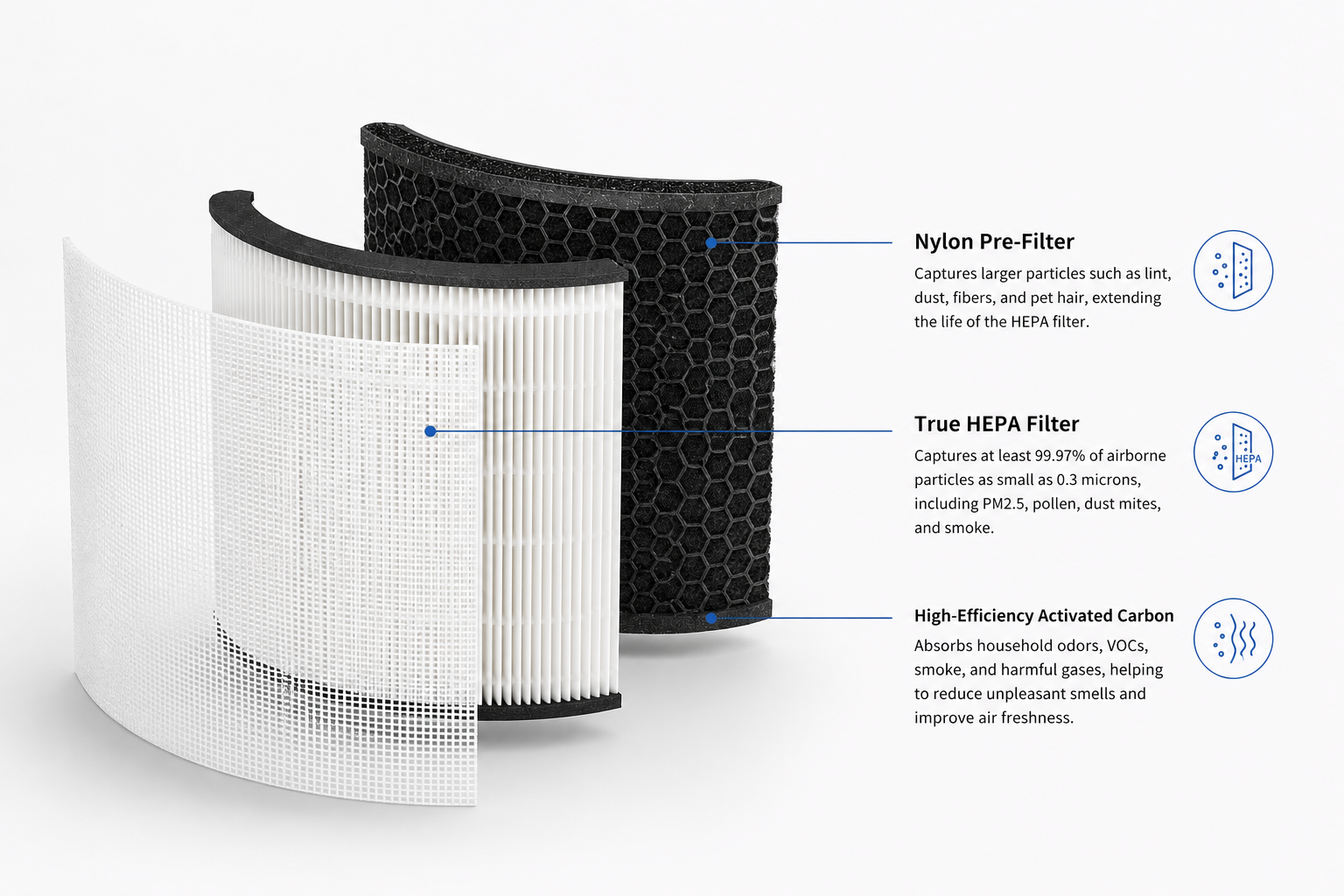

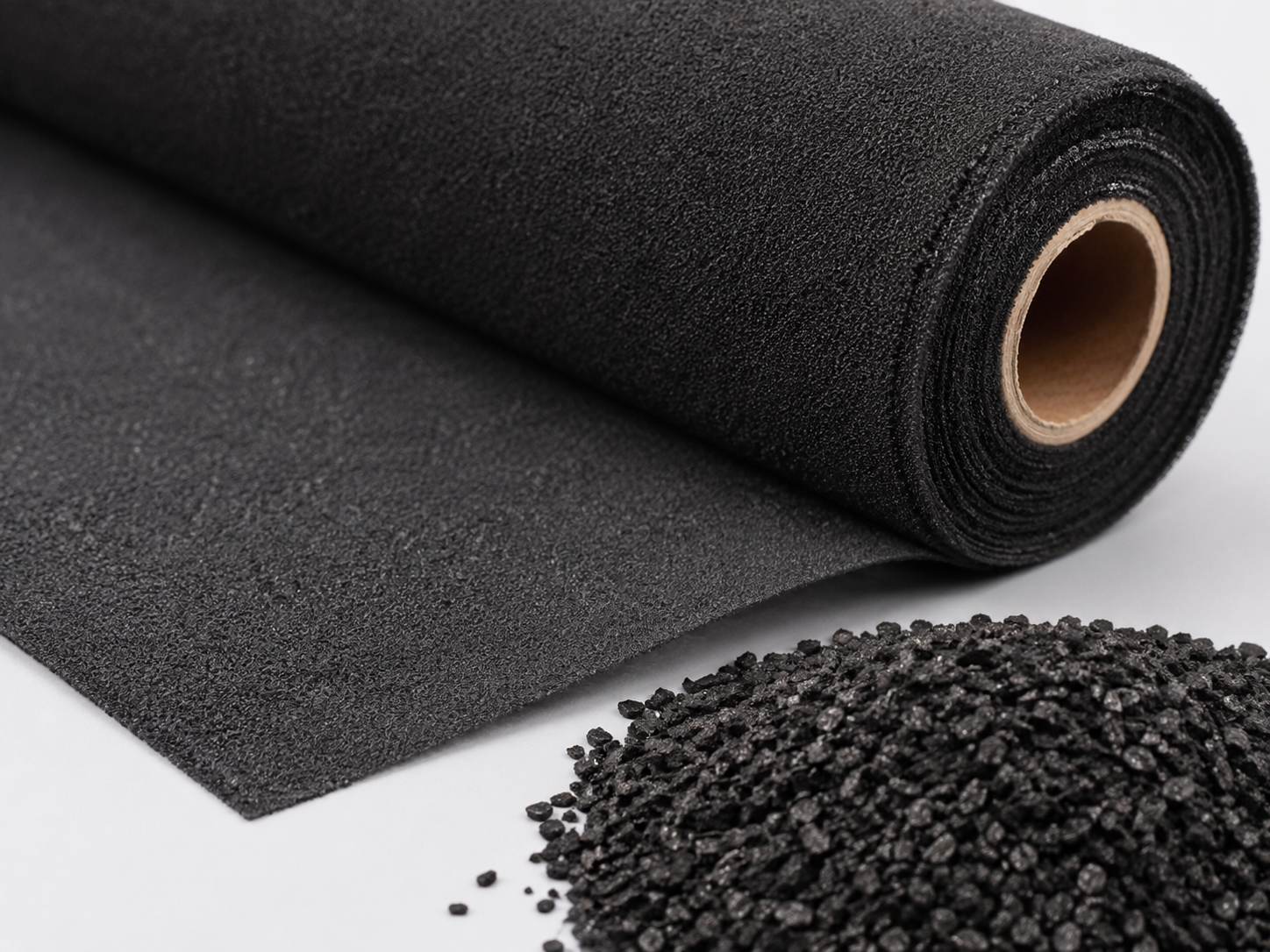
Carbon-impregnated non-woven, granular pads and honeycomb blocks for odor and VOC control in air purifiers, range hoods, refrigerators and HVAC systems, supplied by the roll or die-cut to your housing.
How activated carbon actually removes odor
Activated carbon doesn’t trap odor the way a mechanical filter traps dust. Dust filtration is a physical screen. Particles are too big to pass through the fiber gaps, so they get caught. Odor and VOC molecules are gas-phase and far smaller than any pore a filter could practically weave, so screening them out isn’t an option. Instead, activated carbon works by adsorption. Each gram of activated carbon is riddled with microscopic pores. That gives it an internal surface area that can run into the hundreds of square meters. Odor molecules passing through the media get pulled onto that surface and held there by weak molecular attraction. This is why carbon media needs airflow contact time to work well. It’s also why a thin, poorly loaded layer lets odor pass straight through, even though it looks identical to a properly loaded one.
Three media formats, three jobs
We produce activated carbon media in three formats. The right one depends on airflow, housing depth and how much odor load the filter needs to handle.
Carbon-impregnated non-woven cloth
Thin and flexible. Laminates into pleated panels or slim purifier cartridges.
Granular carbon pad
Loose granules in a pouch. More adsorption capacity per unit of housing area.
Honeycomb carbon block
Rigid structure. Low pressure drop at high airflow, built for duct mounting.
Non-woven carbon cloth is the default choice for slim air purifier panels, range hood liners and refrigerator filters, because it’s easy to die-cut and pleat on standard machinery. Granular pads hold more carbon in the same amount of housing space, which matters when a design faces heavy odor exposure but has limited room to work with. Honeycomb blocks are built for commercial ducting and industrial exhaust, where the goal is high airflow with low resistance, not a compact footprint.
Coconut shell vs. coal-based carbon
The raw material changes the pore structure, not just the price. Coconut shell carbon forms a finer, more even micropore structure, which suits smaller odor and VOC molecules. Coal-based carbon has a wider mix of pore sizes, including larger macropores, which gives it an edge with bigger organic molecules and in humid environments. The table below breaks down when each one makes sense. Tell us the odor source you’re designing against, and we’ll recommend the raw material instead of defaulting to whichever is cheapest that quarter.
| Property | Coconut shell carbon | Coal-based carbon |
|---|---|---|
| Pore structure | Finer, more uniform micropores | Broader mix, including larger macropores |
| Best suited to | Smaller odor and VOC molecules | Larger organic molecules |
| Typical setting | Kitchen, bathroom, general indoor air | Humid environments, heavier-duty use |
| Material cost | Usually higher | Often lower |
Matching carbon loading to the application
Carbon loading is measured in grams per square meter. It’s the single biggest factor in how long a filter lasts before odor starts to break through. A refrigerator crisper filter, with light and occasional odor exposure, can run on a comparatively low loading. A general-purpose air purifier sits in the middle of the range. A kitchen range hood or a filter for a smoking room needs substantially more carbon. At some point, a non-woven cloth format stops being practical, and a granular pad or dual-stage design makes more sense.
The most common mistake we see comes from buyers who source on price alone. They end up with a carbon layer that’s too light for the stated service life. The fan still runs and the indicator light doesn’t flag anything, but the odor comes straight through, because the carbon saturated months before the filter’s rated replacement date.
Buying activated carbon media in bulk
Carbon media ships as flat rolls, pre-slit strips or die-cut sheets, sized to your existing filter housing or pleating line. Standard roll widths cover most air purifier and range hood applications. Custom widths are cut to order for buyers running their own pleating equipment.
One detail worth flagging before you place a production order: activated carbon absorbs moisture from the air during storage and transit. That moisture occupies adsorption sites the same way an odor molecule would, and it quietly lowers capacity before the filter is even installed. If your supply chain includes long sea freight or humid warehousing, ask for foil or vacuum-sealed packaging instead of standard poly wrap. It costs a little more per unit, but it protects the shelf life you’re paying for.