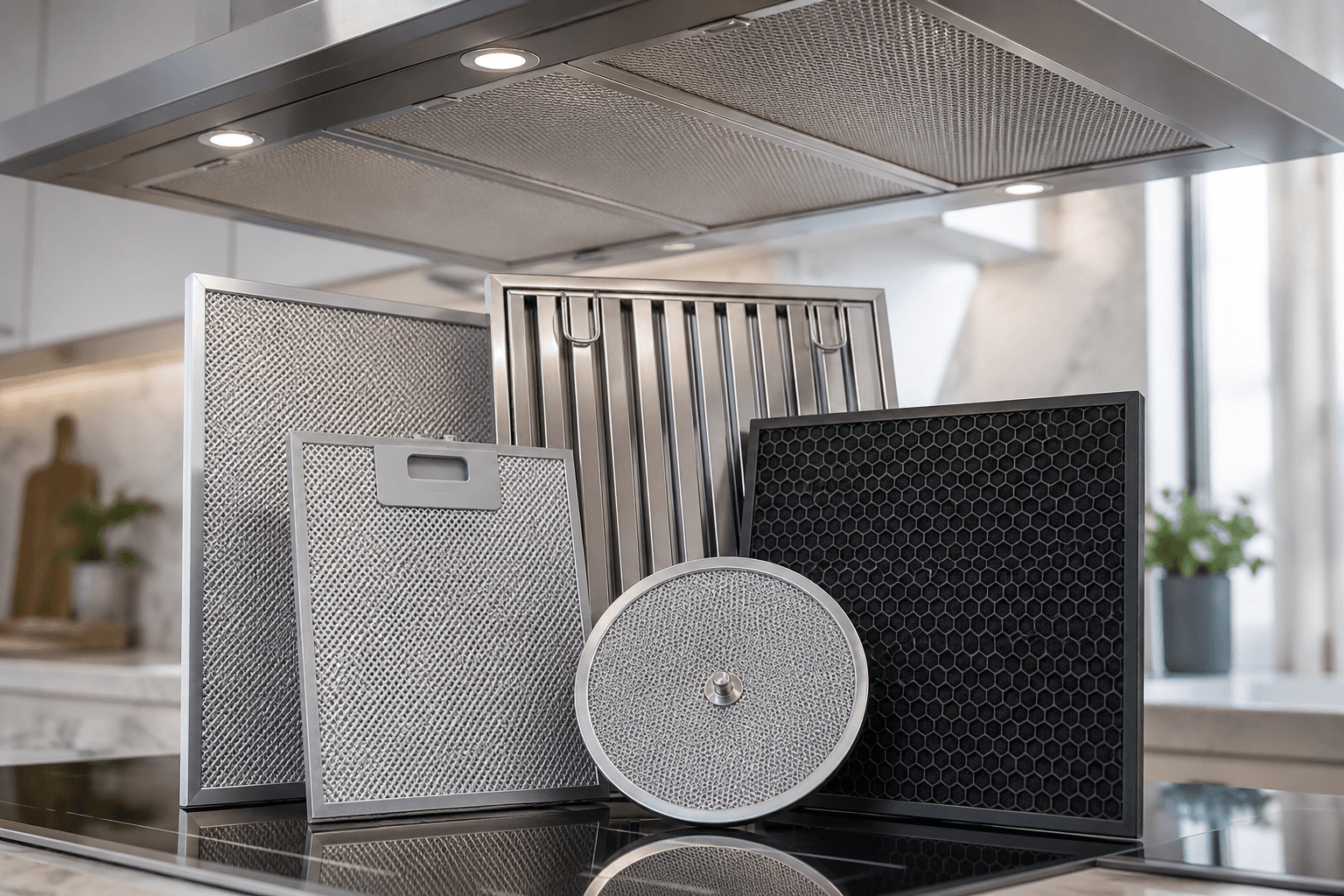
Your range hood filter does more work than most people realize. Every time you fry bacon, sear a steak, or stir fry vegetables, grease and smoke hit that filter first. If it is clean, the grease stays out of your ductwork and your kitchen stays clear. If it is clogged, the hood gets louder, suction drops, and grease starts building up where you cannot see it.
Most people only think about their range hood filter when something goes wrong. This guide breaks down the three filter types you are likely to run into, how to figure out which one your hood uses, how to clean them without ruining them, and when it is time to throw one out and buy a replacement.
What a Range Hood Filter Actually Does
Air gets pulled up through the hood by a fan. Before that air reaches the fan motor or the duct, it passes through the filter. The filter catches grease particles, smoke, and some of the odor molecules from cooking.
That is the whole job, but it matters more than it sounds. Grease that gets past the filter coats the fan blades, builds up inside the duct, and eventually becomes a fire hazard. The National Fire Protection Association lists cooking equipment as the leading cause of restaurant fires, and grease buildup in ducts and hoods is a big part of that. Residential hoods are lower risk, but the same principle applies. A clean filter is the cheapest fire prevention you can buy for your kitchen.
The Three Types Most Hoods Use
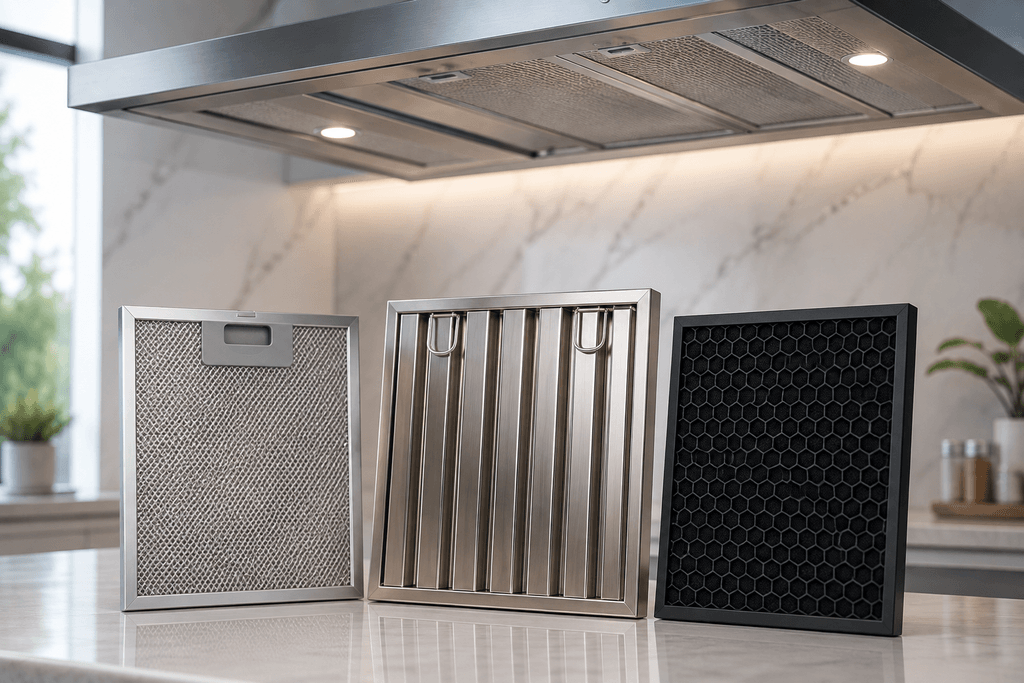
Not every range hood uses the same filter. Some use one type, some use two in combination. The table below gives you a quick side by side look.
| Filter Type | What It Catches | Material | Washable | Where You Find It |
|---|---|---|---|---|
| Grease filter | Grease and oil | Aluminum mesh or steel baffle | Yes | Every ducted hood |
| Charcoal filter | Odors and smoke | Activated carbon | No | Ductless recirculating hoods |
| Baffle filter | Grease and oil | Stainless steel | Yes, dishwasher safe | Commercial and high end residential |
Aluminum Grease Filters
These are the ones you see in most apartments and cheaper range hoods. They look like a mesh screen folded over on itself several times, usually with a thin aluminum frame. The mesh creates a maze, and grease sticks to the wires as air pushes through.
They are cheap, light, and easy to find. That is why manufacturers love them. The downside is that they dent if you look at them wrong, and they need cleaning every couple of weeks if you cook with oil regularly. Leave one too long and the grease turns into a sticky film that a normal soak will not remove.
Charcoal Filters
If your range hood does not vent to the outside, it uses a charcoal filter. These sit behind the grease filter and absorb cooking odors before the air gets blown back into your kitchen.
You cannot clean a charcoal filter. The carbon works by absorbing molecules into its porous surface, and once those pores fill up, the filter stops working. Washing it with water or soap does not restore the carbon. Plan on replacing one every 4 to 6 months, more often if you fry food or cook things like fish and curry on a regular basis.
Baffle Filters
Baffle filters are the upgrade most people wish they had bought. Instead of a mesh, they use curved stainless steel baffles that force air to change direction several times. Grease hits the baffles, slides down, and collects in a tray at the bottom.
They catch grease better than aluminum mesh, they do not dent, and you can throw them in the dishwasher. They cost more upfront, but a set of baffle filters can last 10 years or longer. A lot of people buy a new range hood with aluminum filters and immediately swap them out for baffles. It is one of the easiest upgrades you can make.
Figuring Out Which Filter Your Hood Needs
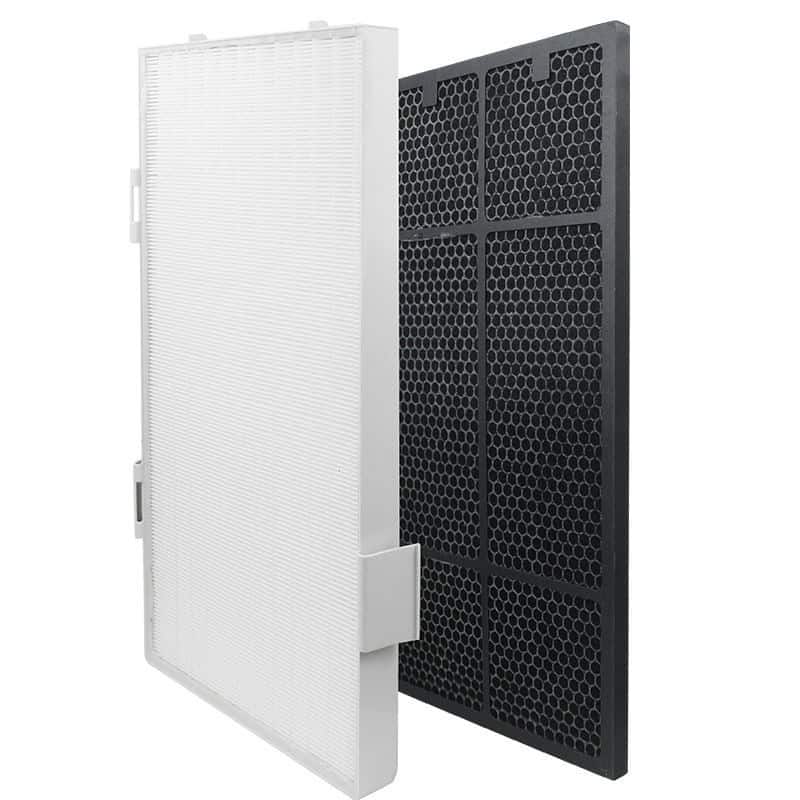
The fastest way is to pull the existing filter out and look at it. If it is a mesh screen, it is an aluminum grease filter. If it is a black carbon slab, it is charcoal. If it is stainless steel with curved ridges, it is baffle.
Write down the dimensions before you buy a replacement. Measure the filter itself, not the slot it sits in. Filters are always slightly smaller than the opening so they can slide in and out. Length, width, and thickness all matter. A filter that is the right length and width but too thick will not seat properly, and one that is too thin will rattle and let grease bypass the edges.
If you have the hood manual, the model number will get you the exact filter part number. No manual? The model number is usually printed on a sticker inside the hood, on the side wall, or sometimes on the underside near the light. Search that number plus “filter” and you will usually find the right size in a minute or two.
Ducted hoods only need grease filters. Ductless hoods need both a grease filter and a charcoal filter. If you are not sure which type you have, look for a duct running from the hood to an outside wall or roof. If you see one, it is ducted. If the hood has a vent panel on the bottom or back and no duct, it is ductless.
Cleaning Without Ruining the Filter
Aluminum mesh filters need cleaning every 2 to 4 weeks. If you fry food several times a week, lean toward 2 weeks. If you mostly boil and bake, 4 weeks is fine.
Pull the filter out. Most slide down from the bottom, held by a small metal clip or a spring latch. Be gentle, aluminum bends easy.
Fill your sink with the hottest water you can get from the tap. Add a few drops of dish soap and about a quarter cup of baking soda. Drop the filter in and let it sit for 10 to 15 minutes. The hot water softens the grease, and the baking soda helps break it down.
After soaking, take a soft brush or a sponge and scrub both sides. Work along the direction of the mesh, not across it, so you do not bend the wires. Rinse under hot water until the water runs clear. Set it somewhere it can dry completely before you put it back. A wet filter in a dark hood grows mold fast.
Baffle filters are easier. Pop them in the dishwasher on a normal cycle and walk away. The high heat and detergent handle the grease. If you do not have a dishwasher, the same soak and scrub method works for baffle filters too.
Skip the oven cleaner and the heavy duty degreasers. They eat through aluminum, leave residues that get into your kitchen air when the hood runs, and generally cause more problems than they solve. Dish soap and baking soda handle 95 percent of cases.
When Cleaning Stops Working
Aluminum grease filters do not last forever. If you see tears in the mesh, bent frame edges that no longer sit flat, or grease that will not come off even after a good soak and scrub, it is done. A filter with holes lets grease straight through to the fan and duct. Replace it.
Baffle filters are nearly indestructible. You might get 10 years out of a set, maybe longer. The only time they need replacement is if something bends the baffles badly enough that gaps open up, which usually means you dropped something heavy on them.
Charcoal filters run on a schedule, not on visible signs. Set a reminder for every 6 months and replace it then. Waiting until you smell fried food lingering in the kitchen means the filter stopped working weeks ago. For people who cook a lot, especially with strong smelling ingredients, 3 to 4 months is a better interval.
A lot of people wait for the hood to start sounding different or for the water to look greasy when they clean the filter. By that point, the filter has been underperforming for weeks. Calendar reminders work better than waiting for a problem to show up.
Which Filters Fit Which Brands
Most brands use standard sizes, but a few have proprietary shapes that only fit their own hoods. The table below covers the common ones.
| Brand | Typical Filter Types | Things to Watch For |
|---|---|---|
| Broan | Aluminum grease, charcoal | Most use standard sizes, check model number |
| Nutone | Aluminum grease, charcoal | Often same filters as Broan, same parent company |
| GE | Aluminum grease, charcoal | Some models use odd sizes |
| Whirlpool | Aluminum grease, charcoal | Mostly standard |
| KitchenAid | Aluminum, baffle on premium | Higher end models ship with baffles |
| Thermador | Baffle, aluminum | Premium brand, baffle filters common |
| Viking | Baffle | Commercial style, baffles only |
Always confirm the part number against your specific hood model. Two hoods from the same brand can use completely different filters depending on when they were made and what series they belong to.
Sourcing Filters for a Store or Brand
Range hood filters are consumables, which means people buy them on a regular schedule. For a kitchen appliance store or an ecommerce brand, that creates steady recurring demand. The tricky part is finding a supplier that holds consistent quality across every batch, because a filter that fits one month and does not fit the next will get you returns.
HIFINE makes all three types, aluminum mesh grease filters, activated carbon charcoal filters, and stainless steel baffle filters. We match most major brand sizes and do custom dimensions for brands that want their own filter shape. Food grade aluminum, high grade carbon with consistent absorption rates, and durable stainless steel are all standard. Every batch gets checked for fit, airflow, and grease capture before it ships. OEM and private label packaging are available, and we do bulk pricing for distributors and retailers.
If you need standard replacement filters from Broan, Nuton, GE, or similar brands in bulk, or if you want to develop custom filters for a range hood you are designing, please contact us for samples and pricing.