Most people assume they have to choose between a HEPA filter and an activated carbon filter. Product marketing pitches one technology as the answer, and comparison articles frame it as an either or decision.
But the two technologies do not compete. They remove completely different classes of contaminants. In most real world environments, you need both.
How HEPA Filtration Works
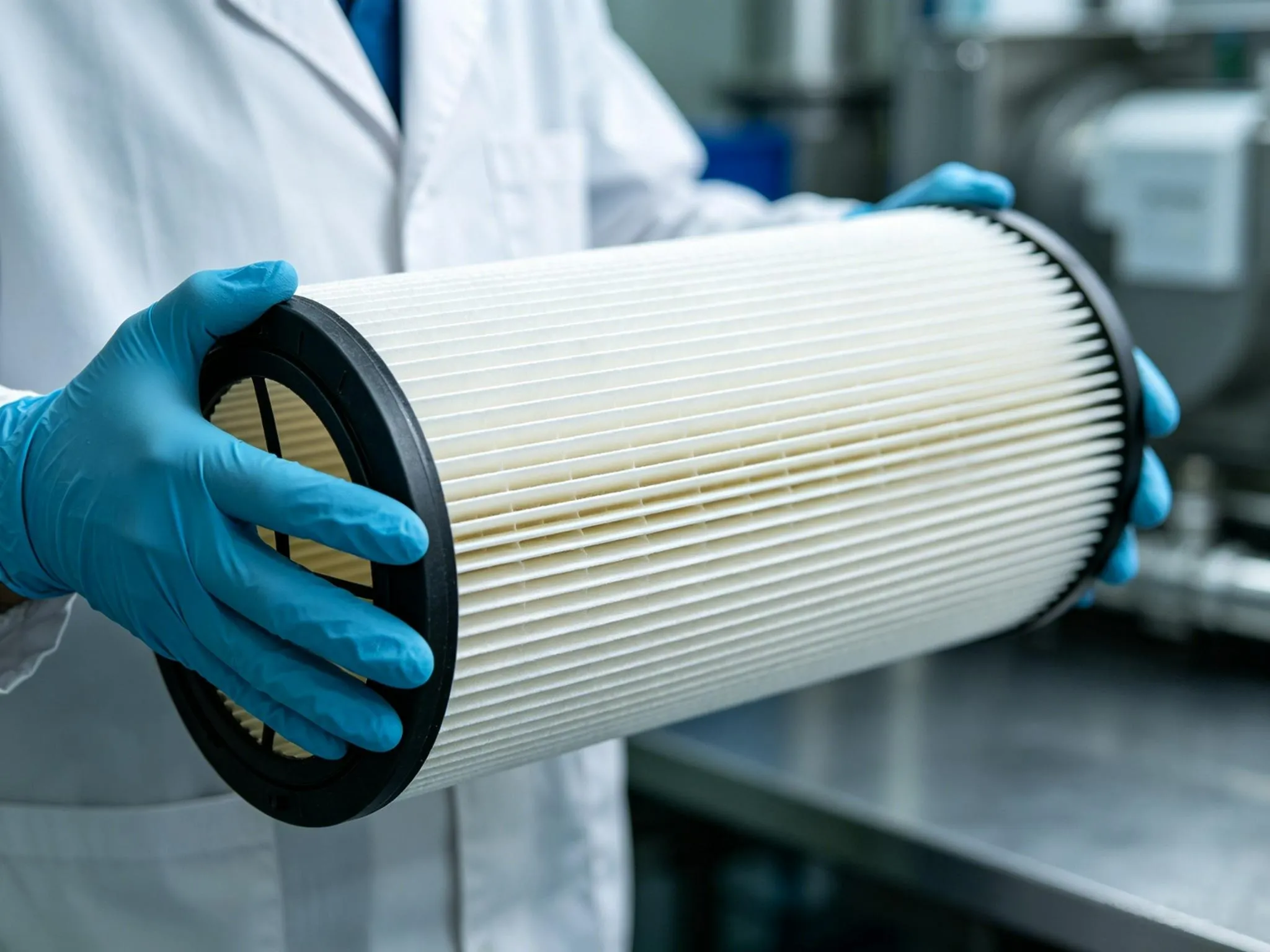
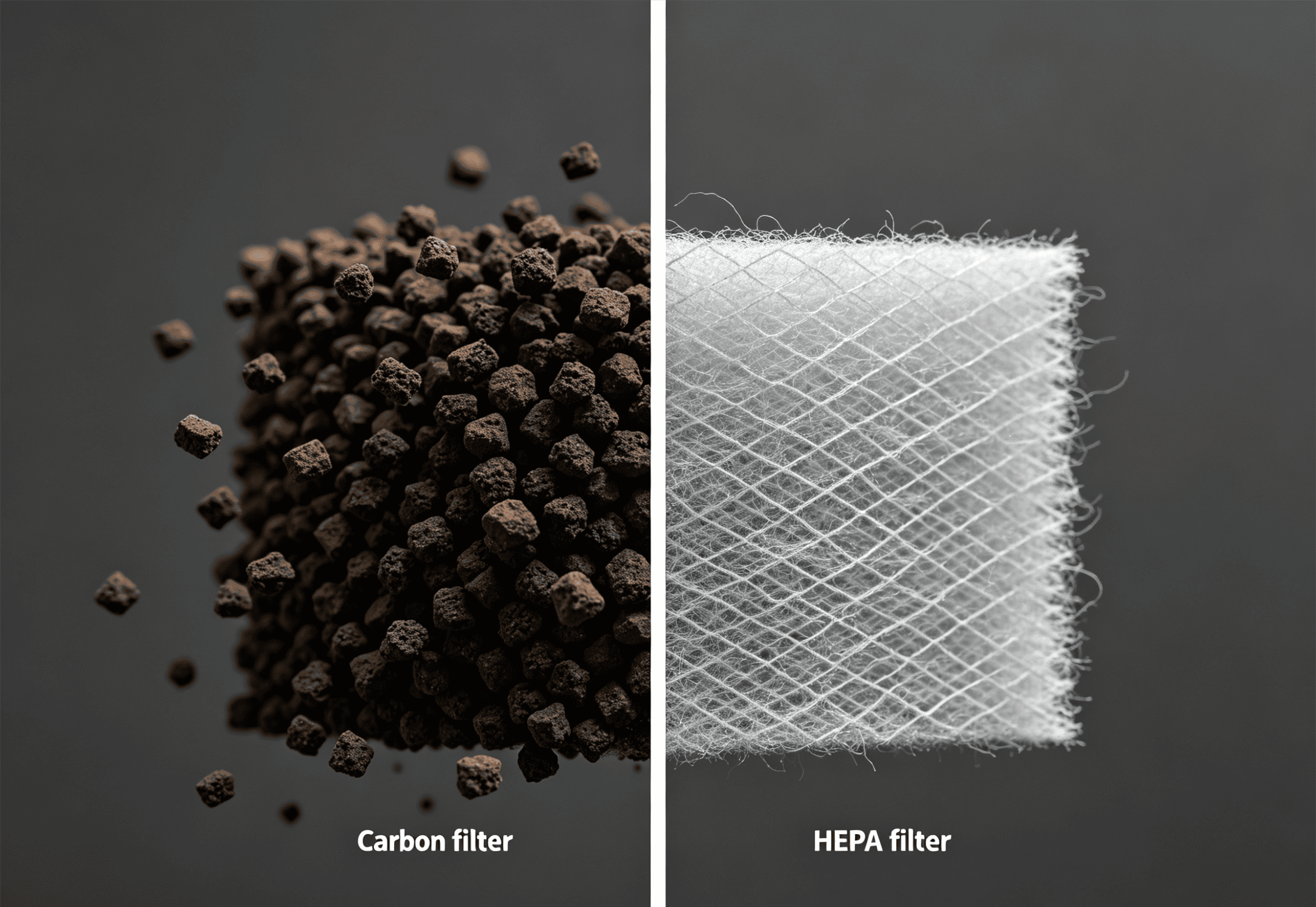
A HEPA filter is a mechanical device. It forces air through a dense mat of micro fiberglass fibers arranged in random orientations. No electricity, no chemicals, just physical barrier.
When a particle approaches a fiber, one of three mechanisms removes it. Larger particles above one micron are too heavy to follow the airstream as it bends, so they crash into the fiber through inertia. Mid size particles pass close enough to touch and stick through interception. The smallest particles move randomly due to Brownian motion, increasing their chance of hitting a fiber through diffusion.
This creates a detail most product descriptions get wrong. There is a particle size range, typically 0.1 to 0.3 microns, where none of the three mechanisms works at peak efficiency. This range is called the Most Penetrating Particle Size, or MPPS.
A filter is rated by its worst performance, not its best. An H13 grade filter under EN 1822:2019 must capture at least 99.95 percent of particles at its specific MPPS. An H14 grade raises that minimum to 99.995 percent.
When marketing says 99.97 percent down to 0.3 microns, it references an older US DOE convention. The modern European standard tests across the full MPPS range and is generally more rigorous.
The practical result is that HEPA excels at solid particles. Dust, pollen, mold spores, bacteria carrying particles, soot, and fine particulate matter all get captured.
But HEPA does nothing against gases or odors. A formaldehyde molecule is roughly a thousand times smaller than the MPPS range and passes straight through. Even the best U17 filter used in semiconductor fabs cannot remove gas phase contaminants.
How Activated Carbon Works
Activated carbon works on an entirely different principle. The carbon is treated with steam or chemicals at high temperature to create an enormous network of internal pores.
A single gram of properly activated carbon can have a surface area exceeding 500 square meters. When gas molecules pass through this structure, they stick to the pore walls through a physical process called adsorption.
The quality of a carbon filter depends on three factors that almost never appear on consumer packaging.
First is total carbon weight. A filter with 800 grams of carbon lasts roughly four times longer than one with 200 grams, assuming equivalent quality.
Second is pore structure. Iodine number measures micropores for small molecules like formaldehyde. Carbon tetrachloride activity measures mesopores for larger organic molecules. Higher numbers in both mean better performance.
Third is contact time. Air must spend enough time passing through the carbon bed for adsorption to happen. A thin layer of carbon dust sprayed onto foam has almost no contact time and minimal actual carbon weight, yet many products sold as carbon filters use exactly this construction.
Carbon excels where HEPA fails. Volatile organic compounds like formaldehyde, benzene, and toluene are adsorbed effectively. Cooking odors, pet smells, cigarette smoke odor, paint fumes, and sewer gas are all carbon targets.
But carbon does nothing for solid particles. Dust passes straight through, and excessive dust will clog the carbon pores and destroy adsorption capacity prematurely.
Why the Two Layers Work Better Together
Putting HEPA and carbon together does more than add their capabilities. The order matters, and the combination creates a protective effect that extends the life of both filters.
In the standard configuration, air passes through HEPA first. This removes nearly all solid particles before they reach the carbon. Without pre filtration, dust and soot would block the carbon pores and shorten carbon life by a factor of two or more.
The carbon layer then removes the gas phase contaminants that HEPA cannot touch. Each layer protects and complements the other.
This synergy explains why combined filtration has become the default across almost every commercial and industrial application.
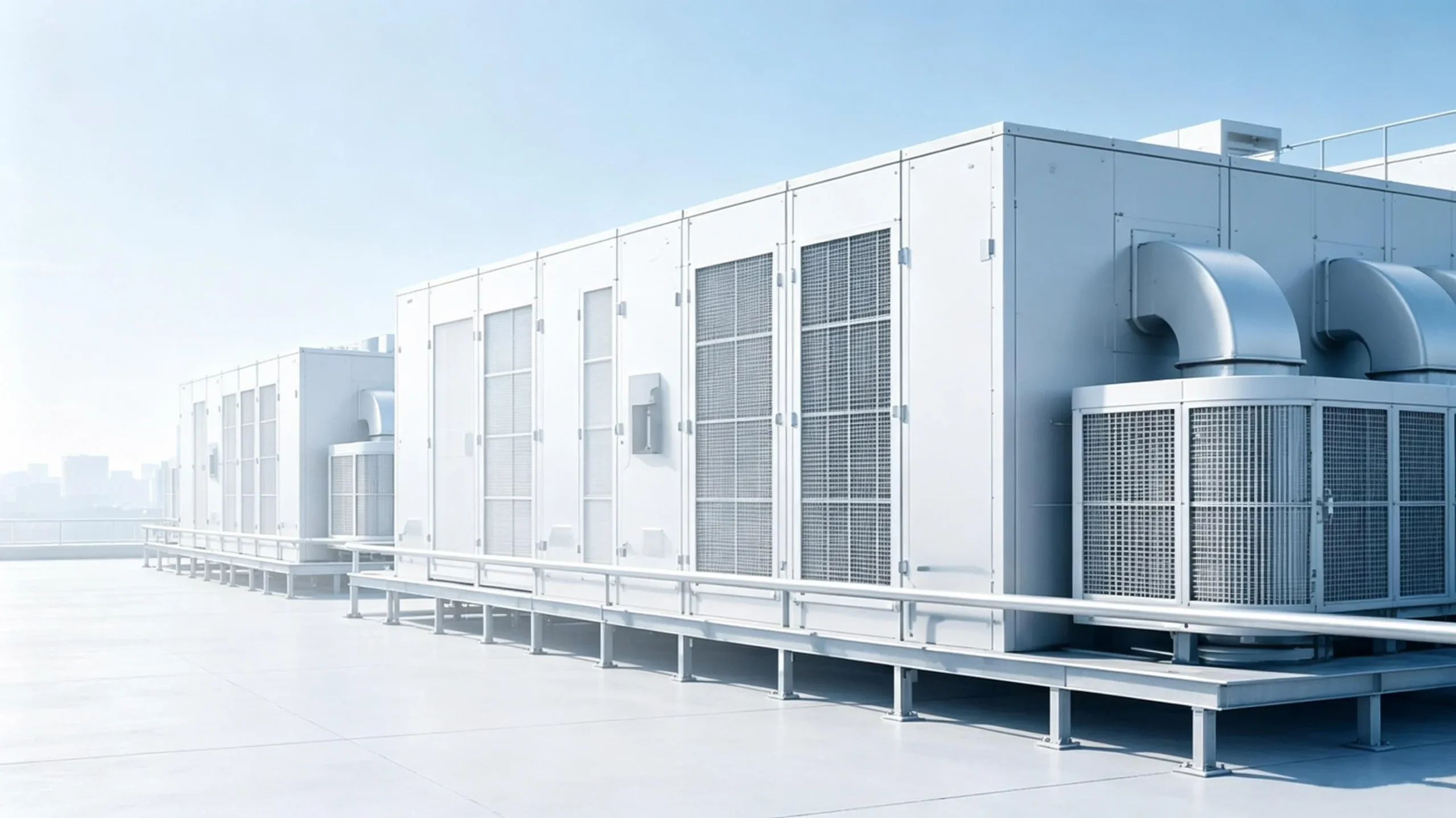
Hospitals need HEPA for bacteria carrying particles and carbon for anesthetic gases and disinfectant odors. Laboratories need HEPA for particulates and carbon for solvent vapors. Office buildings need both to address outdoor pollution that contains both fine particulates and vehicle exhaust gases.
In wildfire prone regions the need is especially clear. Smoke contains both particulate matter and gaseous organic compounds that no single filter type can fully address.
Comparing the Three Configurations
| Contaminant | HEPA Only | Carbon Only | HEPA and Carbon |
|---|---|---|---|
| Dust, pollen, mold spores | Removed | Passes through | Removed |
| PM2.5 and PM1.0 | Removed | Passes through | Removed |
| Bacteria carrying particles | Removed | Passes through | Removed |
| Formaldehyde and VOCs | Passes through | Removed | Removed |
| Cooking and pet odors | Passes through | Removed | Removed |
| Cigarette smoke particles | Removed | Passes through | Removed |
| Cigarette smoke odor | Passes through | Removed | Removed |
| Chemical fumes | Passes through | Removed | Removed |
A HEPA only installation leaves every gas and odor problem unaddressed. A carbon only installation lets all particulates through. Only the combined configuration handles the full spectrum of contaminants typically found in indoor air.
What to Watch When Sourcing Combined Filters
For air purifier brands, OEM buyers, and facility managers, several common pitfalls come from misunderstanding how these filters work.
Not All HEPA Is Equivalent
Filters marketed as HEPA type or HEPA like are not true HEPA and may have no verified efficiency rating. True HEPA should come with test reports showing MPPS efficiency per EN 1822 or an equivalent standard. H13 fits residential and light commercial use. H14 is necessary for medical, pharmaceutical, and cleanroom applications.
Carbon Specifications Matter More Than the Label
A label that says activated carbon filter tells you almost nothing. Ask for the actual gram weight per filter, the iodine value, whether the carbon is pelletized or impregnated onto foam, and the expected service life under defined conditions. Pelletized carbon in a deep bed consistently outperforms carbon coated substrates.
Filter Configuration Affects Long Term Cost
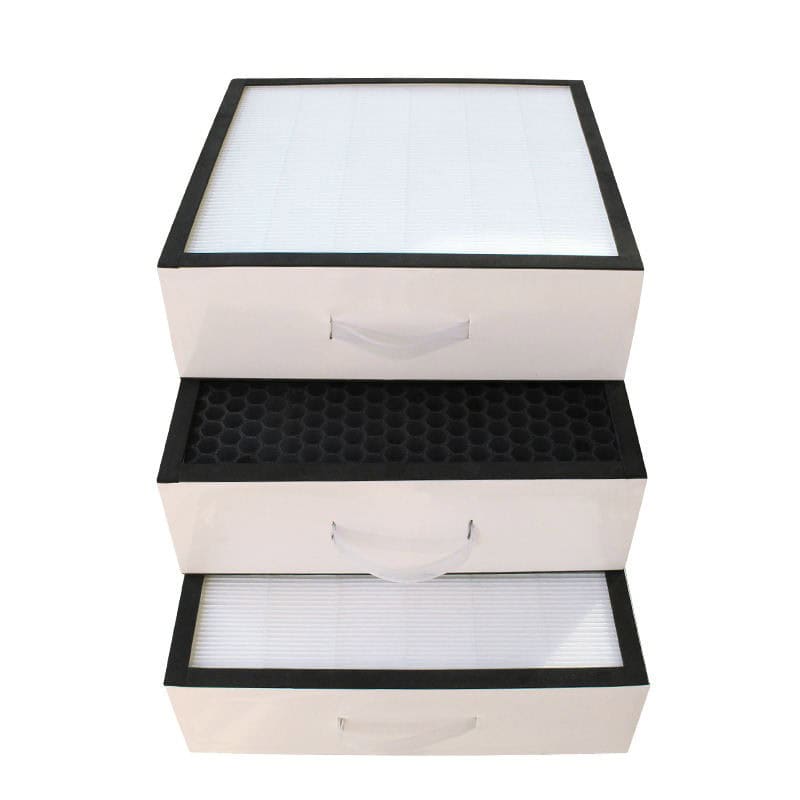
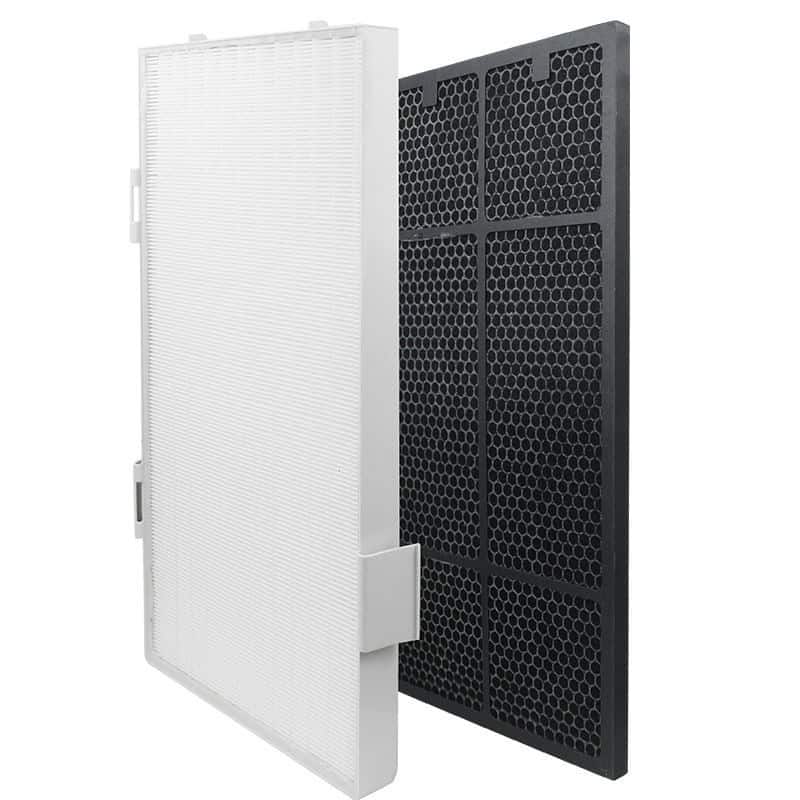
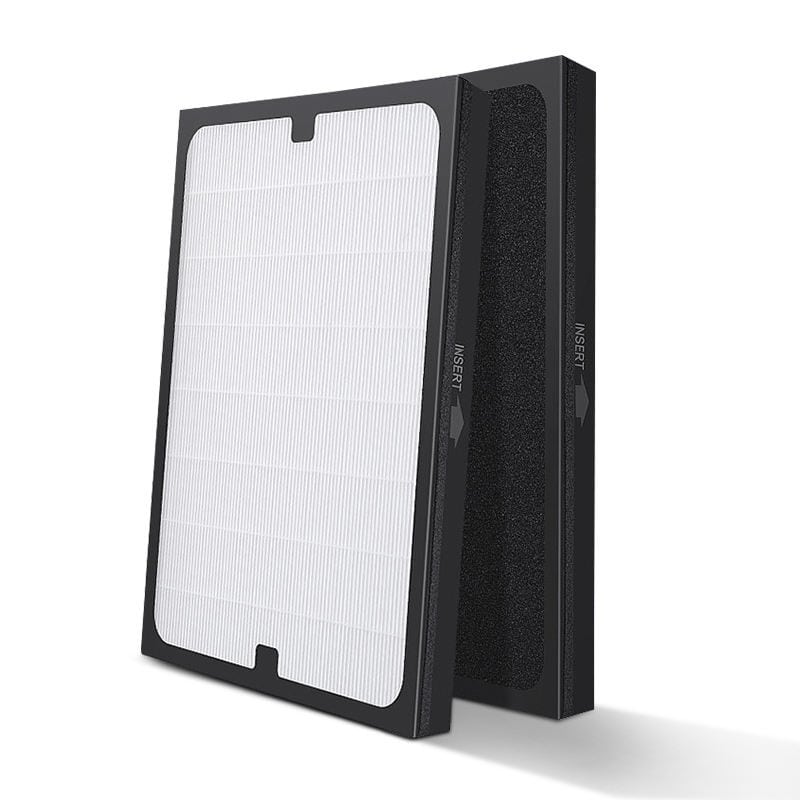
Combined filters can be a single cartridge with both media types, or two separate filters in sequence. Single cartridges are simpler for end users but force replacing both at once. Separate filters allow independent replacement and lower long term operating cost in commercial settings.
Dimensional Tolerance Determines Real World Performance
Even a two millimeter gap between the filter frame and housing lets unfiltered air bypass the media entirely, destroying theoretical efficiency. A manufacturer that holds tight dimensional tolerances across production runs is worth more than one competing only on price.
End
HEPA and activated carbon are not alternatives. They are complementary technologies addressing different phases of air contamination.
HEPA removes solid particles through mechanical fiber interaction. Activated carbon removes gases and odors through molecular adsorption. Used together, with HEPA upstream to protect the carbon from fouling, they deliver performance neither can achieve alone.
For anyone designing or sourcing air filtration equipment, the decision is not which one to choose. It is how to specify both correctly for the specific contaminants and operating conditions of your project.
HIFINE manufactures custom combined HEPA and carbon filters for air purifier brands, HVAC projects, and industrial applications worldwide. We produce H13 and H14 grade HEPA media with activated carbon layers in custom dimensions and configurations, with batch test reports available for every production run. Send your specifications or original filter samples for a quotation within 24 hours.